Global Tofu Market Set For 5.2% CAGR As Sustainable Food Choices Drive Industry Growth

Key Highlights
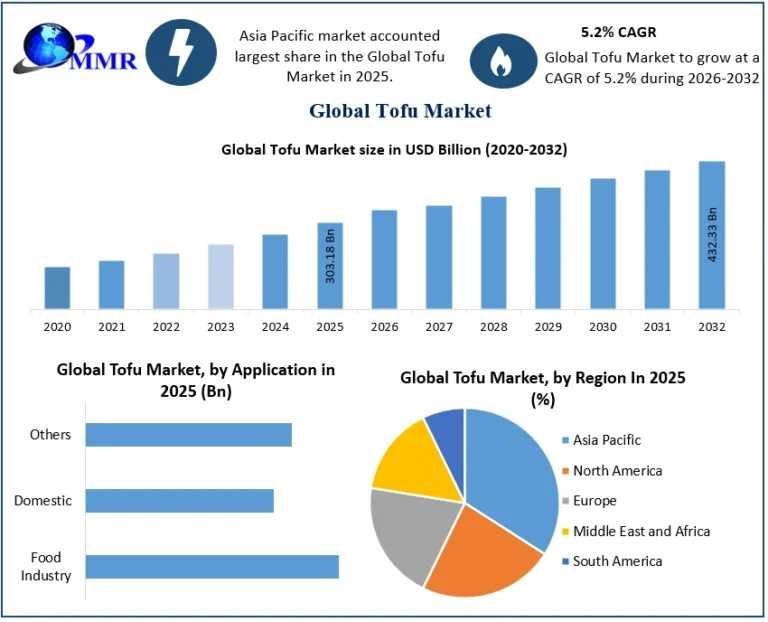
- Global tofu market valued at USD 303.18 billion in 2025.
- Market projected to reach USD 432.33 billion by 2032.
- Expected CAGR stands at 5.2% during 2025–2032.
- Asia Pacific accounts for 56.3% of global demand.
- Processed tofu holds 86% of product market share.
- Food and beverage industry represents 68% of application demand.
- Supermarkets generate nearly 65% of tofu sales worldwide.
- Consumer preference is shifting toward sustainable, cholesterol-free protein sources.
- Manufacturers are expanding premium, organic, and ready-to-eat product portfolios.
Why This Matters Now
Plant-based protein is moving from a niche category into mainstream food consumption. Rising rates of obesity, cardiovascular disease, and diabetes are accelerating consumer preference for healthier diets, while governments and health organizations continue promoting greater consumption of legumes and plant proteins. At the same time, environmental concerns surrounding livestock production are encouraging retailers, restaurants, and food manufacturers to increase investment in tofu-based products. These structural shifts are creating long-term opportunities across production, retail distribution, and foodservice.
Market Overview
Tofu Market is a soy-based protein produced by coagulating soy milk into blocks of varying firmness. It has become one of the world's most established meat alternatives because it combines high protein content with low calories and zero cholesterol.
Demand is expanding across supermarkets, restaurants, quick-service chains, and packaged food manufacturers as consumers seek healthier protein options without sacrificing affordability. Tofu is increasingly incorporated into ready-to-eat meals, functional foods, and plant-based convenience products.
Supply continues to benefit from established soybean processing infrastructure, particularly across East Asia. Meanwhile, manufacturers outside Asia are strengthening local production capabilities to reduce import dependence and improve product freshness.
Macroeconomic trends including urbanization, growing vegan and flexitarian populations, increasing healthcare awareness, and sustainability initiatives continue to reinforce global demand despite challenges associated with soybean allergies and regulatory food labeling requirements.
Key Trends Driving Growth
Health-driven food innovation
Consumers increasingly prioritize protein-rich foods that support cardiovascular health and weight management. Tofu's nutritional profile makes it an attractive ingredient across both retail and foodservice applications.
Expansion of plant-based product portfolios
Food manufacturers are introducing organic, fortified, non-GMO, and ready-to-cook tofu products to appeal to premium consumers. Product innovation is expanding tofu's presence beyond traditional Asian cuisine into mainstream Western diets.
Sustainability influences purchasing decisions
Environmental concerns regarding livestock emissions continue encouraging consumers to substitute animal protein with plant-based alternatives. This trend supports long-term demand across retail and institutional foodservice channels.
Regulatory standards reshape manufacturing
Mandatory allergen labeling for soy products increases compliance costs but also improves consumer transparency. Companies investing in quality assurance and traceability strengthen brand credibility in regulated markets.
Distribution modernization
Online grocery platforms and organized retail chains are expanding tofu availability in urban markets. Broader retail penetration reduces barriers to consumer adoption while supporting premium product launches.
Explore detailed analysis, insights, and growth opportunities : https://www.maximizemarketresearch.com/request-sample/111769/
Segment Insights
Dominant Segment: Processed Tofu
Processed tofu accounts for approximately 86% of the global market.
Extended shelf life remains the primary competitive advantage. Food manufacturers, supermarkets, and restaurants require products with consistent quality, lower spoilage risk, and efficient logistics. Processed tofu satisfies these commercial requirements while enabling wider geographic distribution.
The dominance of processed products also improves operational efficiency for manufacturers by reducing inventory losses and supporting larger production volumes.
Business impact: Companies investing in preservation technologies, packaging innovation, and large-scale processing are better positioned to secure long-term retail contracts and expand exports.
Fastest-Growing Segment: Online Distribution
Although supermarkets remain the leading sales channel, online retail is emerging as the fastest-growing distribution segment.
Growth in e-commerce grocery platforms is increasing consumer access to specialty tofu products, including organic, premium, and non-GMO varieties previously unavailable through conventional retail stores.
Business impact: Digital commerce enables manufacturers to reach health-conscious consumers directly while improving product visibility and expanding premium pricing opportunities.
Additional Key Segments
Food and Beverage Industry
The food and beverage sector commands 68% of global demand. Restaurants, institutional kitchens, and food manufacturers increasingly incorporate tofu into traditional dishes, meat substitutes, and prepared meals.
Commercial kitchens benefit from tofu's versatility, consistent supply, and compatibility with diverse cuisines.
Domestic Consumption
Household demand continues to expand as consumers prepare healthier meals at home. Premium organic tofu is gaining popularity among health-conscious shoppers despite its higher price.
Supermarkets
Supermarkets remain the dominant distribution channel with approximately 65% of sales due to extensive product selection, reliable supply chains, and consumer convenience.
Regional Growth Story
Asia Pacific
Asia Pacific leads the global market with 56.3% market share.
China, Japan, South Korea, Thailand, India, and other regional economies combine centuries of tofu consumption with highly developed manufacturing infrastructure. Japan remains a major consumption hub, while China serves as one of the world's largest production centers.
The region benefits from abundant soybean processing capacity, established consumer familiarity, and integrated supply chains that maintain competitive production costs.
North America
North America continues expanding as vegan, vegetarian, and flexitarian diets gain mainstream acceptance. Retailers are increasing shelf space for plant-based proteins, while restaurants incorporate tofu into broader menu offerings.
Domestic manufacturing investments are improving product availability and reducing dependence on imports.
Europe
European consumers increasingly associate tofu with sustainable eating and healthier lifestyles. Environmental policies supporting lower-carbon food systems continue encouraging plant-based protein consumption.
Demand remains particularly strong across countries with growing vegan populations and established organic food markets.
Middle East, Africa, and South America
These markets remain at earlier stages of adoption but present long-term opportunities through expanding urban populations, improving retail infrastructure, and increasing awareness of affordable plant-based nutrition.
Competitive Landscape
The tofu market remains fragmented, combining established Asian manufacturers with rapidly expanding global plant-based food companies.
Industry leaders including Pulmuone, Sagamiya Foods, CJ CheilJedang, Zuming Bean Products, Shanghai Tramy Green Food Group, Hangzhou Bean Food, Shenyang Fulai Food Industrial, Morinaga Milk Industry, Kikkoman Corporation, and Kong Kee Food maintain competitive advantages through large-scale production, integrated soybean sourcing, and strong domestic distribution networks.
Meanwhile, Hain Celestial Group (Nasoya), House Foods America Corporation, Sunrise Soya Foods, Vitasoy International Holdings, Soyarich Foods, and Invigorate Foods are expanding their presence by introducing organic, non-GMO, clean-label, and ready-to-eat products tailored to Western consumer preferences.
Competition increasingly centers on product quality, manufacturing efficiency, sustainability credentials, and retail partnerships rather than price alone. Companies investing in advanced production technologies, premium positioning, and diversified distribution channels are strengthening long-term competitive advantages.
Recent Developments
- Manufacturers continue expanding premium organic and non-GMO tofu product portfolios.
- Companies are increasing production automation to improve quality consistency and manufacturing efficiency.
- Leading producers are strengthening supermarket and foodservice partnerships to expand retail penetration.
- Investment continues in sustainable packaging and clean-label product development.
- Companies are broadening export capabilities to meet rising international demand for plant-based protein products.
Future Outlook
Companies that combine efficient large-scale production with premium, sustainable, and value-added tofu offerings will capture the greatest market opportunity as global demand for plant-based protein continues to outpace conventional food innovation.
Explore More: Visit our website for Additional reports :
Global Feed Premix Market https://www.maximizemarketresearch.com/market-report/global-feed-premix-market/75053/
Global Probiotics Animal Feed Market https://www.maximizemarketresearch.com/market-report/global-probiotics-animal-feed-market/65175/
About Maximize Market Research
Maximize Market Research Pvt. Ltd. (MMR) is a global market research and consulting company that provides reliable, data-focused, and practical business insights. The firm serves a wide range of industries, including healthcare, pharmaceuticals, technology, automotive, electronics, chemicals, personal care, and consumer goods. Through market forecasts, competitive analysis, strategic consulting, and industry impact assessments, MMR helps organizations understand changing market conditions, identify growth opportunities, and make informed business decisions for long-term success.
Contact Us :
2nd Floor, Navale IT Park Phase 3
Pune Banglore Highway, Narhe
Pune, Maharashtra 411041, India
+91 9607365656
sales@maximizemarketresearch.com
Author Bio
Article Comments
No Comments!
At present there are zero comments on this article.
Why not be the first to make a comment?
Similar Articles
Search Pages
User Upgrade
account to full use of editor,
Including hyperlinks
Article Categories
There are zero sub-categories in this parent category.
There are zero sub-categories in this parent category.