Fast Fashion Market: Revenue Growth And Industry Forecast

Market Revenue Trajectory
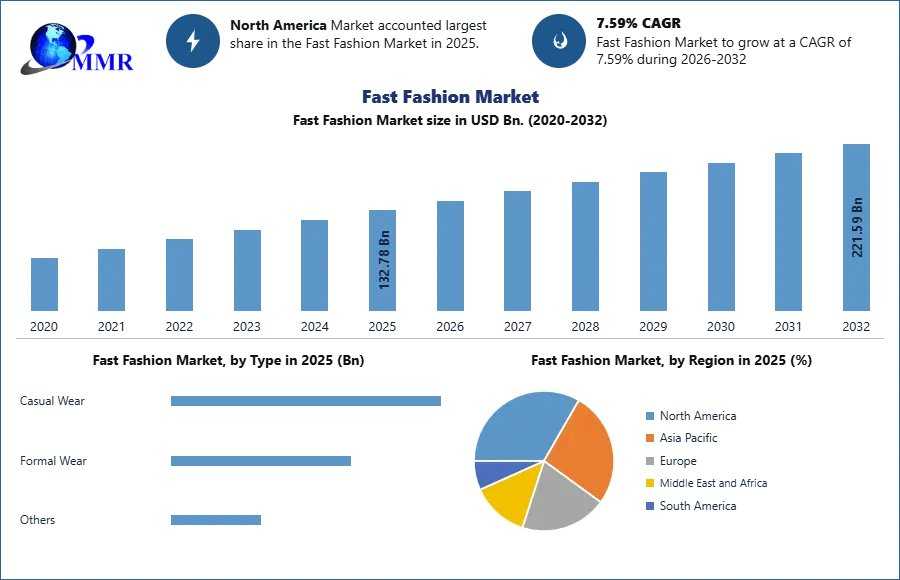
The Global Fast Fashion Market was valued at USD 132.78 billion in 2025 and is projected to grow at a CAGR of 7.59% from 2026 to 2032, reaching approximately USD 221.59 billion by 2032. The market is benefiting from consumers' increasing preference for trendy and affordable clothing, expanding online retail, and the growing influence of social media, fashion influencers, and celebrity-driven trends.
The continued expansion of e-commerce, increasing smartphone and internet adoption, and changing consumer lifestyles are expected to support market growth throughout the forecast period.
Industry Evolution and Market Dynamics
Fast fashion refers to an apparel business model characterized by short production cycles, rapid introduction of new styles, affordable pricing, and quick movement of fashion trends from design to consumers. Major brands are increasingly combining digital technologies, data analytics, social media, and flexible supply chains to respond rapidly to changing consumer preferences.
Get Your Free Sample Report : https://www.maximizemarketresearch.com/request-sample/126719/
Social media has become a major influence on purchasing behavior, particularly among Gen Z and millennial consumers. Influencer marketing, celebrity collaborations, limited-edition collections, and digital campaigns are helping brands increase visibility and encourage frequent purchases.
The market is also moving toward sustainable fashion, circular business models, recycled materials, and more responsible manufacturing. Growing environmental awareness and regulatory scrutiny are encouraging companies to reconsider conventional production and consumption practices.
Technological innovation is another important market factor. Virtual try-on solutions, augmented reality fitting rooms, artificial intelligence-driven design analytics, and data-based demand forecasting are being used to improve personalization, customer engagement, inventory management, and supply-chain efficiency.
However, environmental concerns, labor-practice scrutiny, supply-chain disruption, rising synthetic-fiber costs, and pressure to adopt more sustainable production models remain important challenges for market participants.
Research Coverage and Analytical Framework
The report uses 2025 as the base year and covers the 2026–2032 forecast period, with historical data from 2020 to 2025. The study evaluates the global fast fashion industry through market sizing, segmentation, regional analysis, competitive assessment, market dynamics, technology developments, regulatory considerations, and strategic analysis.
The market is analyzed according to type, distribution channel, end user, and region. Type segmentation includes Casual Wear, Formal Wear, and Others. Distribution channels are divided into Offline and Online, while end users include Men and Women.
The geographical assessment covers North America, Europe, Asia Pacific, Middle East and Africa, and South America, with detailed country-level analysis included for selected markets.
Global Regional Performance
North America held the leading position in the global fast fashion market, accounting for 38% of the market in 2025. Demand is supported by strong consumer interest in affordable fashion, youth-oriented clothing, localized production models, and the adoption of digital and sustainable retail practices.
Asia Pacific is expected to experience significant growth during the forecast period, with the market projected to expand at a 4% CAGR from 2026 to 2032. Rising disposable income, rapid urbanization, expanding e-commerce, and increasing social media influence are supporting demand across countries including China, Japan, and India.
The region also benefits from the presence of major apparel manufacturers and a growing consumer base seeking affordable and trend-focused clothing. Increasing awareness of sustainable fashion is further influencing purchasing behavior across emerging economies.
Europe and other major markets continue to contribute to global fast fashion demand, while regional developments are increasingly influenced by sustainability requirements, digital retail, supply-chain transformation, and changing consumer expectations.
Market Structure by Product, Channel and Consumer
The market is divided by clothing type into Casual Wear, Formal Wear, and Others. These categories reflect the diverse apparel requirements of consumers and the ability of fast fashion companies to rapidly introduce new designs and collections.
By distribution channel, the market comprises Offline and Online retail. The Offline Channel accounted for 59% of the market in 2025, supported by consumers' preference for physically examining clothing, assessing fit, and experiencing products directly. Physical stores are also adopting AR and VR technologies to provide more immersive shopping experiences.
The Online Channel is projected to grow at a CAGR of 7.1% during the forecast period. Increasing smartphone adoption, broad product selection, online discounts, convenient returns, multiple size and color options, and the expansion of digital-first fashion retailers are supporting online sales.
By end user, the market is segmented into Men and Women. The Women's segment dominated the market with a 60% share in 2025, supported by demand for diverse styles, vibrant designs, seasonal collections, and affordable fashion.
The Men's segment is expected to grow at a 5% CAGR from 2026 to 2032, supported by increasing interest in fashion, greater style awareness, and convenient access to affordable apparel through online channels.
Access the Exclusive Report Sample : https://www.maximizemarketresearch.com/request-sample/126719/
Competitive Landscape and Leading Participants
The global fast fashion market is highly competitive, with companies focusing on affordability, rapid product launches, digital commerce, trend responsiveness, brand positioning, and sustainability.
Key companies covered in the report include Zara, H&M Group, Fast Retailing, Gap, Forever 21, Mango, Esprit, Primark, New Look, River Island, C&A, Cotton On, Topshop, Pull & Bear, Bershka, rue21, Miss Selfridge, Charlotte Russe, Bestseller, NewYorker, Fashion Nova, Arcadia, Future Lifestyle Fashions Ltd., Shein, and ASOS plc.
Companies are increasingly investing in e-commerce, social media marketing, artificial intelligence, personalized fashion recommendations, circular fashion initiatives, recycled materials, and localized production. These strategies are designed to improve responsiveness to consumer trends while addressing sustainability and supply-chain challenges.
Recent developments highlighted by the report include AI-driven design applications, designer collaborations, circular fashion investments, strategic brand divestments, and changes to international import-compliance strategies.
Key Market Questions and Answers
What is the size of the Fast Fashion Market?
The global market was valued at USD 132.78 billion in 2025.
What will the market be worth by 2032?
The market is projected to reach approximately USD 221.59 billion by 2032.
What CAGR is expected during the forecast period?
The market is projected to expand at a 7.59% CAGR from 2026 to 2032.
Which region currently dominates the market?
North America led the global market with a 38% share in 2025.
Which end-user segment has the largest market share?
The Women's segment accounted for 60% of the market in 2025.
Explore the Report Sample Before You Buy : https://www.maximizemarketresearch.com/request-sample/126719/
Report Insights and Strategic Coverage
The Fast Fashion Market report provides comprehensive coverage of the industry's present performance and future development. The study includes market size and forecasts, historical analysis, product segmentation, distribution-channel assessment, end-user analysis, regional market evaluation, and competitive benchmarking.
The report further examines market trends, growth drivers, restraints, opportunities, challenges, technological developments, sustainability initiatives, regulatory factors, trade conditions, supply-chain dynamics, and competitive strategies.
Its regional coverage provides insights into North America, Europe, Asia Pacific, Middle East and Africa, and South America, while the competitive assessment examines major global companies and their strategic positioning.
The study also incorporates Porter's Five Forces analysis, PESTLE analysis, technology-roadmap assessment, regulatory analysis, government initiatives, trade analysis, competitive benchmarking, and industry developments, providing stakeholders with a broader view of the factors shaping the global fast fashion industry.
View More Reports :
Jewelry Market https://www.maximizemarketresearch.com/market-report/jewelry-market/147820/
Global Inkjet Coders Market https://www.maximizemarketresearch.com/market-report/global-inkjet-coders-market/43244/
About Maximize Market Research
Maximize Market Research Pvt. Ltd. (MMR) is a global market research and consulting company that provides reliable, data-focused, and practical business insights. The firm serves a wide range of industries, including healthcare, pharmaceuticals, technology, automotive, electronics, chemicals, personal care, and consumer goods. Through market forecasts, competitive analysis, strategic consulting, and industry impact assessments, MMR helps organizations understand changing market conditions, identify growth opportunities, and make informed business decisions for long-term success.
Contact Us :
2nd Floor, Navale IT Park Phase 3
Pune Banglore Highway, Narhe
Pune, Maharashtra 411041, India
+91 9607365656
sales@maximizemarketresearch.com
Author Bio
Article Comments
No Comments!
At present there are zero comments on this article.
Why not be the first to make a comment?
Similar Articles
Search Pages
User Upgrade
account to full use of editor,
Including hyperlinks
Article Categories
There are zero sub-categories in this parent category.
There are zero sub-categories in this parent category.