Tire Cord And Tire Fabrics Market: Industry Developments And Long-Term Forecast

Revenue Prospects and Market Forecast
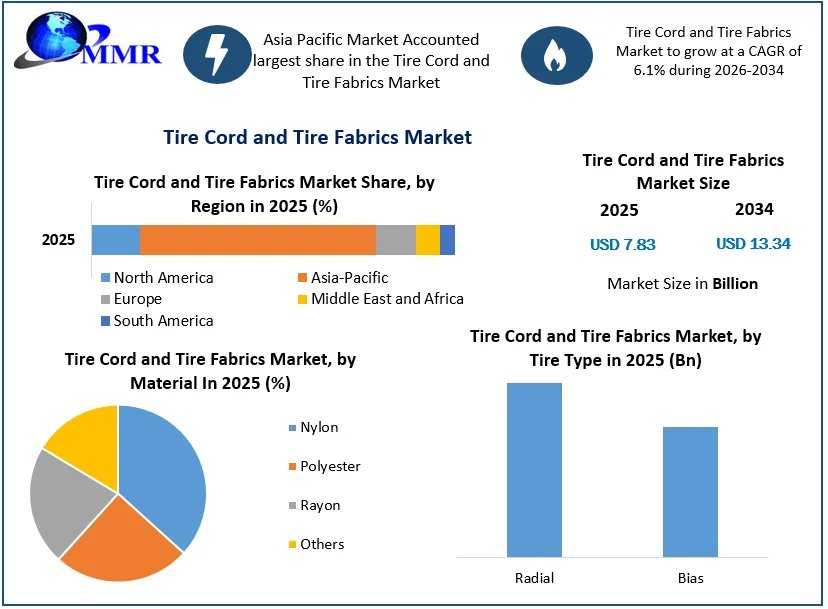
The Tire Cord and Tire Fabrics Market was valued at USD 7.83 billion in 2025 and is projected to grow at a CAGR of 6.1% from 2026 to 2034, reaching approximately USD 13.34 billion by 2034. This growth outlook reflects rising demand for durable, high-performance tires and increasing requirements for reinforcement materials across the automotive industry.
Tire cord and tire fabrics play an important role in improving tire strength, structural stability, durability, and load-bearing capacity. Growing vehicle production, rising tire sales, and demand for reliable tire performance are expected to support market development throughout the forecast period.
The expansion of electric vehicle manufacturing and continued demand for replacement tires also provide opportunities for material manufacturers to develop reinforcement solutions suited to evolving vehicle performance requirements.
Get Your Complimentary Report Preview : https://www.maximizemarketresearch.com/request-sample/55285/
Industry Overview and Emerging Market Dynamics
Tire cord fabrics are high-strength reinforcement materials incorporated into tires to maintain their shape, support vehicle weight, and withstand operating stresses and elevated temperatures. They are manufactured using high-tenacity fibers, including nylon, polyester, and rayon, which offer different performance characteristics for various tire applications.
Major Industry Trends
The market is experiencing growing demand for advanced reinforcement materials that improve tire durability, strength, and performance. Manufacturers are focusing on material selection and product development to meet the requirements of passenger cars, commercial vehicles, and other vehicle categories.
Sustainability is another emerging trend. Interest in environmentally responsible and bio-based alternatives is creating opportunities for the development of more sustainable tire cord materials.
Key Growth Drivers
- Increasing automobile production and vehicle sales worldwide.
- Rising demand for strong, durable, and high-performance tires.
- Greater use of reinforcement materials to improve tire reliability and service life.
- Expanding electric vehicle production and associated tire requirements.
- Demand for material solutions tailored to passenger and commercial vehicle tires.
Market Opportunities
The development of bio-based and environmentally sustainable reinforcement materials presents opportunities for manufacturers. Product innovation, improvements in material performance, and the development of application-specific tire fabrics can also help companies address changing automotive industry requirements.
Industry Challenges
High vehicle costs and economic slowdowns can affect vehicle demand in some markets, indirectly influencing tire production and reinforcement-material consumption. Manufacturers must also manage material costs while meeting the strength, durability, and performance requirements of tire producers.
Research Coverage and Analytical Framework
The study evaluates the global Tire Cord and Tire Fabrics Market using 2025 as the base year, with historical data covering 2020–2025 and a forecast period extending from 2026 to 2034.
The research examines market revenue, industry trends, growth drivers, restraints, opportunities, challenges, regional performance, and competitive positioning. It also assesses the market across material types, tire types, vehicle categories, and applications.
The segmentation framework includes:
- By Material: Nylon, Polyester, Rayon, and Others.
- By Tire Type: Radial and Bias.
- By Vehicle Type: Passenger Cars, Commercial Vehicles, and Others.
- By Application: Original Equipment Manufacturer (OEM) and Replacement.
The study also covers competitive benchmarking, company profiles, market structure, industry developments, and strategic analysis to support business planning and investment decisions.
Regional Performance and Growth Opportunities
The global market is assessed across Asia Pacific, Europe, North America, the Middle East and Africa, and South America. Each region represents a different combination of automotive manufacturing activity, tire demand, industrial capabilities, and market opportunities.
Asia Pacific held the largest share of the global Tire Cord and Tire Fabrics Market in 2025, according to the report. The region includes major automotive and tire-producing countries such as China, India, Japan, and South Korea.
North America benefits from its established automotive industry and demand for replacement tires. Europe remains an important market for automotive materials and tire manufacturing, while South America and the Middle East and Africa offer opportunities associated with developing automotive markets and transportation requirements.
Regional growth opportunities are influenced by vehicle production, tire replacement cycles, investment in manufacturing facilities, and demand for high-performance reinforcement materials. However, specific regional revenue shares and growth rates are not stated in the accessible report overview.
Request the Free Sample Report : https://www.maximizemarketresearch.com/request-sample/55285/
Market Segmentation and Product Analysis
Material-Based Market Structure
The market is categorized into nylon, polyester, rayon, and other materials. Each material offers distinct characteristics relevant to tire reinforcement, including strength, flexibility, durability, and suitability for different operating conditions.
Polyester tire cord fabric is used in applications such as light commercial vehicle tires, while nylon and rayon serve other tire reinforcement requirements. Material selection depends on the intended tire design and its performance needs.
Tire-Type Classification
The market covers radial and bias tires. These categories differ in their construction and reinforcement arrangements, resulting in different performance characteristics and application requirements.
Demand across these categories is influenced by vehicle design, tire-manufacturing requirements, and the need for durability and reliable operation.
Vehicle-Type Coverage
Passenger cars, commercial vehicles, and other vehicle categories form the vehicle-type segmentation. Demand for tire cord and fabrics is connected to vehicle production, tire replacement requirements, and the performance expectations associated with each category.
Commercial vehicle applications can require reinforcement materials capable of withstanding demanding load and operating conditions.
Application-Based Classification
The market is segmented into OEM and replacement applications. OEM demand is associated with tires supplied for new vehicle production, whereas replacement demand comes from the need to replace tires during vehicle operation.
These applications expose reinforcement-material manufacturers to demand from both new vehicle manufacturing and the established vehicle population.
The source identifies these segmentation categories but does not clearly establish a leading material, tire-type, vehicle-type, or application segment in the accessible overview. Accordingly, no unsupported segment-leadership claim is made.
Competitive Landscape and Leading Companies
The Tire Cord and Tire Fabrics Market includes manufacturers specializing in high-strength fibers, industrial textiles, tire reinforcement materials, and related products. Competition is shaped by product quality, material performance, manufacturing capabilities, customer relationships, and the ability to meet tire manufacturers' technical requirements.
Key companies identified in the report include:
- Hyosung
- Kordsa Global
- Kolon Industries
- SRF Ltd.
- Performance Fibers
- Firestone
- Maduratex
- Kordarna Plus A.S.
- Teijin
- Milliken and Company
- Far Eastern Group
- Century Enka
- Cordenka
- Junma
- Shenma
- Jinlun Group
- Haiyang Chemical
- Xiangyu
- Shifeng
- Tianheng
- Taiji
- Dongping Jinma
- Hailide
- Helon Polytex
- Bestory
- Unifull
- Jiayuan
- Dikai
- Ruiqi
- Hesheng.
Market participants can strengthen their competitive positions through material innovation, production efficiency, product diversification, and the development of reinforcement solutions for evolving tire requirements. Sustainability-focused product development also presents a potential area of differentiation as the industry explores bio-based alternatives.
The report's competitive framework includes company benchmarking, business-segment analysis, market structure, company profiles, and mergers and acquisitions coverage. Specific company market shares and individual strategic initiatives should be verified against the detailed report before being attributed to particular businesses.
Frequently Asked Questions About the Market
What was the global Tire Cord and Tire Fabrics Market size in 2025?
The market was valued at USD 7.83 billion in 2025.
What is the expected market value by 2034?
The market is projected to reach approximately USD 13.34 billion by 2034.
What is the projected CAGR during the forecast period?
The market is expected to grow at a CAGR of 6.1% from 2026 to 2034.
What are tire cord and tire fabrics used for?
They reinforce tires, helping maintain structural stability, support vehicle loads, and improve strength and durability.
Which region held the largest market share?
Asia Pacific held the largest market share in 2025.
Explore the Free Report Sample : https://www.maximizemarketresearch.com/request-sample/55285/
Report Coverage and Strategic Insights
The global Tire Cord and Tire Fabrics Market report provides a detailed framework for understanding market size, forecast growth, segmentation, regional dynamics, and competitive conditions.
Key report offerings include:
- Market sizing and forecasts: Historical market data, the 2025 base-year valuation, and projections through 2034.
- Growth analysis: Assessment of the expected CAGR and factors influencing future demand.
- Segmentation analysis: Evaluation of materials, tire types, vehicle types, and OEM and replacement applications.
- Regional assessment: Coverage of Asia Pacific, Europe, North America, the Middle East and Africa, and South America.
- Industry dynamics: Analysis of growth drivers, restraints, opportunities, and market challenges.
- Competitive benchmarking: Profiles of major companies and assessment of the competitive landscape.
- Technology and material trends: Examination of reinforcement materials and the potential for sustainable alternatives.
- Strategic assessment: Insights relevant to product development, manufacturing decisions, market positioning, and investment planning.
- Industry structure: Coverage of market leaders, emerging participants, company comparisons, and mergers and acquisitions.
The report can help tire-material manufacturers, automotive suppliers, investors, and industry stakeholders assess market opportunities, understand competitive dynamics, and identify potential areas for future development.
View More Reports :
Bulk Food Ingredients Market https://www.maximizemarketresearch.com/market-report/bulk-food-ingredients-market/124758/
Ice Flaking Machine Market https://www.maximizemarketresearch.com/market-report/ice-flaking-machine-market/122940/
About Maximize Market Research
Maximize Market Research Pvt. Ltd. (MMR) is a global market research and consulting company that provides reliable, data-focused, and practical business insights. The firm serves a wide range of industries, including healthcare, pharmaceuticals, technology, automotive, electronics, chemicals, personal care, and consumer goods. Through market forecasts, competitive analysis, strategic consulting, and industry impact assessments, MMR helps organizations understand changing market conditions, identify growth opportunities, and make informed business decisions for long-term success.
Contact Us :
2nd Floor, Navale IT Park Phase 3
Pune Banglore Highway, Narhe
Pune, Maharashtra 411041, India
+91 9607365656
sales@maximizemarketresearch.com
Author Bio
Article Comments
No Comments!
At present there are zero comments on this article.
Why not be the first to make a comment?
Similar Articles
Search Pages
User Upgrade
account to full use of editor,
Including hyperlinks
Article Categories
There are zero sub-categories in this parent category.
There are zero sub-categories in this parent category.