Global Compressed Fiberboard Market Forecast To 2032: Growth Trends And Industry Outlook – Report By MMR

Revenue Expansion and Long-Term Market Potential
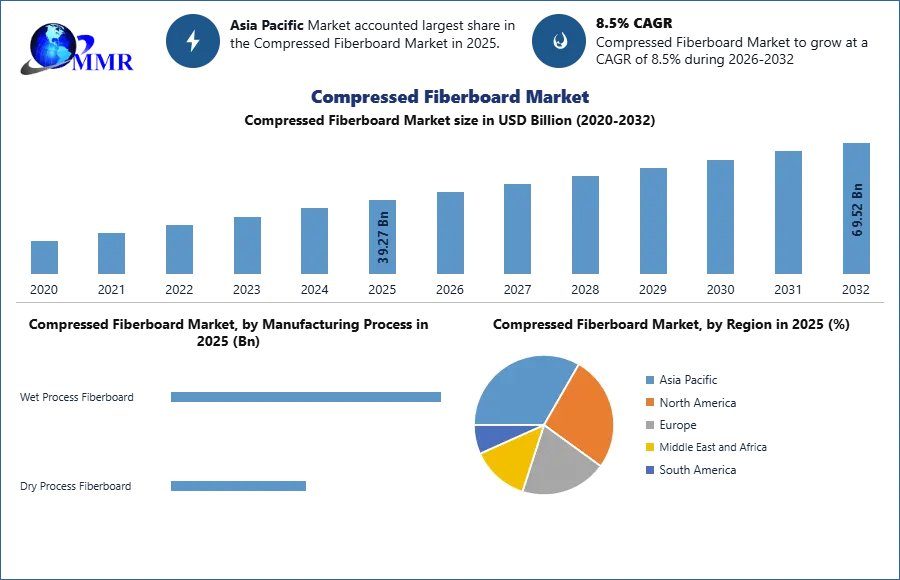
The Global Compressed Fiberboard Market is projected to reach USD 69.52 billion by 2032, growing at a compound annual growth rate (CAGR) of 8.5% during the forecast period from 2026 to 2032. According to Maximize Market Research, the market was valued at USD 39.27 billion in 2025. Increasing construction activity, urbanization, furniture manufacturing, and demand for industrial packaging are supporting the industry's expansion.
Compressed fiberboard, commonly associated with hardboard and other engineered wood panels, offers manufacturers a versatile material for building interiors, furniture components, cabinets, doors, and packaging applications. Its cost-effectiveness and broad range of uses position it as an important material across residential, commercial, and industrial markets.
Explore the Report Sample Before You Buy : https://www.maximizemarketresearch.com/request-sample/102480/
Industry Evolution and Emerging Product Applications
Compressed fiberboard is manufactured by compressing wood fibers, typically obtained from wood chips, under high pressure and temperature, with binders used according to the manufacturing process. The resulting boards are applied in wall partitions, false ceilings, flooring components, doors, furniture, and cabinets. Commercial applications also include selected household appliances and automotive components.
The market is benefiting from the wider use of engineered wood products in construction and interior design. As urban populations grow and residential and commercial projects expand, demand for adaptable panel materials is increasing. Furniture producers also use fiberboard in applications where consistent dimensions, workability, and cost efficiency are important.
Industrial packaging provides another avenue for market development. Manufacturers can explore applications that require practical, formed board materials for handling and protecting goods. Continued product development, manufacturing improvements, and investment in production capabilities may create additional opportunities for suppliers.
Major Growth Catalysts and Industry Challenges
Urbanization and construction-sector expansion are key drivers of the compressed fiberboard market. Growing demand for residential buildings, commercial spaces, furniture, and interior fittings supports the consumption of engineered panels. Rising interest in interior aesthetics and the need for economical construction materials further contribute to market development.
Industrialization also creates opportunities by increasing demand for building components, furniture, and packaging materials. Investment in research and development may help manufacturers improve production processes and develop products suited to changing customer requirements.
However, durability remains an important market constraint identified in the report. Depending on the product specification and operating environment, fiberboard may face limitations related to moisture exposure, wear, and long-term performance. Manufacturers must address these concerns through suitable product selection, quality control, and appropriate application guidance. Competition from alternative construction and panel materials, together with production costs and raw-material availability, may also influence purchasing decisions and supplier profitability.
Research Scope and Analytical Methodology
The market study examines historical performance from 2020 to 2025, with 2025 serving as the base year and 2026–2032 representing the forecast period. It evaluates market revenue, production and capacity considerations, supply and demand, cost and profitability factors, competitive positioning, and regional opportunities.
The analysis covers manufacturing processes, product types, applications, end-use industries, and geographic markets. It also considers competitive benchmarking, company strategies, and the potential effects of broader economic and industry conditions. Analytical frameworks, including SWOT, PESTEL, and Porter's Five Forces, support the assessment of competitive pressures, external influences, and business risks.
Regional Demand Patterns and Expansion Prospects
Asia Pacific is expected to hold the largest regional market share, supported by industrialization and demand from packaging and other industrial applications. Expanding construction activity and manufacturing capacity provide further opportunities across the region.
North America is projected to register the highest CAGR during the forecast period, according to the report. Demand from furniture manufacturing and interior design is expected to contribute to regional growth. Europe also offers growth opportunities, supported by demand for furniture and building-related applications.
The market assessment additionally covers South America and the Middle East and Africa. Growth prospects across these regions depend on construction activity, industrial development, local manufacturing capabilities, and the adoption of engineered wood products.
Request Free Access to the Sample Report : https://www.maximizemarketresearch.com/request-sample/102480/
Market Segmentation by Manufacturing, Product, and End Use
The Global Compressed Fiberboard Market is classified across four principal dimensions.
By manufacturing process: Wet-process fiberboard and dry-process fiberboard.
By product type: Low-density fiberboard, medium-density fiberboard, and high-density fiberboard.
By application: Industrial packaging, furniture manufacturing, building materials, and other applications.
By end-use industry: Residential, commercial, and industrial sectors.
These categories help stakeholders evaluate demand across different production technologies and customer industries. They also provide a framework for identifying application-specific opportunities without assuming that a particular segment leads the market when a verified share is not available.
Competitive Positioning and Leading Industry Participants
The competitive landscape includes manufacturers of engineered wood panels, fiberboard, and related building materials. Companies compete through production capabilities, product portfolios, distribution networks, manufacturing efficiency, and regional presence.
Key players identified in the report include Georgia-Pacific LLC, Fritz EGGER GmbH & Co. OG, Kronospan Limited, Arauco, Weyerhaeuser Company, Daiken Corporation, Greenply Industries Limited, Timber Products Company, Borg Manufacturing, Richwood Industries Inc., Eucatex SA, Roseburg Forest Products, Siempelkamp, Sonae Industria, Kastamonu Entegre, Duratex SA, Swiss Krono Group, Pfleiderer Group, and Century Plyboards India Ltd.
Their positioning reflects the breadth of the industry, from established wood-panel producers to companies serving regional construction, furniture, and industrial markets.
Key Questions Addressed in the Market Study
- What was the market value of compressed fiberboard in 2025?
- What revenue is the market expected to achieve by 2032?
- What CAGR is forecast for 2026–2032?
- Which factors are supporting market expansion?
- What durability-related challenges may restrict adoption?
- Which manufacturing processes are covered in the study?
- How is the market divided by fiberboard density?
- Which applications and end-use industries are assessed?
- What regional trends are influencing market development?
- Who are the major companies operating in the industry?
Future Market Direction and Strategic Opportunities
The compressed fiberboard market is expected to benefit from continued construction activity, demand for furniture and interior components, and industrial packaging requirements through 2032. Asia Pacific offers opportunities associated with industrial growth, while North America is projected to experience strong expansion during the forecast period.
Future competitiveness will depend on product performance, manufacturing efficiency, cost management, and the ability to meet application-specific requirements. Companies that address durability concerns while developing reliable, cost-effective panel solutions may be better positioned to capture emerging opportunities across residential, commercial, and industrial markets.
View More Reports :
Global Antifreeze Agents for Oil & Gas Market https://www.maximizemarketresearch.com/market-report/global-antifreeze-agents-for-oil-gas-market/79084/
Global Octyl Acid Phosphate Market https://www.maximizemarketresearch.com/market-report/global-octyl-acid-phosphate-market/83627/
About Maximize Market Research
Maximize Market Research Pvt. Ltd. (MMR) is a global market research and consulting company that provides reliable, data-focused, and practical business insights. The firm serves a wide range of industries, including healthcare, pharmaceuticals, technology, automotive, electronics, chemicals, personal care, and consumer goods. Through market forecasts, competitive analysis, strategic consulting, and industry impact assessments, MMR helps organizations understand changing market conditions, identify growth opportunities, and make informed business decisions for long-term success.
Contact Us :
2nd Floor, Navale IT Park Phase 3
Pune Banglore Highway, Narhe
Pune, Maharashtra 411041, India
+91 9607365656
sales@maximizemarketresearch.com
Author Bio
Article Comments
No Comments!
At present there are zero published comments on this article.
Similar Articles
Search Pages
Article Categories
There are zero sub-categories in this parent category.
There are zero sub-categories in this parent category.