Top Robotics Market Trends: Autonomous Systems And Intelligent Robotic Solutions – Report By MMR

Revenue Forecast and Long-Term Market Potential
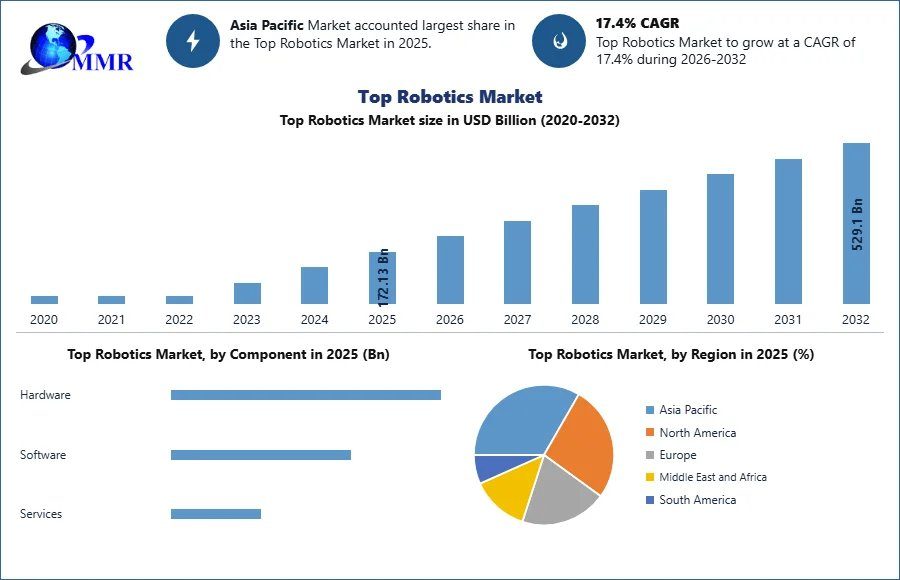
The global Top Robotics Market was valued at USD 172.13 billion in 2025 and is projected to reach nearly USD 529.1 billion by 2032, expanding at a compound annual growth rate (CAGR) of 17.4% during the forecast period from 2026 to 2032. Increasing industrial automation, growing investments in artificial intelligence (AI), and rising demand for autonomous systems across manufacturing, healthcare, logistics, and other industries are supporting market expansion. Businesses are adopting robotic technologies to improve productivity, reduce repetitive manual work, enhance operational accuracy, and strengthen workplace safety.
Transformative Robotics Trends and Technology Developments
Robotics is evolving through advances in AI, machine learning, computer vision, sensors, and autonomous navigation. These technologies enable robots to perform increasingly complex tasks, adapt to changing environments, and collaborate more effectively with human workers. The integration of robotics with the Internet of Things (IoT), cloud computing, edge computing, and digital twins is also supporting connected manufacturing and intelligent automation.
Explore the Report Sample Before You Buy : https://www.maximizemarketresearch.com/request-sample/6910/
Collaborative robots, autonomous mobile robots, and specialised service robots are expanding the range of applications beyond conventional factory automation. In warehouses, robots support inventory movement, sorting, picking, and packaging. In healthcare, robotic systems assist with surgical procedures and other specialised tasks. These developments are creating opportunities for manufacturers to deliver flexible automation solutions for businesses of different sizes.
Major Growth Catalysts and Market Challenges
The growing need for automation in transportation and logistics is a major factor influencing market growth. Expanding e-commerce activity, rising parcel volumes, and demand for faster order fulfilment are encouraging investments in automated warehouses, robotic picking systems, and autonomous guided vehicles. Robotics can help businesses improve throughput, reduce operational costs, and address workforce shortages.
AI-powered automation and Industry 4.0 initiatives are also supporting adoption in automotive, electronics, semiconductor, and heavy manufacturing industries. In addition, healthcare, agriculture, retail, food processing, and aerospace applications offer opportunities to expand the use of specialised robotic systems.
Despite these opportunities, high initial investment costs, system integration requirements, maintenance expenses, and the need for skilled personnel can create barriers, particularly for small and medium-sized enterprises. Cybersecurity, operational reliability, worker safety, and compatibility with existing infrastructure also require attention. Suppliers that improve affordability, flexibility, and ease of integration may be better positioned to reach a wider customer base.
Research Scope and Analytical Methodology
The market assessment covers historical data from 2020 to 2025, with 2025 serving as the base year and 2026–2032 representing the forecast period. The study examines market size, revenue projections, competitive positioning, regional performance, industry trends, and adoption opportunities.
Market estimation incorporates a bottom-up approach, alongside company-level assessments and industry analysis. The research framework includes SWOT analysis, PESTLE analysis, competitive benchmarking, regulatory assessment, and evaluation of technological developments. These methods help assess the factors shaping investment decisions, industry competition, and long-term robotics adoption.
Regional Robotics Adoption and Growth Opportunities
Asia Pacific dominated the Top Robotics Market in 2025 and is expected to maintain its leading position throughout the forecast period. Strong manufacturing activity, electronics production, industrial automation, and investment in smart factories across China, Japan, South Korea, and India are supporting regional demand. The expansion of robotics in automotive manufacturing, semiconductor production, e-commerce, and warehousing further strengthens the region's market position.
North America represents an important market, supported by automation investments across manufacturing, logistics, healthcare, and technology-driven industries. Europe also offers substantial opportunities through its established industrial base and demand for precision manufacturing, factory modernisation, and collaborative robotics.
The Middle East and Africa and South America are included in the report's geographic assessment. Adoption opportunities across these regions depend on industrial investment, infrastructure development, automation requirements, and the availability of technical expertise.
Market Segmentation by Robot Type, Components, and Applications
The market is segmented by robot type into industrial robotics and service robotics. Industrial robotics dominated in 2025, driven by automation requirements across automotive, electronics, semiconductor, and heavy manufacturing. Articulated robots led the industrial robotics subsegment because their multi-axis movement and flexibility support welding, assembly, painting, and material handling.
Service robotics is also expanding across professional and personal applications, including logistics, healthcare, hospitality, and domestic assistance.
By component, the market includes hardware, software, and services. Hardware covers sensors, controllers, drives, and other components. Software enables programming, monitoring, coordination, and intelligent operation, while services support deployment, integration, maintenance, and technical assistance.
Application segments include material handling, welding and soldering, assembly and disassembly, dispensing, processing, inspection and quality testing, and packaging and palletising. End-use industries encompass automotive, electrical and electronics, healthcare, food and beverages, logistics and warehousing, aerospace and defence, retail, agriculture, and construction.
Request Free Access to the Sample Report : https://www.maximizemarketresearch.com/request-sample/6910/
Competitive Landscape and Leading Robotics Companies
The competitive environment includes established industrial automation suppliers, specialised robotics developers, and companies focused on healthcare and logistics automation. Key players covered in the report include ABB Ltd., FANUC Corporation, Yaskawa Electric Corporation, KUKA AG, Kawasaki Heavy Industries Ltd., Mitsubishi Electric Corporation, DENSO Corporation, Universal Robots A/S, Omron Corporation, Siemens AG, Teradyne Inc., Intuitive Surgical Inc., Boston Dynamics, and Agility Robotics.
Competition centres on technological innovation, precision, reliability, automation capabilities, product flexibility, and integration with existing industrial systems. The report also highlights developments involving AI-enabled robotic automation and next-generation collaborative robots.
Key Questions Addressed in the Market Study
- What was the global Top Robotics Market value in 2025?
- What revenue is projected by 2032?
- What CAGR is forecast for 2026–2032?
- Which factors are driving robotics adoption?
- What challenges may restrict market expansion?
- Which robot type dominated the market in 2025?
- What are the major components and application segments?
- Which region led the market in 2025?
- Who are the key companies competing in the industry?
- Which technologies and end-use industries offer future growth opportunities?
Future Prospects for the Global Robotics Industry
The Top Robotics Market is expected to experience strong growth through 2032 as organisations prioritise intelligent automation, operational efficiency, and connected production systems. AI integration, autonomous mobility, collaborative robotics, and warehouse automation are likely to remain important areas of development.
However, sustained growth will depend on addressing implementation costs, workforce training, system interoperability, and safety requirements. Companies that combine reliable hardware with intelligent software, responsive support services, and application-specific solutions may be well positioned to capture emerging opportunities across global industries.
About Maximize Market Research
Maximize Market Research Pvt. Ltd. (MMR) is a global market research and consulting company that provides reliable, data-focused, and practical business insights. The firm serves a wide range of industries, including healthcare, pharmaceuticals, technology, automotive, electronics, chemicals, personal care, and consumer goods. Through market forecasts, competitive analysis, strategic consulting, and industry impact assessments, MMR helps organizations understand changing market conditions, identify growth opportunities, and make informed business decisions for long-term success.
Contact Us :
2nd Floor, Navale IT Park Phase 3
Pune Banglore Highway, Narhe
Pune, Maharashtra 411041, India
+91 9607365656
sales@maximizemarketresearch.com
Author Bio
Article Comments
No Comments!
At present there are zero published comments on this article.
Similar Articles
Search Pages
Article Categories
There are zero sub-categories in this parent category.
There are zero sub-categories in this parent category.