Kvass Market Analysis: Rising Demand For Fermented Beverages And Traditional Drinks – Report By MMR

Revenue Expansion and Long-Term Market Potential
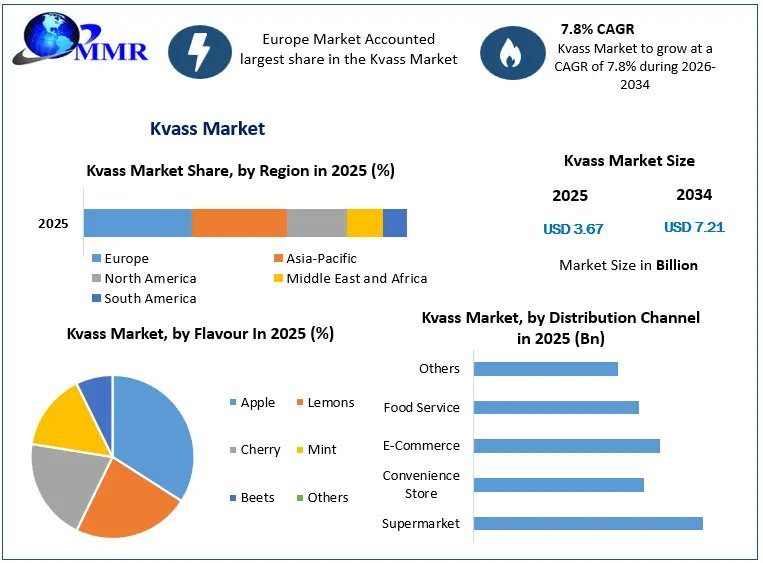
The global Kvass Market was valued at USD 3.67 billion in 2025 and is projected to reach nearly USD 7.21 billion by 2034, growing at a CAGR of 7.8% during the forecast period from 2026 to 2034. Market expansion is supported by increasing consumer interest in fermented beverages, natural ingredients, and functional drinks. Kvass, a traditional fermented beverage commonly prepared using rye bread or malt, is gaining attention beyond its established Eastern European markets as consumers explore alternatives to conventional carbonated soft drinks.
Changing Consumer Preferences and Emerging Kvass Trends
Kvass is recognised for its distinctive sweet-and-tangy flavour and traditionally low alcohol content, although its composition varies by production method. Fruit, vegetable, and herbal flavour variations are broadening its appeal among consumers seeking different beverage experiences. Growing awareness of fermented foods and drinks is also encouraging interest in products associated with traditional preparation methods and potential probiotic characteristics.
Explore the Report Sample Before You Buy : https://www.maximizemarketresearch.com/request-sample/147641/
Manufacturers are exploring flavour innovation and updated packaging to reach younger consumers and health-conscious buyers. Online retail is creating additional opportunities to introduce specialised beverages to consumers outside traditional distribution markets. As kvass becomes more visible in Western Europe, North America, and parts of Asia Pacific, producers have opportunities to combine regional beverage heritage with contemporary product positioning.
Major Growth Drivers, Market Opportunities, and Challenges
Increasing demand for functional beverages is an important factor supporting the Kvass Market. Consumers seeking alternatives to conventional soft drinks are showing interest in fermented products and beverages made with recognisable ingredients. The revival of traditional drinks and growing curiosity about international food cultures are also supporting market development.
Flavour innovation represents another opportunity. Apple, lemon, cherry, mint, and beet varieties allow manufacturers to diversify their portfolios and appeal to different preferences. E-commerce and wider retail distribution may further improve product accessibility, particularly in markets where kvass has limited historical recognition.
However, competition from beer, wine, hard seltzers, and established non-alcoholic beverages remains a significant challenge. Consumer familiarity with these alternatives can make market penetration difficult, particularly among younger buyers. Producers must also address differences in regional tastes, product awareness, formulation requirements, and applicable food and beverage regulations. Communicating product characteristics accurately will be important for building consumer confidence.
Research Scope and Market Estimation Methodology
The market study covers historical data from 2020 to 2025, with 2025 serving as the base year and 2026–2034 forming the forecast period. It examines market revenue, competitive positioning, product developments, regional demand, and emerging business opportunities.
The research evaluates the market by flavour, packaging, distribution channel, and geography. Its analytical framework includes market estimation, competitive assessment, and tools such as SWOT, PESTLE, and Porter's Five Forces analysis. These approaches help assess industry competition, external influences, market risks, and potential expansion opportunities.
Regional Market Performance and Expansion Prospects
Europe held the largest regional share in 2025, supported by kvass's cultural significance and established consumption patterns in Eastern European countries. Russia and neighbouring markets provide an important foundation for traditional producers, while interest in flavoured, low-alcohol beverages may create further opportunities across other European markets.
North America is attracting interest as consumers explore international beverages and fermented drink alternatives. Distribution through specialist retailers and online platforms may help introduce kvass to a wider audience. Asia Pacific also presents potential for expansion as beverage manufacturers assess opportunities associated with fermented products and evolving consumer preferences.
The market additionally covers South America and the Middle East and Africa. Growth across these regions will depend on consumer awareness, product availability, distribution capabilities, and the suitability of local marketing strategies.
Product Segmentation by Flavour, Packaging, and Distribution
By flavour, the market includes apple, lemon, cherry, mint, beet, and other varieties. The beet-flavoured segment held the largest share in 2025, according to the report, supported by consumer interest in vegetable-based flavours and naturally derived ingredients.
By packaging, the categories comprise bottles, cans, and others. Bottles represented the leading packaging segment in 2025. Glass and plastic bottles offer different advantages in product presentation, handling, transportation, and storage, while PET packaging can provide lightweight and practical distribution options.
Distribution channels include supermarkets, convenience stores, e-commerce, food service, and others. These channels provide different routes for reaching household consumers and food service customers, while online platforms can help specialised brands access geographically dispersed audiences.
Request Free Access to the Sample Report : https://www.maximizemarketresearch.com/request-sample/147641/
Competitive Positioning and Leading Market Participants
The Kvass Market includes regional beverage producers and larger companies with established manufacturing and distribution capabilities. Key participants identified in the report include Deka Company, Ochakovo, Pivzavod Trekhsosenskiy, Baltika Breweries (Carlsberg Group), PepsiCo, Inc., The Coca-Cola Company, Kvas Beverages LLC, Harbin Brewery, and Asahi Group Holdings.
Competition centres on product differentiation, flavour development, brand recognition, pricing, and distribution reach. Companies seeking international growth may benefit from adapting traditional recipes to local preferences while maintaining distinctive product characteristics.
Key Questions Addressed in the Kvass Market Report
- What was the global Kvass Market value in 2025?
- What revenue is projected by 2034?
- What CAGR is expected from 2026 to 2034?
- What factors are driving market growth?
- Which challenges may restrict market penetration?
- Which flavour segment held the largest share in 2025?
- Which packaging category dominated the market?
- Which region accounted for the largest market share?
- Which companies are key participants in the industry?
- What opportunities could support future market expansion?
Future Outlook for the Global Kvass Industry
The Kvass Market is expected to expand steadily through 2034 as interest in fermented beverages, flavour diversity, and traditional drink alternatives creates new opportunities. Product innovation, improved distribution, and greater awareness beyond established markets could support future demand. Nevertheless, competition from other beverages and differences in consumer preferences will remain important considerations.
Manufacturers that combine distinctive flavours, reliable product quality, effective branding, and accessible distribution strategies may be well positioned to participate in the market's projected growth.
View More Reports :
Fiber Supplements Market https://www.maximizemarketresearch.com/market-report/fiber-supplements-market/266946/
Coconut Spread Market https://www.maximizemarketresearch.com/market-report/global-coconut-spread-market/96206/
About Maximize Market Research
Maximize Market Research Pvt. Ltd. (MMR) is a global market research and consulting company that provides reliable, data-focused, and practical business insights. The firm serves a wide range of industries, including healthcare, pharmaceuticals, technology, automotive, electronics, chemicals, personal care, and consumer goods. Through market forecasts, competitive analysis, strategic consulting, and industry impact assessments, MMR helps organizations understand changing market conditions, identify growth opportunities, and make informed business decisions for long-term success.
Contact Us :
2nd Floor, Navale IT Park Phase 3
Pune Banglore Highway, Narhe
Pune, Maharashtra 411041, India
+91 9607365656
sales@maximizemarketresearch.com
Author Bio
Article Comments
No Comments!
At present there are zero published comments on this article.
Similar Articles
Search Pages
Article Categories
There are zero sub-categories in this parent category.
There are zero sub-categories in this parent category.