Food Texture Market: Market Size, Segmentation And Growth Forecast 2026–2034

Revenue Forecast and Future Market Potential
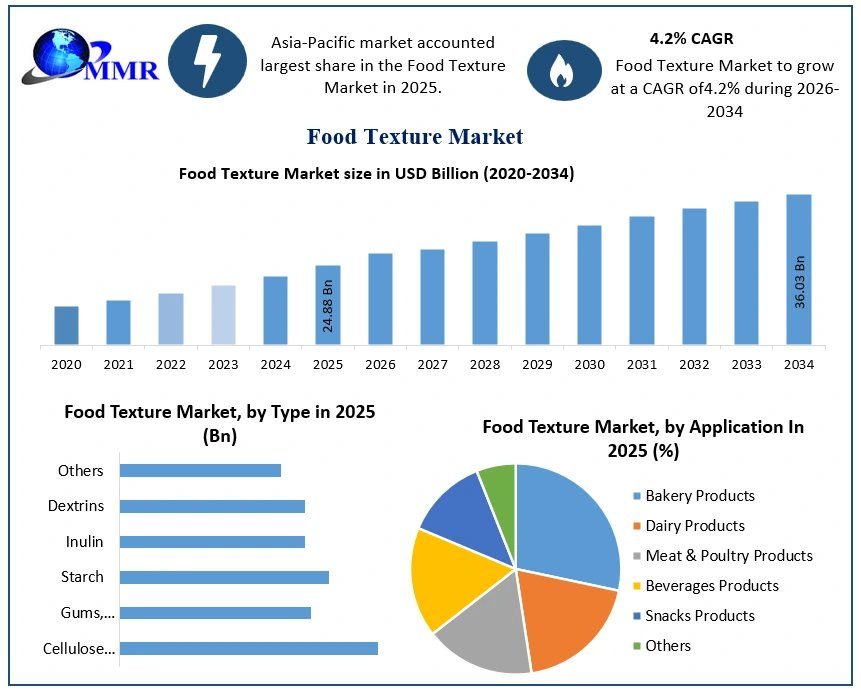
The Food Texture Market was valued at USD 24.88 billion in 2025 and is projected to reach approximately USD 36.03 billion by 2034, expanding at a CAGR of 4.2% from 2026 to 2034. Market growth is supported by increasing demand for processed and convenience foods, evolving consumer preferences, and the growing use of texturizing ingredients to improve the quality and sensory characteristics of food and beverages.
Food texture ingredients help manufacturers achieve desirable consistency, creaminess, stability, thickness, and mouthfeel across a wide range of products. Their applications extend to dairy products, bakery goods, beverages, meat and poultry products, snacks, and other processed foods. As food manufacturers continue to develop convenient, appealing, and consistent products, demand for specialized texturizing solutions is expected to increase throughout the forecast period.
Request Free Access to the Sample Report : https://www.maximizemarketresearch.com/request-sample/117857/
Consumer Preferences and Forces Reshaping the Industry
Food texture plays an important role in how consumers evaluate food quality, freshness, taste, and overall eating experience. Manufacturers use texturizing ingredients to improve product consistency, maintain stability, enhance appearance, and support shelf-life requirements.
Urbanization, changing lifestyles, rising disposable incomes, and busier work schedules are increasing demand for ready-to-eat meals, frozen products, and other convenience foods. These consumption patterns are encouraging food producers to adopt texturizing agents that help maintain product quality during processing, storage, and distribution.
Clean-label formulations and ingredient innovation are also influencing the market. Consumers increasingly seek products with recognizable ingredients and reduced sugar content, while manufacturers explore natural texturizers and alternative formulations that preserve the desired mouthfeel. Texture modification can also help companies manage formulation costs without significantly compromising sensory quality.
Emulsifiers, thickeners, stabilizers, and gelling agents serve different functional purposes. Emulsifiers help combine and stabilize ingredients that would otherwise separate, while thickeners increase viscosity and stabilizers help maintain uniformity. These functions are important in products such as bakery items, chocolates, margarine, sauces, dairy foods, and beverages.
Despite these opportunities, the industry faces challenges involving ingredient safety, formulation complexity, consumer concerns about additives, and the need to balance texture with nutritional requirements. Manufacturers must ensure that texturizing solutions meet relevant food safety requirements while delivering consistent performance across different applications.
Research Coverage and Market Evaluation Framework
The MMR study uses 2025 as the base year, with a forecast period of 2026–2034 and historical data covering 2020–2025. The analysis examines market value, growth patterns, industry dynamics, regional developments, competitive positioning, and demand across key applications.
The Food Texture Market is segmented by four principal categories:
- Product: Natural and Synthetic
- Type: Cellulose Derivatives; Gums, Pectins and Gelatins; Starch; Inulin; Dextrins; and Others
- Application: Bakery Products, Dairy Products, Meat & Poultry Products, Beverages Products, Snacks Products, and Others
- Functionality: Thickening Agents, Gelling Agents, Emulsifying Agents, Stabilizing Agents, and Other Agents
The research methodology combines primary and secondary research. Secondary research includes reviewing company annual reports, financial information, industry publications, and other relevant market data. Primary research involves interviews with company representatives and industry professionals. A bottom-up approach is used to estimate market size by volume and value across the specified segments.
The report also incorporates competitive benchmarking, value-chain assessment, Porter's Five Forces, PESTEL analysis, regulatory considerations, and supply- and demand-side indicators to support strategic decision-making.
Regional Demand Trends and Geographic Opportunities
Asia Pacific represents an important growth opportunity for the Food Texture Market. Increasing consumption of processed foods in countries such as India and China, a growing food and beverage industry, access to raw materials, and expanding retail networks are supporting regional demand.
Consumer expectations concerning mouthfeel and consistency vary across the region. In India, thick and creamy textures are popular in beverages such as lassi and flavored milk, while preferences in China reflect the needs of different consumer groups. These differences create opportunities for manufacturers to develop application-specific ingredients and formulations.
North America is expected to experience rapid market growth, supported by food product innovation, demand for functional ingredients, and the presence of established food manufacturers. Frozen foods and traditional vegetarian products are among the application areas where texture modification can improve product quality and consumer appeal.
Europe is another important market, with demand opportunities in jams, confectionery, jellies, and other processed food categories. The report identifies significant regional growth potential associated with these applications.
The report also covers the Middle East and Africa and South America, including country-level assessments of key markets. Opportunities across these regions depend on food processing activity, consumer preferences, ingredient availability, and the development of local food manufacturing capabilities.
Ingredient Categories and Application-Level Performance
The Food Texture Market covers ingredients classified by product origin, ingredient type, functionality, and end application. Each segment serves different formulation needs across the food and beverage industry.
By product, the market is divided into Natural and Synthetic ingredients. This classification allows manufacturers to evaluate different ingredient sources and formulation approaches according to product requirements.
By type, the market includes cellulose derivatives, gums, pectins, gelatins, starch, inulin, dextrins, and other ingredients. These materials provide different texturizing functions depending on their formulation and the food product in which they are used.
By functionality, the Emulsifying Agents segment accounted for more than 40% of the market in 2023, according to MMR. Emulsifiers help stabilize mixtures of ingredients and improve product appearance, consistency, and texture. Lecithin and monoglycerides are examples of commonly used emulsifying agents, with applications in baked products, chocolates, and margarine.
The Thickening Agents segment is expected to grow at a significant rate during the forecast period. These ingredients increase the viscosity of liquid and semi-liquid products and are widely used in sauces, soups, puddings, and similar foods.
By application, Dairy Products accounted for 32.1% of the Food Texture Market in 2025. Demand is supported by the need for smooth, creamy, and stable dairy formulations, including liquid and frozen products. Texturizing ingredients help manufacturers maintain consistency and reduce unwanted separation or crystallization.
The Processed Foods segment is expected to grow at a CAGR of 3.8% during the forecast period, according to the report. Meat products also represent an important application area, with demand supported by the need to improve palatability and the eating experience.
Access the Exclusive Report Sample : https://www.maximizemarketresearch.com/request-sample/117857/
Competitive Strategies and Leading Ingredient Suppliers
Competition in the Food Texture Market is shaped by ingredient performance, product innovation, formulation expertise, manufacturing capabilities, customer relationships, and geographic reach. Manufacturers are developing customized solutions to meet the specific texture requirements of different food and beverage applications.
Major companies identified in the MMR report include:
- CP Kelco
- Tate & Lyle PLC
- Ingredion Incorporated
- DuPont
- Kerry Group
- JELU-WERK
- Cargill, Incorporated
- Ajinomoto Co., Inc.
- Archer Daniels Midland Company
- Penford Corporation
- Fiberstar Inc.
- SELECTAROME
- Willy Benecke GmbH
- Jost Chemicals GmbH
- SM-Service Ltd.
Companies are pursuing product development, partnerships, acquisitions, and expanded application capabilities to strengthen their competitive positions. Customized texturizing ingredients are particularly important because manufacturers require different levels of thickness, stability, creaminess, and consistency depending on the finished product.
Recent industry developments highlighted by MMR include Cargill's June 2026 modernization project at its Baupte facility in France, involving mechanical vapor recompression technology for hydrocolloid processing. Ingredion reported improved operating income in its Texture & Healthful Solutions division in February 2026. In October 2025, Roquette introduced AMYSTA™ L 123, a thermally soluble pea starch, while Ingredion announced a commercialization partnership with Cosaic focused on a fermentation-derived texturizer.
These developments illustrate the industry's emphasis on processing efficiency, ingredient functionality, and innovative solutions for evolving food formulations.
Key Industry Questions and Evidence-Based Answers
- What was the Food Texture Market size in 2025?
The global market was valued at USD 24.88 billion in 2025. - What is the projected market value by 2034?
The market is expected to reach approximately USD 36.03 billion by 2034. - What is the forecast CAGR?
The market is projected to grow at a 4.2% CAGR from 2026 to 2034. - Which functionality segment held the largest share?
Emulsifying Agents accounted for more than 40% of the market in 2023. - Which application led the market in 2025?
Dairy Products held a 32.1% market share in 2025.
Report Intelligence for Business Planning and Investment Decisions
The MMR report provides an assessment of the Food Texture Market through 2034, combining market forecasts, ingredient segmentation, application analysis, regional assessments, and competitive intelligence.
Its principal areas of coverage include:
- Global market valuation and forecast through 2034
- Historical market trends and current industry conditions
- Natural and synthetic product analysis
- Ingredient-type assessment covering cellulose derivatives, gums, pectins, gelatins, starch, inulin, and dextrins
- Functionality analysis of emulsifiers, thickeners, gelling agents, stabilizers, and other agents
- Application analysis across dairy, bakery, meat and poultry, beverages, snacks, and other foods
- Regional and country-level market assessments
- Competitive landscape and company profiling
- Market drivers, restraints, opportunities, and challenges
- Consumer preferences and clean-label formulation trends
- Ingredient innovation and food processing developments
- Supply-chain, regulatory, and value-chain considerations
- Porter's Five Forces and PESTEL assessments
- Strategic insights for manufacturers, investors, and market participants
Overall, the Food Texture Market is positioned for continued growth as food manufacturers seek ingredients that improve consistency, stability, sensory appeal, and formulation performance. Innovation in texturizing agents, demand for convenient foods, and the development of application-specific solutions are expected to remain important influences on the industry through 2034.
View More Reports :
Global Low Alcohol Beverage Market https://www.maximizemarketresearch.com/market-report/low-alcohol-beverage-market/112935/
Reverse Osmosis Membrane Market https://www.maximizemarketresearch.com/market-report/reverse-osmosis-membrane-market/221749/
About Maximize Market Research
Maximize Market Research Pvt. Ltd. (MMR) is a global market research and consulting company that provides reliable, data-focused, and practical business insights. The firm serves a wide range of industries, including healthcare, pharmaceuticals, technology, automotive, electronics, chemicals, personal care, and consumer goods. Through market forecasts, competitive analysis, strategic consulting, and industry impact assessments, MMR helps organizations understand changing market conditions, identify growth opportunities, and make informed business decisions for long-term success.
Contact Us :
2nd Floor, Navale IT Park Phase 3
Pune Banglore Highway, Narhe
Pune, Maharashtra 411041, India
+91 9607365656
sales@maximizemarketresearch.com
Author Bio
Article Comments
No Comments!
At present there are zero published comments on this article.
Similar Articles
Search Pages
Article Categories
There are zero sub-categories in this parent category.
There are zero sub-categories in this parent category.