Electronic Thermostat Market To Reach USD 8.11 Billion By 2032 At 10.32% CAGR

Anticipated Growth in Revenue
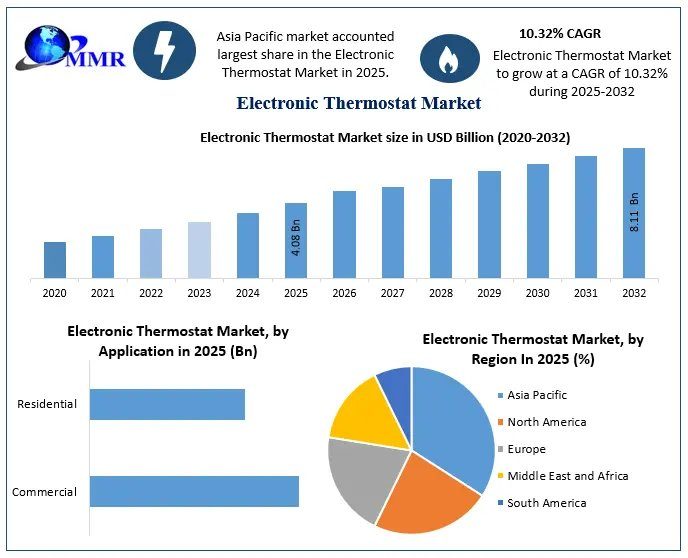
The Electronic Thermostat Market was valued at USD 4.08 billion in 2025 and is expected to grow at a CAGR of 10.32% from 2026 to 2032, reaching nearly USD 8.11 billion by 2032. Increasing adoption of smart temperature-control systems, energy-efficient heating and cooling solutions, and automated building management technologies is supporting market expansion.
Market Overview
Electronic thermostats are temperature-control devices that regulate heating, ventilation, and air conditioning (HVAC) systems through electronic sensors and control mechanisms. These devices monitor indoor temperatures and automatically adjust heating or cooling operations to maintain the desired temperature.
The market is witnessing increasing demand due to growing awareness of energy conservation, rising adoption of smart homes, and expanding commercial infrastructure. Electronic thermostats offer improved temperature accuracy, programmable settings, and automated control compared with conventional mechanical thermostats.
Explore the Free Report Sample : https://www.maximizemarketresearch.com/request-sample/86136/
The integration of Internet of Things (IoT), wireless connectivity, artificial intelligence, and smart building technologies is further transforming the industry. Smart electronic thermostats allow users to monitor and control indoor temperatures remotely through smartphones and connected devices.
The residential sector is an important contributor to market demand, supported by increasing smart home adoption and consumer preference for convenient climate-control solutions. Commercial applications, including offices, hospitals, hotels, shopping centres, and educational institutions, are also generating demand for advanced temperature-management systems.
Additionally, increasing construction activities, urbanization, and government initiatives promoting energy-efficient buildings are creating growth opportunities. However, high installation costs, compatibility challenges with existing HVAC infrastructure, and cybersecurity concerns associated with connected devices may restrict market expansion.
Scope and Methodology
The Electronic Thermostat Market report provides a comprehensive assessment of market size, growth drivers, emerging trends, competitive developments, and regional opportunities through 2032.
The study evaluates the market across different product categories, applications, and geographical regions. It examines historical performance, current industry developments, technological advancements, consumer demand, and future growth prospects.
The research methodology combines primary and secondary research to estimate market size and evaluate industry developments. Primary research includes insights from industry participants, manufacturers, suppliers, and other stakeholders, while secondary research incorporates company publications, industry reports, technical literature, and market databases.
The report also applies analytical frameworks such as PORTER's Five Forces, PESTEL analysis, SWOT analysis, value-chain analysis, and competitive benchmarking to assess market competition, external influences, industry risks, and strategic opportunities.
Regional Insights
North America
North America represents an important market for electronic thermostats due to increasing adoption of smart home technologies, advanced HVAC systems, and energy-efficient building solutions. The United States contributes significantly through investments in residential automation, commercial infrastructure, and connected building technologies.
Growing awareness of energy consumption and the adoption of programmable and smart thermostats are supporting regional market development.
Access the Exclusive Report Sample : https://www.maximizemarketresearch.com/request-sample/86136/
Europe
Europe is supported by increasing emphasis on energy efficiency, sustainable construction, and smart building technologies. Government initiatives promoting energy-efficient infrastructure and the modernization of heating systems are encouraging the adoption of electronic thermostats.
Germany, the United Kingdom, France, and other European countries offer opportunities through investments in residential and commercial building automation.
Asia Pacific
Asia Pacific is expected to offer significant growth opportunities due to rapid urbanization, expanding construction activities, rising disposable incomes, and increasing adoption of smart home technologies.
China, India, Japan, and South Korea are important markets because of their growing residential infrastructure, commercial development, and expanding HVAC industries. Increasing demand for automated climate-control solutions is further supporting regional growth.
Middle East & Africa
The Middle East & Africa market is supported by infrastructure development, commercial construction, hospitality investments, and increasing demand for advanced cooling systems. Rising temperatures and the need for efficient indoor climate management are creating opportunities for electronic thermostat manufacturers.
South America
South America is witnessing opportunities through expanding residential and commercial construction, increasing adoption of modern HVAC systems, and growing awareness of energy-efficient technologies. Brazil and Argentina represent important markets within the region.
Market Segmentation
By Product Type
- Smart Thermostats
- Programmable Thermostats
- Non-Programmable Electronic Thermostats
Smart thermostats are gaining attention due to their remote-access capabilities, connectivity features, automated temperature adjustments, and integration with smart home ecosystems.
By Application
- Residential
- Commercial
- Industrial
Residential applications are supported by growing smart home adoption and increasing consumer demand for convenient temperature management.
Commercial applications include offices, hotels, hospitals, educational institutions, and retail facilities, where automated HVAC control helps improve indoor comfort and manage energy consumption.
Industrial applications include manufacturing facilities, warehouses, and other environments requiring controlled temperature conditions.
By Connectivity
- Wired
- Wireless
Wireless electronic thermostats are gaining adoption due to their installation flexibility, remote monitoring capabilities, and compatibility with connected building-management systems.
Key Players
The global Electronic Thermostat Market includes established HVAC manufacturers, electronics companies, and smart building technology providers competing through product innovation, energy-efficient solutions, automation technologies, and strategic partnerships.
Major industry participants include:
- Honeywell International Inc.
- Schneider Electric SE
- Siemens AG
- Johnson Controls International plc
- Emerson Electric Co.
- Danfoss A/S
- Carrier Global Corporation
- Robert Bosch GmbH
- ABB Ltd.
- Legrand SA
- Nest Labs (Google)
- Ecobee Inc.
- Resideo Technologies, Inc.
- Lennox International Inc.
- Mitsubishi Electric Corporation
Market participants are focusing on smart connectivity, advanced temperature sensors, energy-management capabilities, wireless technologies, and integration with building automation systems to strengthen their competitive positions.
Request Free Access to the Sample Report : https://www.maximizemarketresearch.com/request-sample/86136/
Key Questions Answered
- What was the global Electronic Thermostat Market size in 2025?
- What will be the market size by 2032?
- What CAGR is expected during the forecast period 2026–2032?
- What are the major factors driving the Electronic Thermostat Market?
- What are the key challenges and restraints affecting market growth?
- Which product segment is expected to dominate the market?
- Which application segment accounts for significant market demand?
- What role does smart home technology play in market expansion?
- How is IoT integration transforming electronic thermostat technologies?
- Which region is expected to witness significant market growth?
- What are the emerging opportunities in commercial and industrial applications?
- Who are the leading companies operating in the global market?
- What strategies are key players adopting to strengthen their market presence?
- How are energy-efficiency regulations influencing product development?
- What are the major trends expected to shape the market through 2032?
Key Offerings of the Report
The Electronic Thermostat Market report provides:
- Market size and revenue forecast through 2032.
- Historical market assessment and industry growth analysis.
- CAGR and revenue projections for the forecast period.
- Market segmentation by product type, application, connectivity, and region.
- Regional and country-level market assessment.
- Market drivers, restraints, opportunities, and challenges.
- Technological advancements and emerging industry trends.
- Competitive landscape and market positioning analysis.
- Company profiles of major industry participants.
- Strategic developments, partnerships, and product innovations.
- PORTER's Five Forces analysis.
- PESTEL analysis of external market influences.
- SWOT analysis of market dynamics.
- Value-chain analysis of the electronic thermostat industry.
- Investment opportunities and strategic recommendations.
- Competitive benchmarking of leading market participants.
View More Reports :
Global Biodegradable Bone Graft Polymers Market https://www.maximizemarketresearch.com/market-report/global-biodegradable-bone-graft-polymers-market/71083/
Global Gypsum Ceiling Tiles Market https://www.maximizemarketresearch.com/market-report/global-gypsum-ceiling-tiles-market/71376/
About Maximize Market Research
Maximize Market Research Pvt. Ltd. (MMR) is a global market research and consulting company that provides reliable, data-focused, and practical business insights. The firm serves a wide range of industries, including healthcare, pharmaceuticals, technology, automotive, electronics, chemicals, personal care, and consumer goods. Through market forecasts, competitive analysis, strategic consulting, and industry impact assessments, MMR helps organizations understand changing market conditions, identify growth opportunities, and make informed business decisions for long-term success.
Contact Us :
2nd Floor, Navale IT Park Phase 3
Pune Banglore Highway, Narhe
Pune, Maharashtra 411041, India
+91 9607365656
sales@maximizemarketresearch.com
Author Bio
Article Comments
No Comments!
At present there are zero published comments on this article.
Similar Articles
Search Pages
Article Categories
There are zero sub-categories in this parent category.
There are zero sub-categories in this parent category.