Pea Protein Market To Reach USD 6.63 Billion By 2032, Growing At 13.97% CAGR

Anticipated Growth in Revenue
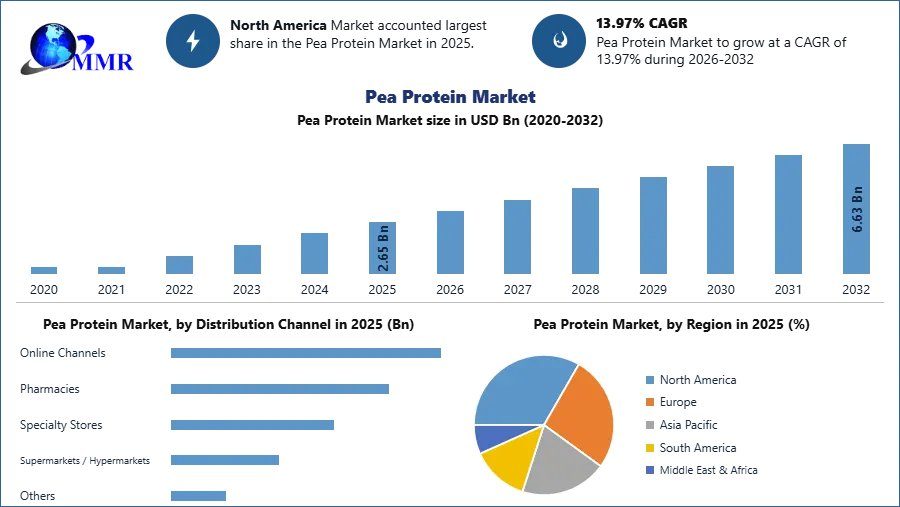
The Pea Protein Market was valued at USD 2.65 billion in 2025 and is expected to grow at a CAGR of 13.97% from 2026 to 2032, reaching approximately USD 6.63 billion by 2032. Market growth is driven by increasing demand for plant-based protein, rising consumer preference for sustainable food ingredients, and expanding applications across food, beverages, dietary supplements, and animal nutrition.
Market Overview
Pea protein is a plant-derived protein ingredient extracted primarily from yellow peas. It is widely used in food and beverage formulations because of its nutritional value, protein content, functional properties, and suitability for vegetarian, vegan, and plant-based diets. It is available in different forms, including pea protein isolates, concentrates, and textured pea protein.
Explore the Report Sample Before You Buy : https://www.maximizemarketresearch.com/request-sample/26472/
The growing adoption of plant-based diets is one of the major factors supporting the expansion of the global pea protein industry. Consumers are increasingly choosing alternative protein sources because of changing dietary preferences, health awareness, lactose intolerance, and demand for animal-free food products.
The food and beverage industry represents a significant application area. Pea protein is incorporated into meat alternatives, dairy-free beverages, protein bars, nutritional powders, bakery products, snacks, and ready-to-eat meals. Its ability to improve nutritional composition and provide functional characteristics makes it an important ingredient for food manufacturers.
The increasing popularity of sports nutrition and fitness products is further supporting market demand. Pea protein provides plant-based protein for consumers seeking protein supplementation, muscle recovery, and nutritional support. Its use in protein powders, meal replacements, and functional beverages is creating additional commercial opportunities.
Furthermore, manufacturers are investing in advanced extraction, processing, and formulation technologies to improve taste, solubility, texture, and nutritional performance. These developments are helping pea protein gain wider acceptance in mainstream food applications.
However, challenges such as raw-material price fluctuations, processing costs, taste limitations, and competition from soy, rice, and other plant-based proteins may influence market expansion. Continuous product innovation and improvements in manufacturing efficiency are expected to strengthen the industry's long-term growth potential.
Scope and Methodology
The Pea Protein Market report provides a comprehensive assessment of market size, industry trends, growth drivers, restraints, opportunities, competitive developments, and future revenue projections through 2032.
The study evaluates the market across different product categories, applications, forms, and geographical regions. It examines changing consumer preferences, plant-based food consumption, technological developments, production trends, and the competitive environment.
The research methodology combines primary and secondary research to evaluate market conditions and estimate market size. Primary research involves discussions and information gathering from industry participants, manufacturers, suppliers, and other relevant stakeholders. Secondary research includes company publications, industry databases, research reports, and relevant market information.
The report also incorporates analytical frameworks such as PORTER's Five Forces, PESTEL analysis, SWOT analysis, value-chain analysis, and competitive benchmarking. These methodologies help assess industry competition, business risks, investment opportunities, and the strategic positioning of major companies.
Regional Insights
North America
North America is expected to maintain a leading position in the global Pea Protein Market, supported by established food-processing infrastructure, strong consumer awareness, and increasing demand for plant-based nutrition. The United States and Canada are important markets due to the growing consumption of meat alternatives, dairy-free products, dietary supplements, and sports nutrition.
The presence of major manufacturers, advanced processing facilities, and established distribution networks further supports regional development.
Europe
Europe represents an important market for pea protein, driven by increasing vegan and flexitarian populations, demand for sustainable food ingredients, and growing adoption of plant-based alternatives. Countries such as Germany, France, the United Kingdom, and Belgium are significant markets due to their established food-processing industries and plant-based product innovation.
Asia Pacific
Asia Pacific is expected to experience considerable growth due to rising disposable incomes, urbanization, changing dietary preferences, and increasing awareness of plant-based nutrition. China, India, Japan, and Australia are important markets for pea protein manufacturers.
Expanding food and beverage production, increasing demand for nutritional supplements, and growing investments in alternative protein manufacturing are creating new opportunities across the region.
Request Free Access to the Sample Report : https://www.maximizemarketresearch.com/request-sample/26472/
Middle East & Africa
The Middle East & Africa market is developing through increasing demand for nutritional food products, expanding retail infrastructure, and growing awareness of alternative protein sources. South Africa and GCC countries offer opportunities for plant-based food manufacturers and ingredient suppliers.
South America
South America is witnessing growing interest in plant-based food ingredients, supported by changing consumer preferences and increasing demand for healthier food alternatives. Brazil and Argentina represent important markets due to their agricultural resources and expanding food-processing industries.
Market Segmentation
The Pea Protein Market is segmented based on type, form, source, application, distribution channel, and region.
By Type
- Isolates
- Concentrates
- Textured
Pea protein isolates are widely used in nutritional supplements, sports nutrition, beverages, and high-protein food products because of their concentrated protein content. Concentrates are used in bakery products, snacks, and other food formulations, while textured pea protein is increasingly utilized in plant-based meat alternatives.
By Form
- Dry
- Wet
Dry pea protein is widely used because of its longer shelf life, convenient storage, transportation, and suitability for powdered food formulations. Wet pea protein is utilized in specific food-processing applications where liquid ingredients are preferred.
By Source
- Split Yellow Peas
- Lentils
- Chickpeas
- Others
Split yellow peas are the primary source of commercial pea protein because of their protein content, availability, and suitability for large-scale processing. Alternative plant sources are also being explored to diversify protein ingredients.
By Application
- Animal Feed
- Bakery Goods
- Beverages
- Dietary Supplements
- Infant Nutrition
- Meat Substitutes
- Personal Cosmetics
- Others
Food and beverage applications represent a significant growth opportunity. Increasing demand for plant-based meat, dairy alternatives, protein beverages, and nutritional products is expanding the use of pea protein across food manufacturing.
Dietary supplements and sports nutrition are also important applications, supported by growing consumer interest in protein-enriched products.
By Distribution Channel
- Online Channels
- Pharmacies
- Specialty Stores
- Supermarkets / Hypermarkets
- Others
Online channels are gaining importance because of expanding e-commerce platforms and increasing consumer access to plant-based nutritional products. Supermarkets and specialty stores also play an important role in distributing pea protein products.
By Region
- North America
- United States
- Canada
- Mexico
- Europe
- United Kingdom
- France
- Germany
- Italy
- Spain
- Sweden
- Austria
- Rest of Europe
- Asia Pacific
- China
- South Korea
- Japan
- India
- Australia
- ASEAN
- Indonesia
- Philippines
- Malaysia
- Vietnam
- Thailand
- Rest of Asia Pacific
- Middle East & Africa
- South Africa
- GCC
- Nigeria
- Rest of Middle East & Africa
- South America
- Brazil
- Argentina
- Rest of South America
Key Players
The global Pea Protein Market is characterized by the presence of established food ingredient manufacturers, plant-based protein suppliers, and specialty nutrition companies. Market participants are focusing on product innovation, processing technologies, production capacity expansion, and strategic partnerships to strengthen their competitive positions.
Key players operating in the global market include:
- Roquette Frères
- Ingredion Incorporated
- DuPont
- Puris
- Burcon NutraScience Corporation
- AGT Food and Ingredients
- The Scoular Company
- Axiom Foods, Inc.
- Cosucra Groupe Warcoing SA
- Emsland Group
- Glanbia PLC
- Kerry Group
- Yantai Shuangta Foods Co., Ltd.
- Shandong Jianyuan Group
- ET-Chem
- Shandong Huatai Food
- Shandong Xiangchi Jianyuan Bio-Tech Co., Ltd.
- Shandong Oriental Herbest Bio-Tech Co., Ltd.
- Sotexpro SA
- The Green Labs LLC
Companies are increasingly investing in improved protein extraction, flavor enhancement, product functionality, and sustainable manufacturing processes to address changing consumer requirements.
Unlock Your Free Sample Report : https://www.maximizemarketresearch.com/request-sample/26472/
Key Questions Answered
- What was the global Pea Protein Market size in 2025?
- What is the expected market size by 2032?
- What CAGR is projected during the 2026–2032 forecast period?
- What are the major factors driving the growth of the Pea Protein Market?
- What are the key challenges and restraints affecting market expansion?
- Which type segment dominates the global market?
- Which form of pea protein is witnessing increasing demand?
- Which source contributes significantly to commercial pea protein production?
- Which application segment offers the highest growth opportunities?
- Which region is expected to dominate the global market?
- What factors are supporting the adoption of plant-based protein?
- How are technological advancements influencing pea protein production?
- Who are the major players operating in the global Pea Protein Market?
- What strategies are manufacturers adopting to strengthen their market positions?
- What emerging opportunities are expected to shape the industry through 2032?
Key Offerings of the Report
The Pea Protein Market report provides comprehensive industry insights, including:
- Market Size and Forecast: Global market valuation and revenue projections through 2032.
- Historical Market Analysis: Assessment of historical industry developments and demand patterns.
- CAGR Analysis: Evaluation of market growth throughout the forecast period.
- Market Segmentation: Detailed analysis by type, form, source, application, distribution channel, and region.
- Regional Analysis: Market assessment across North America, Europe, Asia Pacific, Middle East & Africa, and South America.
View More Reports :
Malted Milk Market https://www.maximizemarketresearch.com/market-report/malted-milk-market/75417/
E-commerce Logistics Market https://www.maximizemarketresearch.com/market-report/global-e-commerce-logistics-market/55619/
About Maximize Market Research
Maximize Market Research Pvt. Ltd. (MMR) is a global market research and consulting company that provides reliable, data-focused, and practical business insights. The firm serves a wide range of industries, including healthcare, pharmaceuticals, technology, automotive, electronics, chemicals, personal care, and consumer goods. Through market forecasts, competitive analysis, strategic consulting, and industry impact assessments, MMR helps organizations understand changing market conditions, identify growth opportunities, and make informed business decisions for long-term success.
Contact Us :
2nd Floor, Navale IT Park Phase 3
Pune Banglore Highway, Narhe
Pune, Maharashtra 411041, India
+91 9607365656
sales@maximizemarketresearch.com
Author Bio
Article Comments
No Comments!
At present there are zero published comments on this article.
Similar Articles
Search Pages
Article Categories
There are zero sub-categories in this parent category.
There are zero sub-categories in this parent category.