Abaca Fiber Market Set For Strong Growth Driven By Rising Demand For Sustainable Materials

Anticipated Growth in Revenue
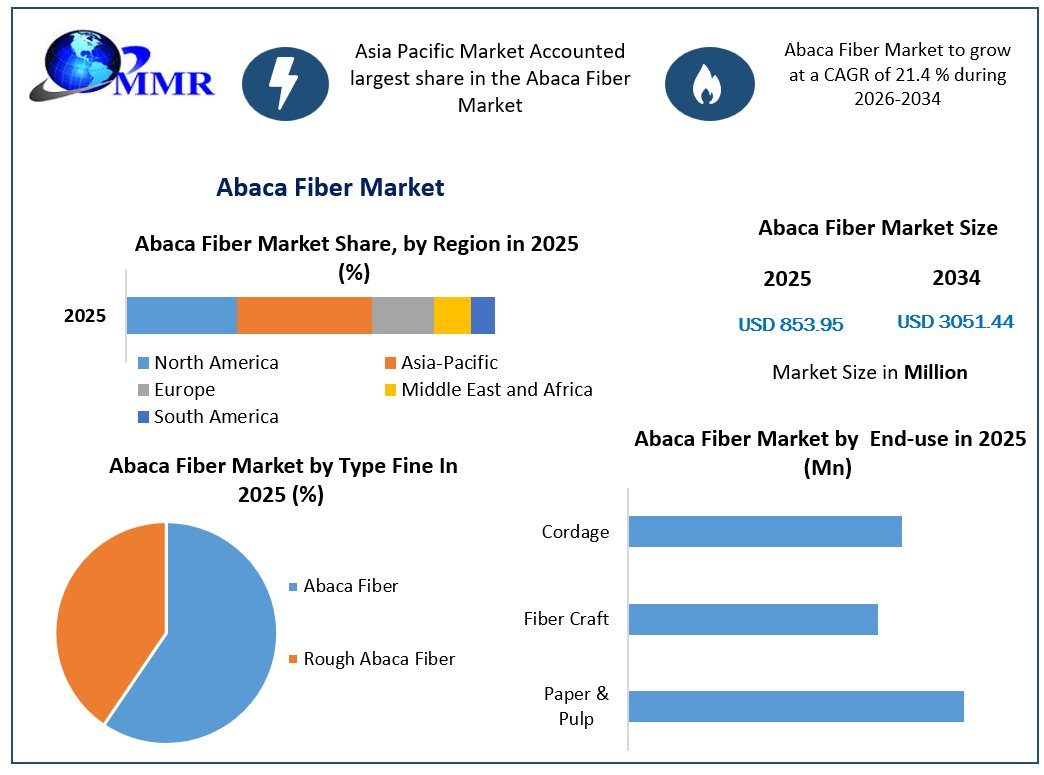
The Abaca Fiber Market is expected to reach US$ 3,051.44 million by 2034, growing at a CAGR of 15.2% during the forecast period. Increasing demand for sustainable, biodegradable, and renewable natural fibers across paper, textiles, automotive, packaging, and other industrial applications is supporting market expansion.
Market Overview
Abaca fiber, also known as Manila hemp, is a natural fiber extracted from the leaf stalks of the abaca plant (Musa textilis). It is recognized for its high tensile strength, durability, flexibility, and resistance to saltwater. These properties make it suitable for applications across paper manufacturing, textiles, automotive components, marine products, and specialty industrial materials.
The growing emphasis on environmentally responsible materials is creating new opportunities for the abaca fiber industry. Manufacturers are increasingly exploring natural fibers as alternatives to synthetic materials because of their renewable origin, biodegradability, and potential to reduce environmental impact.
The paper and pulp industry represents an important application area for abaca fiber. Its long fiber structure and strength make it suitable for specialty papers, tea bags, currency paper, filter papers, and other high-performance paper products.
Request Free Access to the Sample Report : https://www.maximizemarketresearch.com/request-sample/81632/
The automotive industry is also creating opportunities through the adoption of natural-fiber-reinforced composites. Abaca fiber can be incorporated into interior automotive components, helping manufacturers explore lightweight alternatives to conventional materials.
Furthermore, increasing demand for sustainable textiles, handicrafts, ropes, cordage, and packaging materials is supporting the development of new applications. Growing awareness of circular-economy practices and renewable raw materials is encouraging manufacturers to expand their natural-fiber product portfolios.
However, limited cultivation areas, seasonal production, supply-chain constraints, inconsistent fiber quality, and processing challenges can affect market development. Improvements in agricultural practices, processing technologies, and distribution networks are expected to strengthen the industry's long-term growth potential.
Scope and Methodology
The Abaca Fiber Market report provides a detailed assessment of industry structure, market dynamics, production trends, regional performance, and competitive positioning. The study evaluates historical developments and future growth opportunities across major applications and geographical markets.
The research covers the market based on fiber type, end-use industry, and region. It examines demand from paper and pulp manufacturing, fiber crafts, cordage production, and other industrial applications.
The methodology combines primary and secondary research to evaluate market size, revenue trends, production capacity, pricing, and competitive developments. It also considers manufacturer shipments, revenue performance, gross profits, product portfolios, and regional business distribution.
Strategic assessment tools, including PORTER's Five Forces, PESTEL analysis, SWOT analysis, and value-chain analysis, are used to understand competitive pressures, industry risks, market opportunities, and external economic factors.
Regional Insights
Asia Pacific
Asia Pacific represents a leading region in the Abaca Fiber Market, supported by its strong production base and established natural-fiber industry. The Philippines is a major global producer of abaca fiber, benefiting from suitable climatic conditions, agricultural expertise, and established export networks.
Growing demand from paper manufacturing, cordage production, textiles, and handicrafts supports regional consumption. Government initiatives to improve fiber quality and increase production capacity are also creating opportunities for industry participants.
North America
North America represents an important consumption market for abaca fiber, particularly in specialty paper manufacturing, industrial cordage, and sustainable material applications. Demand from the United States and Canada is supported by the use of natural fibers in specialized industrial and commercial products.
Europe
Europe offers growth opportunities through increasing interest in renewable materials, specialty paper products, sustainable textiles, and environmentally responsible manufacturing. Demand for high-quality natural fibers across industrial and consumer applications supports the regional market.
Middle East & Africa
The Middle East & Africa market is supported by demand for industrial fibers, cordage, specialty materials, and sustainable alternatives. Opportunities are associated with expanding industrial activities and the adoption of natural-fiber-based products.
South America
South America presents opportunities through industrial development and growing interest in renewable raw materials. Brazil and Argentina are among the important markets considered in the regional assessment.
The regional analysis covers North America, Europe, Asia Pacific, Middle East & Africa, and South America, with country-level assessments across major economies.
Get Instant Access to the Sample Report : https://www.maximizemarketresearch.com/request-sample/81632/
Market Segmentation
By Type
- Fine Abaca Fiber
- Rough Abaca Fiber
Fine abaca fiber is suitable for applications requiring higher-quality fiber characteristics, including specialty paper and textile products. Rough abaca fiber is used in applications where strength and durability are important.
By End-Use
- Paper & Pulp
- Fiber Craft
- Cordage
Paper & Pulp represents a significant end-use segment because abaca fiber offers strength, durability, and long fiber characteristics. It is used in specialty paper manufacturing, including tea bags, decorative papers, and banknotes.
The fiber craft segment benefits from demand for natural-fiber handicrafts, woven products, and decorative materials. Cordage applications include ropes, marine products, and industrial uses where tensile strength and durability are essential.
Industry Analysis and Forecast 2030
Key Players
The global Abaca Fiber Market consists of manufacturers, suppliers, exporters, and fiber-processing companies competing through product quality, production capacity, distribution networks, and international market expansion.
Key players operating in the market include:
- Tag Fibers, Inc.
- Ching Bee Trading Corporation
- MAP Enterprises
- Selinrail International Trading
- The Fiber World
- Italfil Expo Bags Company Limited
- Yzen Handicraft Export Trading
- Peral Enterprises
Market participants are focusing on improving fiber quality, strengthening supply chains, expanding export operations, and developing new applications across paper manufacturing, textiles, cordage, and industrial materials.
Industry Analysis and Forecast 2030
Key Questions Answered
- What is the expected size of the global Abaca Fiber Market by 2034?
- What CAGR is projected during the forecast period?
- What are the major factors driving Abaca Fiber Market growth?
- What are the key challenges affecting abaca fiber production and supply?
- Which type segment dominates the global market?
- Which end-use industry accounts for significant market demand?
- Why is the paper and pulp industry important for abaca fiber consumption?
- Which region holds a significant position in the global market?
- How is the Philippines contributing to global abaca fiber production?
- What opportunities are emerging from natural-fiber adoption in the automotive industry?
- How is demand for sustainable and biodegradable materials influencing the market?
- Who are the leading manufacturers and suppliers operating in the market?
- What strategies are companies adopting to strengthen their market positions?
- What are the future growth opportunities for abaca fiber manufacturers through 2034?
Key Offerings of the Report
The Abaca Fiber Market report provides comprehensive industry insights, including:
- Market size and revenue forecast through 2034.
- CAGR analysis for the forecast period.
- Historical market performance and industry trends.
- Market segmentation by fiber type and end-use industry.
- Regional and country-level market assessment.
- Market drivers, restraints, opportunities, and challenges.
- Production and consumption trend analysis.
- Supply-chain and demand-side assessment.
- Competitive landscape and company profiling.
View More Reports :
Malted Milk Market https://www.maximizemarketresearch.com/market-report/malted-milk-market/75417/
E-commerce Logistics Market https://www.maximizemarketresearch.com/market-report/global-e-commerce-logistics-market/55619/
About Maximize Market Research
Maximize Market Research Pvt. Ltd. (MMR) is a global market research and consulting company that provides reliable, data-focused, and practical business insights. The firm serves a wide range of industries, including healthcare, pharmaceuticals, technology, automotive, electronics, chemicals, personal care, and consumer goods. Through market forecasts, competitive analysis, strategic consulting, and industry impact assessments, MMR helps organizations understand changing market conditions, identify growth opportunities, and make informed business decisions for long-term success.
Contact Us :
2nd Floor, Navale IT Park Phase 3
Pune Banglore Highway, Narhe
Pune, Maharashtra 411041, India
+91 9607365656
sales@maximizemarketresearch.com
Author Bio
Article Comments
No Comments!
At present there are zero published comments on this article.
Similar Articles
Search Pages
Article Categories
There are zero sub-categories in this parent category.
There are zero sub-categories in this parent category.