Fifth-Generation Fighter (F-35, Su-57, J-20) Support Market Growth Analysis, Dynamics, Key Players And Innovations, Outlook And Forecast 2026-2034

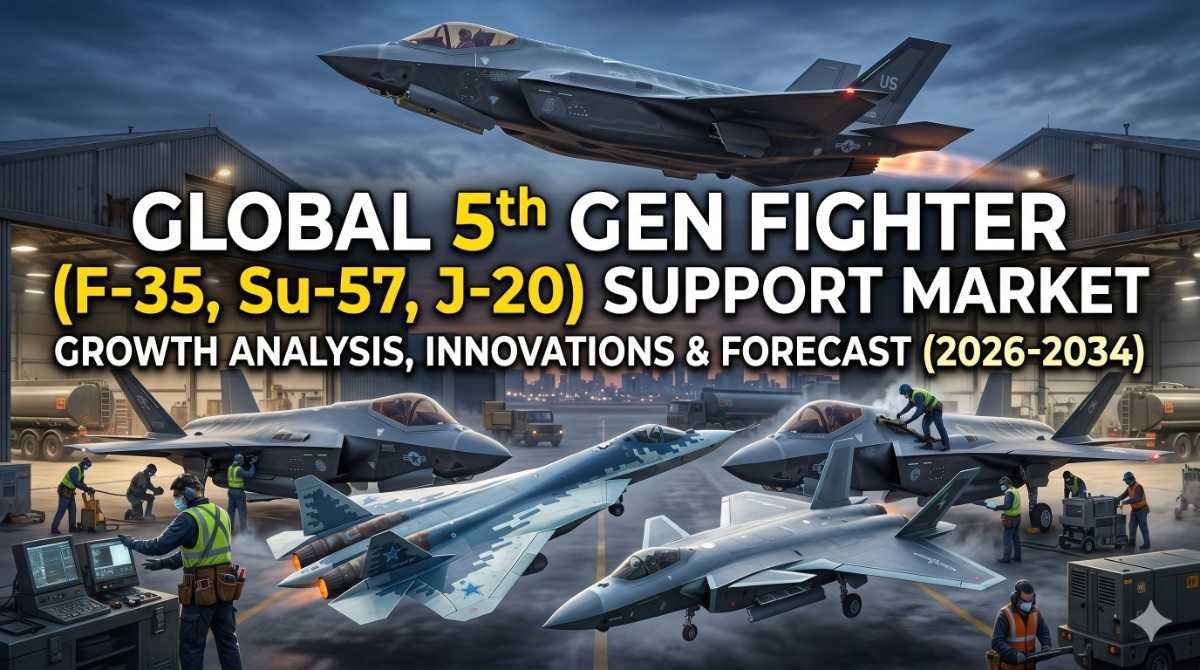
According to a new report from Intel Market Research, the global Fifth-Generation Fighter (F-35, Su-57, J-20) Support Market was valued at USD 17.8 billion in 2025 and is projected to reach USD 28.4 billion by 2034, growing at a robust CAGR of 5.3% during the forecast period (2026–2034). This growth is driven by expanding fleet sizes, heightened geopolitical tensions, and accelerating adoption of predictive‑maintenance technologies.
Fifth‑generation fighter support encompasses the extensive maintenance, sustainment, training, software upgrades, and logistics required to keep advanced platforms such as the F‑35 Lightning II, Su‑57 Felon, and J‑20 Mighty Dragon mission‑ready. These aircraft rely heavily on integrated avionics, stealth coatings, next‑generation propulsion systems, and complex sensor‑fusion technologies, all of which demand specialized tooling, secure data infrastructure, and continuous lifecycle management. Because these platforms operate with high‑cost, technologically intensive components, the support ecosystem includes engine overhauls, low‑observable (LO) material upkeep, cybersecurity upgrades, mission‑data‑file updates, and supply‑chain resilience measures that ensure operational readiness.
📥 Download FREE Sample Report:
Fifth-Generation Fighter (F-35, Su-57, J-20) Support Market - View in Detailed Research Report
The market is expanding steadily as defense ministries increase sustainment budgets and prioritize multi‑decade lifecycle programs. While demand for advanced maintenance capabilities continues to rise due to higher flight‑hour utilization and expanding fleet sizes, challenges persist related to supply‑chain bottlenecks and the complexity of next‑generation avionics. Furthermore, modernization initiatives across major operators are accelerating growth. For instance, the F‑35 global fleet surpassed 2,200 cumulative aircraft orders by early 2024, prompting substantial investment in Performance‑Based Logistics (PBL) frameworks and regional sustainment hubs. Similarly, China’s ongoing J‑20 fleet expansion and Russia’s incremental Su‑57 production have strengthened demand for specialized support capabilities, driving competition among OEMs and service providers in this rapidly evolving domain.
MARKET DRIVERS
Expanding Global Fleets of Fifth‑Generation Fighters
The Fifth‑Generation Fighter (F‑35, Su‑57, J‑20) Support Market is primarily driven by the rapid expansion and operational maturation of advanced fighter fleets worldwide. The F‑35 program continues to see strong growth, with record deliveries exceeding 190 aircraft in 2025 and projections for hundreds more in Europe alone by 2030. This scale drives sustained demand for comprehensive sustainment, maintenance, repair, and overhaul (MRO) services across airframes, engines, and complex avionics systems.
➤ Rising emphasis on predictive maintenance and digital logistics solutions enhances fleet availability for these sophisticated aircraft.
Overall, the transition toward information‑centric warfare and the need for interoperability among allied forces further propel demand for specialized support infrastructure and services tailored to stealth fighters.
MARKET CHALLENGES
High Sustainment Costs and Availability Issues
The Fifth‑Generation Fighter (F‑35, Su‑57, J‑20) Support Market faces significant hurdles from elevated operating and support costs. For the F‑35, lifetime sustainment estimates exceed $1.5 trillion, with flight‑hour costs notably higher than legacy platforms, straining defense budgets despite efforts to optimize through contracts and technological improvements.
Other Challenges
Supply Chain and Technical Complexity
Maintaining stealth coatings, advanced sensors, and proprietary systems requires specialized expertise and parts, leading to logistical bottlenecks and extended downtime for F‑35, Su‑57, and J‑20 fleets.
MARKET RESTRAINTS
Budgetary Pressures and Cost Overruns
Escalating sustainment expenses continue to restrain broader adoption and operational tempo in the Fifth‑Generation Fighter (F‑35, Su‑57, J‑20) Support Market. Programs grapple with higher‑than‑expected maintenance labor hours and parts obsolescence management, which divert resources from fleet expansion initiatives.
MARKET OPPORTUNITIES
Advancements in Lifecycle Management Technologies
The Fifth‑Generation Fighter (F‑35, Su‑57, J‑20) Support Market presents substantial growth potential through integration of AI‑driven predictive maintenance, digital‑twin technologies, and modernized logistics networks like the transition to advanced data systems for the F‑35. These innovations promise to improve availability rates and reduce long‑term ownership costs.
International Collaboration and Depot Expansion
Opportunities exist in expanding international sustainment partnerships, depot activations, and performance‑based logistics contracts. Growing J‑20 fleets and F‑35 global partnerships create avenues for localized support capabilities, training programs, and upgrade services amid ongoing fleet modernization efforts.
COMPETITIVE LANDSCAPE
Key Industry Players
Fifth‑Generation Fighter Support Market Analysis
The Fifth‑Generation Fighter Support Market is dominated by Lockheed Martin, the prime contractor and systems integrator for the F‑35 Lightning II program, which operates the most extensive global sustainment network. This market encompasses maintenance, repair and overhaul (MRO), logistics, supply‑chain management, training, and upgrades for platforms including the F‑35, with more limited international support ecosystems for Russia’s Su‑57 and China’s J‑20. The structure features a few prime integrators overseeing complex, high‑tech sustainment operations characterised by advanced predictive‑maintenance systems and global parts distribution.
Significant niche players include major subsystem providers and specialised logistics firms that support specific components such as propulsion, avionics, and airframe elements. For non‑Western platforms, support remains primarily state‑controlled with limited private‑sector visibility, creating distinct market segments driven by geopolitical alignments and technology‑access restrictions.
List of Key Fifth‑Generation Fighter Support Companies Profiled
- Lockheed Martin
- Lockheed Martin
- Northrop Grumman
- Northrop Grumman
- BAE Systems
- BAE Systems
- RTX Corporation (Pratt & Whitney)
- RTX Corporation
- L3Harris Technologies
- Boeing Defense
- Leonardo S.p.A.
- Saab AB
- Elbit Systems
- Thales Group
- United Aircraft Corporation (for Su‑57)
- Chengdu Aircraft Corporation (for J‑20)
Fifth‑Generation Fighter (F‑35, Su‑57, J‑20) Support Market Trends
Global Sustainment Challenges and Logistics Evolution
The Fifth‑Generation Fighter (F‑35, Su‑57, J‑20) Support Market continues to evolve as operators prioritise aircraft availability amid complex operational demands. The F‑35 programme faces notable sustainment pressures, with fleet‑availability rates averaging around 50 % in recent assessments due to maintenance complexities, spare‑part constraints, and extended service‑life projections. This has driven investments in prognostic health‑management systems that enable condition‑based maintenance approaches, aiming to optimise workforce requirements and improve overall readiness for the extensive global fleet.
Other Trends
Contractor Performance and Affordability Initiatives
In the F‑35 ecosystem, sustainment contracts emphasise performance metrics, though challenges persist in meeting availability targets. Efforts focus on reducing per‑flight‑hour costs through enhanced supply‑chain efficiencies and technical‑data improvements. For operators of the Su‑57, support remains constrained by limited production scales and specialised requirements for stealth coatings and engine maintenance, which often necessitate significant disassembly and advanced expertise. The J‑20 platform benefits from domestic industrial capacity in China, supporting higher production tempos and integrated logistics tailored to regional operational needs.
Technological Advancements in Predictive Support
Across the Fifth‑Generation Fighter (F‑35, Su‑57, J‑20) Support Market, a key trend involves the integration of advanced sensors and data analytics for predictive maintenance. The F‑35’s sophisticated onboard systems generate substantial data volumes used to forecast component failures, though full realisation depends on robust training and technical infrastructure. Russian and Chinese programmes similarly advance indigenous capabilities, with emphasis on reducing reliance on external suppliers amid geopolitical factors. Global support networks for the F‑35 benefit from multinational participation, facilitating shared logistics and parts interoperability among allied operators, while Su‑57 and J‑20 support structures reflect more centralised national approaches with ongoing maturation in spare‑part availability and technician specialisation.
Regional Analysis: Fifth‑Generation Fighter (F‑35, Su‑57, J‑20) Support Market
North America
North America stands as the dominant force in the Fifth‑Generation Fighter (F‑35, Su‑57, J‑20) Support Market, driven by its unmatched operational experience with advanced fighter platforms, particularly the F‑35. The region’s extensive network of specialised maintenance facilities, simulation training centres, and integrated logistics hubs enables seamless sustainment of complex avionics, stealth coatings, and sensor systems. Collaborative ecosystems between defence contractors, air forces, and technology providers foster continuous innovation in predictive maintenance and software upgrades, ensuring high mission‑availability rates. Strategic investments in workforce development create a deep pool of skilled technicians proficient in handling next‑generation fighter support requirements. The mature supply‑chain infrastructure supports rapid component sourcing and overhaul services, minimising downtime for critical assets. Partnerships emphasise interoperability enhancements, allowing for smoother integration of evolving capabilities across allied operations. Environmental considerations also shape support strategies, with growing emphasis on sustainable practices in hangar operations and material recycling for composite structures. This comprehensive approach positions North America as the benchmark for fifth‑generation fighter sustainment excellence, influencing global standards in the support market.
Operational Maturity
Extensive real‑world deployment of fifth‑generation platforms has refined support protocols, creating robust frameworks for troubleshooting advanced systems. Emphasis on data‑driven insights helps anticipate maintenance needs, enhancing overall fleet readiness in dynamic security environments.
Innovation Ecosystem
Close collaboration between industry leaders and military branches accelerates development of cutting‑edge support solutions, including augmented‑reality training tools and AI‑powered diagnostics tailored for stealth fighter technologies.
Supply Chain Resilience
Well‑established domestic manufacturing and logistics networks ensure reliable access to proprietary components, reducing vulnerabilities while supporting rapid response to evolving operational demands for F‑35 sustainment.
Europe
Europe demonstrates growing sophistication in the Fifth‑Generation Fighter (F‑35, Su‑57, J‑20) Support Market through multinational cooperation and indigenous capability development. Nations operating F‑35 variants are building specialised maintenance depots and pilot training facilities that emphasise cross‑border standardisation. Focus areas include enhancing electronic‑warfare support systems and stealth‑material restoration techniques adapted to European climates. Collaborative programmes encourage shared resource pools for high‑value spare parts, optimising costs across participating air forces. The region prioritises regulatory harmonisation to streamline certification processes for support innovations, fostering an environment conducive to technological advancement. Workforce initiatives target specialised skills in sensor fusion and propulsion‑system upkeep, addressing the unique demands of modern fighter sustainment. Strategic autonomy efforts complement alliance commitments, positioning Europe as an increasingly self‑reliant player capable of delivering high‑quality support services while contributing to broader transatlantic defence objectives.
Asia‑Pacific
The Asia‑Pacific region exhibits dynamic evolution in the Fifth‑Generation Fighter (F‑35, Su‑57, J‑20) Support Market, characterised by rapid infrastructure expansion and technology localisation. Countries fielding J‑20 platforms are investing heavily in domestic support ecosystems, including advanced simulation centres and component‑manufacturing hubs. Regional operators explore indigenous solutions for avionics maintenance and software customisation to meet specific operational theatres. Growing emphasis on regional security drives development of agile logistics networks capable of supporting dispersed deployments. Training programmes incorporate scenario‑based exercises that prepare personnel for complex fifth‑generation maintenance challenges. Collaborative forums facilitate dialogue on best practices, although varying platform types create opportunities for specialised service differentiation. The region’s strategic geography underscores the importance of reliable support infrastructure, spurring investments in hardened facilities and rapid‑deployment capabilities that enhance operational resilience across diverse maritime and continental environments.
South America
South America is gradually developing its footprint in the Fifth‑Generation Fighter (F‑35, Su‑57, J‑20) Support Market through selective modernisation initiatives and international partnerships. Countries exploring advanced fighter acquisitions are prioritising foundational support infrastructure, including basic maintenance training and logistics planning. Focus remains on building human capital capable of handling sophisticated systems through targeted education programmes and technician exchanges. Regional cooperation mechanisms help pool resources for shared training facilities, reducing individual country burdens. Emphasis on climate‑adapted support solutions addresses unique environmental challenges affecting aircraft performance. While current scale remains modest compared to other regions, strategic planning aims to establish sustainable frameworks that can scale with future fleet expansions. This measured approach ensures long‑term viability and positions South American nations to integrate effectively into global support networks as their fifth‑generation capabilities mature.
Middle East & Africa
The Middle East and Africa region shows strategic interest in the Fifth‑Generation Fighter (F‑35, Su‑57, J‑20) Support Market, driven by security requirements and diversification of defence partnerships. Operators in the Middle East are establishing sophisticated support centres equipped for harsh desert conditions, focusing on sand‑resistant coatings and thermal‑management systems. Training academies emphasise rapid‑turnaround maintenance to maintain high operational tempo in volatile environments. African nations prioritise foundational capabilities and knowledge‑transfer agreements to develop local expertise in fighter sustainment. Regional hubs serve as potential service centres for neighbouring countries, promoting economies of scale. Investment in resilient infrastructure protects critical support assets against environmental and security challenges. Collaborative efforts with established providers accelerate capability building while fostering technology adaptation suited to local operational contexts. This positions the region as an emerging participant with significant potential for specialised support services tailored to unique geographical and mission profiles.
📥 Get Full Report Here:
Fifth‑Generation Fighter (F‑35, Su‑57, J‑20) Support Market - View Detailed Research Report
About Intel Market Research
Intel Market Research is a leading provider of strategic intelligence, offering actionable insights in biotechnology, pharmaceuticals, and healthcare infrastructure. Our research capabilities include:
- Real-time competitive benchmarking
- Global clinical trial pipeline monitoring
- Country-specific regulatory and pricing analysis
- Over 500+ healthcare reports annually
Trusted by Fortune 500 companies, our insights empower decision‑makers to drive innovation with confidence.
🌐 Website: https://www.intelmarketresearch.com
📞 Asia‑Pacific: +91 9169164321
🔗 LinkedIn: Follow Us
Author Bio
Article Comments
No Comments!
At present there are zero comments on this article.
Why not be the first to make a comment?
Similar Articles
Search Pages
User Upgrade
account to full use of editor,
Including hyperlinks
Article Categories
There are zero sub-categories in this parent category.
There are zero sub-categories in this parent category.