Cellulosic Ethanol Market Outlook: Strong Expansion Path Through 2032 At 38.26% CAGR

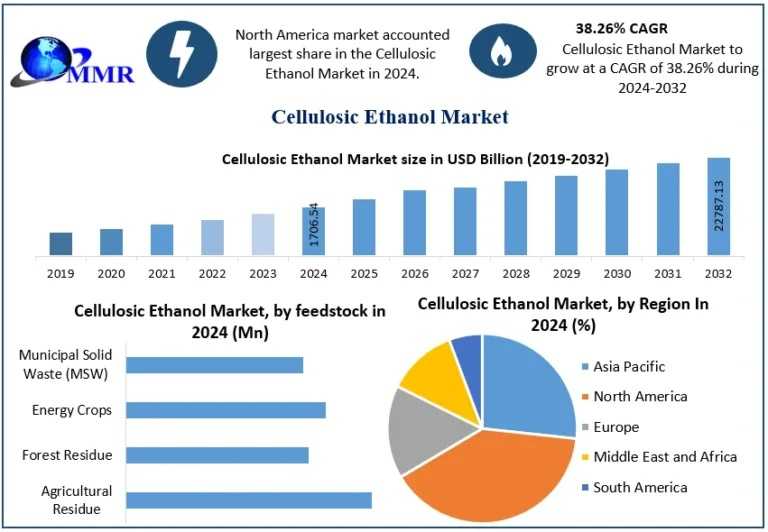
Key Highlights
- Market valued at USD 1,706.54 million in 2024
- Forecast to reach USD 22,787.13 million by 2032
- Expanding at a CAGR of 38.26% (2025–2032)
- North America holds dominant share at 35.2% in 2024
- Energy crops expected to lead feedstock segment
- Gasoline blending remains key application driver
- Enzyme technology reduces production barriers
- Waste biomass-based fuel strengthens sustainability shift
Why This Matters Now
Energy security pressures and decarbonization mandates are forcing governments and fuel producers to diversify beyond conventional fossil fuels. Cellulosic ethanol directly converts agricultural and forest waste into transport fuel, reducing dependence on food crops. This shift matters for fuel producers, agricultural supply chains, and industrial biotech firms as regulatory and ESG-linked fuel standards tighten globally.
Market Overview
The cellulosic ethanol market represents advanced biofuel production using non-food biomass sources including agricultural residues, forest residues, energy crops, and municipal solid waste. The fuel is used as a gasoline substitute and additive, supporting emissions reduction targets and energy diversification strategies.
Demand is driven by rising fuel consumption, tightening emissions regulations, and increasing focus on renewable transport fuels. Governments are incentivizing ethanol blending in gasoline to reduce air pollution and improve energy independence.
Supply dynamics remain constrained by feedstock logistics, enzyme cost intensity, and infrastructure limitations for distribution and storage. Despite this, technological improvements in biomass conversion are improving yield efficiency and commercial viability.
Macro drivers include climate policy alignment, renewable energy investment cycles, and industrial biotechnology advancements supporting large-scale ethanol production.
Key Trends Driving Growth
Technology and enzyme innovation
Advancements in enzyme technologies are improving biomass breakdown efficiency. This increases conversion rates from lignocellulosic materials into ethanol, directly improving production scalability and lowering unit costs.
Waste-to-energy transition
Non-food biomass utilization is reducing pressure on agricultural supply chains. This strengthens circular economy models in agriculture and forestry industries.
Regulatory push for clean fuels
Governments are promoting ethanol blending mandates to reduce emissions in transportation fuels. This creates stable long-term demand for ethanol producers.
Feedstock diversification
Agricultural residues and energy crops are gaining preference due to cost efficiency and availability. This reduces dependency on single-source feedstock systems.
Infrastructure constraint pressure
Limited pipeline compatibility and transportation challenges are pushing investment toward localized production clusters near feedstock sources.
Explore detailed analysis, insights, and growth opportunities : https://www.maximizemarketresearch.com/request-sample/148030/
Segment Insights (DETAILED)
By Feedstock – Energy Crops Lead
Energy crops are expected to dominate due to their dedicated cultivation for biofuel production. Unlike food crops, they do not compete with food supply chains. This improves policy acceptance and ensures consistent biomass availability for ethanol producers.
Agricultural residues and forest residues remain critical secondary inputs, especially in regions with strong agricultural output. Municipal solid waste offers emerging potential but requires higher preprocessing investment.
Business impact: Feedstock specialization is reshaping agricultural supply chains into industrial biofuel ecosystems.
By Application – Gasoline Blending Dominates
Gasoline applications lead due to widespread ethanol blending mandates in transportation fuels. Ethanol serves as a direct gasoline substitute and additive for emissions reduction.
Detergent applications are smaller but growing steadily due to rising demand for sustainable cleaning products.
Business impact: Fuel blending policies anchor demand stability, reducing market volatility for producers.
Regional Growth Story
North America
North America holds 35.2% market share in 2024. The region benefits from established ethanol blending infrastructure and large-scale production capacity. Regulatory frameworks supporting renewable fuels reinforce demand stability.
Europe
Europe ranks second, driven by strict environmental regulations and decarbonization targets. Adoption is supported by policy-driven renewable fuel mandates.
Asia Pacific
Asia Pacific is emerging as a high-growth region due to rising fuel demand in India, China, and Southeast Asia. Government incentives for energy security and domestic fuel production support market expansion.
South America
Brazil plays a major role due to strong ethanol production ecosystems and agricultural biomass availability.
Business impact: Regional leadership is shifting toward policy-driven biofuel adoption economies with strong agricultural supply bases.
Competitive Landscape
The market is fragmented with global biotech firms, energy companies, and biofuel specialists competing on enzyme efficiency, feedstock access, and production scalability.
- Raízen Energia focuses on large-scale ethanol production integration with agricultural supply chains.
- Novozymes A/S drives enzyme innovation critical for biomass conversion efficiency.
- POET - DSM Advanced Biofuels LLC specializes in advanced ethanol production technologies.
- GranBio Group targets commercial-scale cellulosic ethanol deployment.
- Aemetis Inc. expands production capacity in low-carbon fuel segments.
- Enerkem Inc. focuses on converting municipal waste into ethanol.
- Clariant International Ltd. develops catalytic and biochemical process solutions for ethanol production.
- BP PLC invests in renewable fuels diversification strategies.
Competition is shifting toward enzyme innovation, feedstock integration efficiency, and scaling commercial viability. Strategic advantage is concentrating among firms that control both biotechnology inputs and feedstock logistics.
Recent Developments
The report does not list specific dated company-level developments for the cellulosic ethanol market. Competitive movement is instead reflected through ongoing technology commercialization, enzyme innovation, and feedstock integration investments across key producers.
Future Outlook
Market leadership will consolidate around vertically integrated biofuel producers and enzyme technology innovators capable of lowering conversion costs while scaling waste-based ethanol production.
Explore More: Visit our website for Additional reports :
Organic Baby Food Market https://www.maximizemarketresearch.com/market-report/organic-baby-food-market/221143/
Manuka Honey Market https://www.maximizemarketresearch.com/market-report/manuka-honey-market/217559/
About Maximize Market Research
Maximize Market Research Pvt. Ltd. (MMR) is a global market research and consulting company that provides reliable, data-focused, and practical business insights. The firm serves a wide range of industries, including healthcare, pharmaceuticals, technology, automotive, electronics, chemicals, personal care, and consumer goods. Through market forecasts, competitive analysis, strategic consulting, and industry impact assessments, MMR helps organizations understand changing market conditions, identify growth opportunities, and make informed business decisions for long-term success.
Contact Us :
2nd Floor, Navale IT Park Phase 3
Pune Banglore Highway, Narhe
Pune, Maharashtra 411041, India
+91 9607365656
sales@maximizemarketresearch.com
Author Bio
Article Comments
No Comments!
At present there are zero comments on this article.
Why not be the first to make a comment?
Similar Articles
Search Pages
User Upgrade
account to full use of editor,
Including hyperlinks
Article Categories
There are zero sub-categories in this parent category.
There are zero sub-categories in this parent category.