IoT & AI Revolutionize Global Milking Robot Market Growth

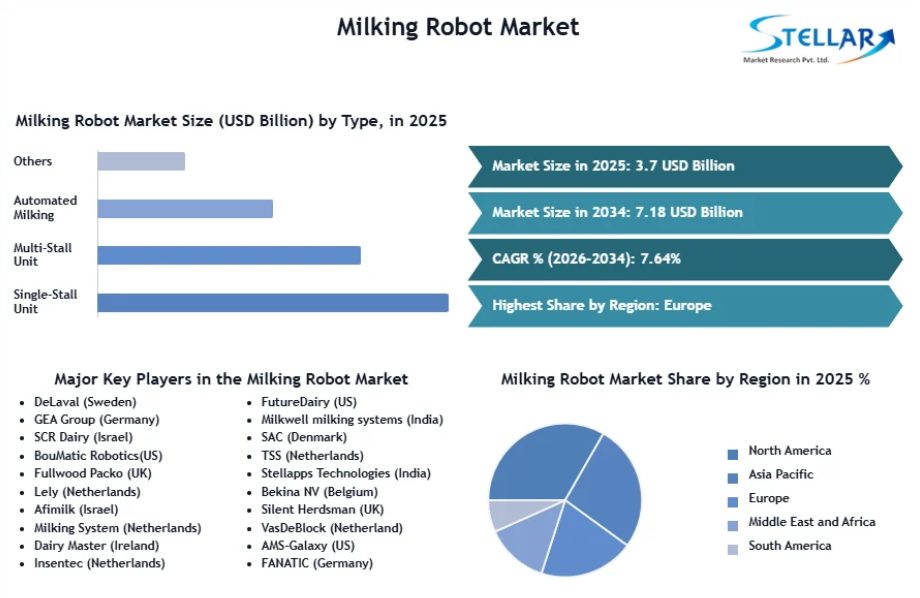
The global Milking Robot Market size was valued at USD 3.7 billion in 2025 and is projected to expand robustly at a compound annual growth rate (CAGR) of 7.64% over the forecast period, reaching nearly USD 7.18 billion by 2034. The market's aggressive growth trajectory is heavily propelled by acute labor shortages in the agricultural sector, rising global milk consumption, and the accelerated digital transformation of dairy farms through IoT and artificial intelligence integration.
Modern dairy farming is undergoing a structural paradigm shift. Traditionally plagued by severe labor dependency, erratic milking schedules, and physical inefficiencies, commercial dairy operations are rapidly pivoting toward automated milking systems (AMS) to secure long-term viability. The convergence of precision livestock farming (PLF) and advanced machine-learning algorithms allows automated stalls and rotary units to monitor cow health in real time, analyze individual milk yield parameters, and optimize milking frequency without human intervention.
Key Findings from the Report
Valuation & Growth Dynamics: The global milking robot market is valued at USD 3.7 billion in 2025, scaling to USD 7.18 billion by 2034 at a 7.64% CAGR.
System Type Dominance: Multi-stall units and automated milking rotaries hold a commanding revenue share, favored by medium-to-large commercial dairy farms seeking simultaneous multi-cow processing and rapid return on investment.
Component Breakdown: The hardware sector commands the lion's share of market revenue, driven by heavy investments in robotic arms, precision sensor arrays, automated teat-cleaning mechanisms, and sanitary cluster removers.
Herd Size Segmentation: The 100 to 1,000 herd size segment represents the primary demand driver, balancing high-capacity automation with optimal capital efficiency.
Regional Leadership: Europe leads the global adoption matrix, supported by stringent labor regulations, advanced agricultural cooperatives, and strong government incentives for smart farming.
High-Growth Frontier: Asia Pacific emerges as the fastest-growing regional market, catalyzed by expanding commercial dairy sectors in India, China, and Japan.
Investment Relevance: Venture capital and private equity allocations into agricultural robotics are shifting toward cloud-connected farm management software and predictive veterinary diagnostic tools.
For further information, click the following link:https://www.stellarmr.com/report/req_sample/milking-robot-market/2477
Market Drivers and Restraints
Key Drivers
Severe Agricultural Labor Shortages: Escalating labor deficits and surging wages across rural economies compel dairy farm owners to automate continuous, labor-intensive milking cycles.
Technological Convergence (IoT & AI): Integration of real-time health monitoring sensors, automated mastitis detection, and data-driven feed optimization maximizes per-cow productivity.
Optimized Milking Frequency: Automated systems support voluntary, multi-time milking regimens that elevate overall milk yields by 10% to 20% compared to traditional twice-daily milking routines.
Key Restraints
Prohibitive Capital Expenditure: High upfront costs associated with purchasing, installing, and servicing advanced robotic stalls and rotary systems present entry barriers for small-scale dairy operators.
Complex Technical Maintenance Needs: System downtime requires specialized technical support; unexpected mechanical or sensor failures can disrupt herd health and trigger substantial repair overheads.
Technology, Regulation, and Sustainability Trends
The integration of edge computing and computer vision has redefined milking robot architecture. Modern systems deploy high-precision cameras and laser-guided teat-detection software to ensure seamless attachment, minimizing animal stress and teat trauma. On the regulatory and environmental front, sustainability mandates are pushing farms toward energy-efficient robots that optimize water usage during automated sanitation cycles and lower carbon footprints per liter of milk produced. Furthermore, strict food safety traceability standards are accelerating the adoption of automated data-logging software that tracks milk quality metrics from udder to cold storage.
Regional Insights
Europe: Dominates the global landscape due to early technology adoption, proactive government subsidies for green farming tech, and an established infrastructure of progressive dairy cooperatives.
North America: Characterized by large-scale commercial dairy consolidation in the United States and Canada, where rising herd sizes drive steady investments in automated milking rotaries.
Asia Pacific: Demonstrates the highest growth potential, led by India and China, where rapid urbanization, rural labor migration, and state-backed agricultural modernization initiatives are fast-tracking smart dairy deployment.
Recent Industry Developments
DeLaval (2025): Rolled out enhanced versions of its Flow-Responsive Milking technology across North American markets, dynamically tuning vacuum levels to shorten milking durations and elevate cow comfort.
Lely (2025): Expanded its global production footprint by scaling manufacturing lines for the Lely Astronaut A5 milking system, supporting surging European and Latin American demand for autonomous farm infrastructure.
GEA Group (2024): Unveiled advanced digital herd management software updates integrating predictive AI analytics for early somatic cell count detection, cutting veterinary intervention costs for commercial dairy clients.
Stellapps Technologies (2024): Strengthened its automated dairy supply chain footprint in India through strategic partnerships with regional dairy cooperatives, integrating IoT hardware with fintech milk-procurement platforms.
BouMatic Robotics (2025): Formed strategic distribution alliances across Eastern Europe to increase market penetration for multi-stall robotic milking configurations targeting mid-sized family farms.
Competitive Landscape
The global milking robot market is characterized by intensive competition among established agricultural engineering leaders. Key players including DeLaval (Sweden), GEA Group (Germany), Lely (Netherlands), BouMatic Robotics (US), SCR Dairy (Israel), and Fullwood Packo (UK) dominate the ecosystem. Leading companies are actively pursuing strategic mergers, acquisitions, and R&D joint ventures to integrate proprietary AI diagnostics, expand international distribution networks, and offer comprehensive turnkey automation packages for modern dairy enterprises.
Analyst Commentary
"The milking robot market has transitioned from an experimental luxury into an essential operational pillar for modern dairy economics," said a Senior Research Analyst at Stellar Market Research. "As labor pools shrink and milk-yield expectations rise, farms that fail to automate risk margin compression. The projected climb to USD 7.18 billion by 2034 reflects a broader structural realignment toward precision livestock farming, where data accuracy and animal welfare directly dictate farm profitability."
Future Outlook
Looking ahead through 2034, the milking robot market will experience profound technological maturation. Market expansion will be increasingly dictated by autonomous software ecosystems capable of predictive health diagnostics, automated feeding adjustments, and fully autonomous barn management. While developed markets in Europe and North America will focus on fleet upgrades and AI software integration, emerging economies in Asia Pacific and Latin America will serve as primary volume drivers. As hardware costs moderate and modular multi-stall systems become accessible to mid-sized operators, automated milking will establish a permanent baseline for global dairy production.
For further information, click the following link:https://www.stellarmr.com/report/req_sample/milking-robot-market/2477
About Stellar Market Research
Stellar Market Research is a multifaceted market research and consulting company with professionals from several industries. Some of the industries we cover include medical devices, pharmaceutical manufacturers, science and engineering, electronic components, industrial equipment, technology and communication, cars and automobiles, chemical products and substances, general merchandise, beverages, personal care, and automated systems. To mention a few, we provide market-verified industry estimations, technical trend analysis, crucial market research, strategic advice, competition analysis, production and demand analysis, and client impact studies.
Address
Phase 3, Navale IT Zone, S.No. 51/2A/2, Office No. 202, 2nd floor, Near, Navale Brg, Narhe, Pune, Maharashtra 411041
Email
sales@stellarmr.com
Mobile
+91 9607365656
Author Bio
Article Comments
No Comments!
At present there are zero published comments on this article.
Similar Articles
Search Pages
Article Categories
There are zero sub-categories in this parent category.
There are zero sub-categories in this parent category.