Global Elastomeric Foam Market Expands As Manufacturers Invest In Advanced Insulation Technologies

Key Highlights
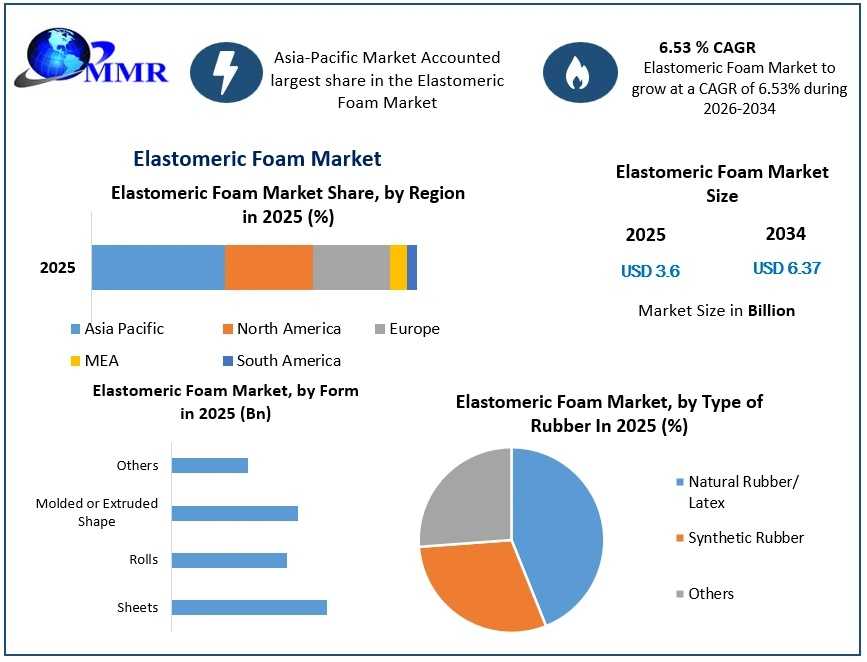
- Global market valued at USD 3.6 billion in 2025.
- Market projected to reach USD 6.37 billion by 2034.
- CAGR estimated at 6.53% during 2026–2034.
- HVAC remains the largest application segment.
- Synthetic rubber dominates material demand.
- Asia Pacific leads both production and consumption.
- Rising building efficiency standards support insulation demand.
- Automotive electrification expands high-performance foam applications.
Why This Matters Now
Governments are tightening building energy regulations while manufacturers seek lighter, safer, and more durable insulation materials. Elastomeric foam addresses thermal efficiency, condensation control, acoustic insulation, and sustainability requirements simultaneously. Growing investments in HVAC systems, electric vehicles, and industrial infrastructure are expanding its addressable market across developed and emerging economies.
Market Overview
The elastomeric foam market supplies flexible closed-cell insulation materials for HVAC systems, automotive components, electrical equipment, industrial facilities, and commercial buildings. Products are manufactured primarily from synthetic rubber formulations including NBR and EPDM that deliver moisture resistance, thermal insulation, and long service life.
Demand is being driven by stricter energy-efficiency standards, expanding construction activity, and increasing HVAC installations. Building owners are prioritizing insulation solutions that reduce operational energy costs while extending equipment life.
Supply conditions continue to improve through manufacturing expansion across Asia Pacific. However, producers remain exposed to price fluctuations in petrochemical feedstocks including nitrile butadiene rubber, EPDM, and chloroprene rubber, creating pressure on production costs.
Urbanization, industrial modernization, and investments in sustainable infrastructure continue to reshape long-term market demand.
Key Trends Driving Growth
Energy-Efficient Building Technologies
Construction companies increasingly specify high-performance insulation to reduce heating and cooling losses. Elastomeric foam supports compliance with stricter energy codes while lowering lifecycle operating costs.
Advanced HVAC Applications
Modern HVAC installations require insulation that resists condensation, minimizes thermal losses, and maintains performance over long operating periods. This strengthens demand from commercial and industrial facilities.
Sustainability Initiatives
Manufacturers are introducing low-smoke, halogen-free, and environmentally responsible insulation products. Sustainability certifications are becoming competitive differentiators as environmental regulations tighten.
Raw Material Price Volatility
Fluctuating prices of synthetic rubber feedstocks continue to affect manufacturing costs. Producers are improving procurement strategies and operational efficiency to maintain profitability.
Automotive Electrification
Electric vehicle manufacturers increasingly require lightweight insulation materials for thermal management, vibration control, and passenger comfort. This creates new opportunities beyond conventional automotive applications.
Explore detailed analysis, insights, and growth opportunities : https://www.maximizemarketresearch.com/request-sample/30554/
Segment Insights
Dominant Segment: HVAC
HVAC represented the largest application segment in 2025.
Commercial buildings, manufacturing plants, hospitals, and residential developments continue expanding HVAC installations to improve indoor climate control and energy efficiency. Elastomeric foam minimizes heat loss, prevents condensation, and reduces maintenance requirements throughout system lifecycles.
Business impact:
Growing HVAC installations directly increase recurring insulation demand while supporting premium pricing for high-performance products.
Fastest-Growing Segment: Synthetic Rubber
Synthetic rubber is expected to maintain market leadership throughout the forecast period.
NBR remains the preferred material because of its oil resistance, affordability, and durability. EPDM continues gaining adoption where UV stability, weather resistance, and extended service life are required.
Business impact:
Manufacturers specializing in advanced synthetic formulations can expand margins through differentiated performance rather than commodity pricing.
Additional Key Segments
EPDM Products
Demand continues increasing for outdoor insulation applications requiring long-term weather resistance and lower thermal conductivity.
Sheets and Rolls
These formats remain widely adopted because they simplify installation across HVAC ducts, industrial pipelines, and commercial construction projects.
Automotive
Vehicle manufacturers increasingly integrate elastomeric foam into sealing systems, acoustic insulation, battery protection, and vibration management solutions.
Electrical & Electronics
Foam materials protect sensitive electronic components through thermal insulation, cushioning, and shock absorption, supporting demand from electronics manufacturing.
- Regional Growth Story
Asia Pacific
Asia Pacific dominates the global market due to rapid industrialization, expanding manufacturing capacity, rising infrastructure spending, and growing HVAC installations across China, India, Japan, and Southeast Asia.
The region also benefits from increasing automotive production and rising disposable income supporting commercial construction.
North America
Demand remains supported by building retrofits, industrial modernization, and replacement of aging HVAC infrastructure. Energy efficiency regulations continue encouraging insulation upgrades.
Europe
Europe's transition toward low-carbon heating systems is accelerating elastomeric foam adoption. Heat pump installations and stricter building efficiency standards are increasing insulation requirements across residential and commercial projects.
Middle East, Africa and South America
Urban development, commercial construction, and industrial investments are gradually expanding insulation demand, although market penetration remains lower than in developed regions.
Competitive Landscape
Competition is centered on product performance, manufacturing capacity, sustainability, and geographic expansion.
Armacell continues strengthening its market position through product innovation, manufacturing expansion, and sustainability certifications. Its investments in advanced insulation technologies reinforce leadership across HVAC, industrial, and marine applications.
Zotefoams is expanding production capabilities and integrating acquisitions to increase high-performance foam output while improving regional supply coverage.
Manufacturers including K-Flex, Kaimann, NMC, Huamei Energy-Saving Technology, Sekisui Plastics, and Aeroflex USA continue competing through specialized insulation products, regional manufacturing expansion, and application-specific solutions across construction, transportation, and industrial markets.
Industry competition is increasingly shifting toward environmentally compliant insulation technologies rather than price-based differentiation.
Recent Developments
- June 2025: Armacell received IMO certification for NH/ArmaFlex Smart C halogen-free insulation sheets, expanding marine application opportunities.
- June 2025: Armacell opened a new aerogel and technical insulation manufacturing facility in Pune, India, significantly increasing production capacity.
- December 2025: Armacell earned a Silver EcoVadis Sustainability Medal, strengthening its environmental positioning.
- March 2025: Armacell introduced ArmaFlex Ultima insulation across North America to address evolving fire safety requirements.
- April 2026: Zotefoams expanded manufacturing operations following the integration of Overseas Konstellation Company, increasing revenue through technical insulation growth.
Future Outlook
Companies investing in sustainable insulation technologies, advanced synthetic materials, and Asia Pacific manufacturing capacity will capture the strongest long-term opportunities as global energy-efficiency standards continue to tighten.
Explore More: Visit our website for Additional reports :
Global Cosmetic Dyes Market https://www.maximizemarketresearch.com/market-report/global-cosmetic-dyes-market/33130/
Global Azadirachtin Market https://www.maximizemarketresearch.com/market-report/global-azadirachtin-market/109615/
About Maximize Market Research
Maximize Market Research Pvt. Ltd. (MMR) is a global market research and consulting company that provides reliable, data-focused, and practical business insights. The firm serves a wide range of industries, including healthcare, pharmaceuticals, technology, automotive, electronics, chemicals, personal care, and consumer goods. Through market forecasts, competitive analysis, strategic consulting, and industry impact assessments, MMR helps organizations understand changing market conditions, identify growth opportunities, and make informed business decisions for long-term success.
Contact Us :
2nd Floor, Navale IT Park Phase 3
Pune Banglore Highway, Narhe
Pune, Maharashtra 411041, India
+91 9607365656
sales@maximizemarketresearch.com
Author Bio
Article Comments
No Comments!
At present there are zero comments on this article.
Why not be the first to make a comment?
Similar Articles
Search Pages
User Upgrade
account to full use of editor,
Including hyperlinks
Article Categories
There are zero sub-categories in this parent category.
There are zero sub-categories in this parent category.