Cellulosic Ethanol Market Insights: Technology Breakthroughs Transform Renewable Fuel Production

Key Highlights
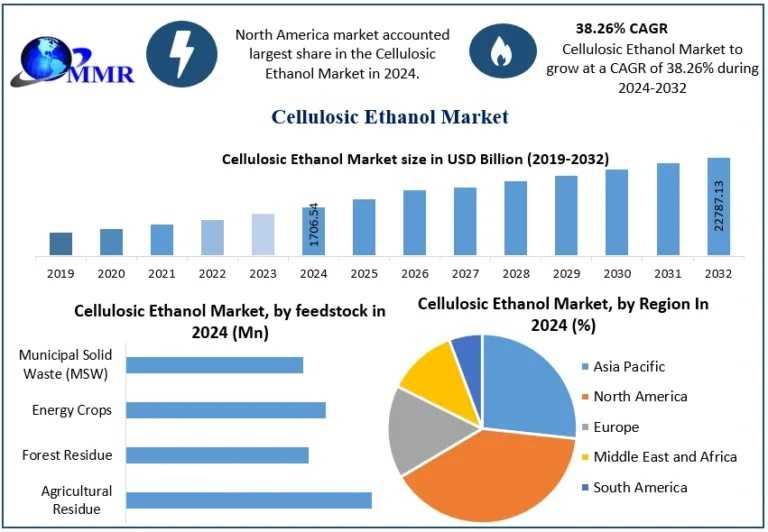
- The Cellulosic Ethanol Market was valued at USD 1,706.54 million in 2024.
- The market is forecast to reach USD 22,787.13 million by 2032.
- CAGR is projected at 38.26% during 2025–2032.
- Energy crops remain the leading feedstock segment.
- Gasoline blending continues to dominate end-use demand.
- North America accounted for 35.2% of global revenue in 2024.
- Enzyme technology is reducing conversion costs and improving plant economics.
- Government renewable fuel policies continue to support commercial deployment.
- Infrastructure limitations remain the largest commercialization challenge.
Why This Matters Now
Governments are tightening emission standards while expanding renewable fuel mandates. Cellulosic ethanol addresses both carbon reduction and waste management by converting agricultural residues and non-food biomass into transport fuel. Unlike first-generation biofuels, it avoids direct competition with food production, making it increasingly attractive for policymakers, fuel producers, and investors seeking scalable decarbonization solutions. Improvements in enzyme efficiency and feedstock processing are also narrowing the cost gap with conventional ethanol, accelerating commercial investment.
Market Overview
Cellulosic ethanol Market is a second-generation biofuel produced from lignocellulosic biomass, including agricultural residues, forest waste, dedicated energy crops, and municipal solid waste. Unlike conventional ethanol derived from food crops, it utilizes non-edible biomass that would otherwise remain underutilized.
Market demand is primarily driven by rising renewable fuel consumption, stricter environmental regulations, and increasing investments in low-carbon transportation fuels. Governments continue to promote ethanol blending programs to reduce dependence on fossil fuels while improving energy security.
Supply dynamics are evolving as enzyme technologies improve biomass conversion efficiency. Higher ethanol yields and declining processing costs are making commercial-scale production increasingly feasible. However, feedstock logistics, transportation infrastructure, and expensive pre-treatment technologies continue to influence project economics.
Macroeconomic factors including energy security concerns, climate commitments, carbon reduction targets, and growing investment in circular economy initiatives are strengthening long-term demand for advanced biofuels.
Key Trends Driving Growth
Enzyme Technology Improves Commercial Economics
Advancements in enzyme engineering have significantly increased biomass conversion rates while lowering enzyme consumption. Higher production efficiency reduces operating costs, making commercial-scale facilities more competitive against conventional ethanol producers.
Renewable Fuel Policies Drive Investment
National renewable fuel standards and emission reduction targets continue to encourage investments in advanced biofuel capacity. Government incentives reduce investment risk while supporting commercialization of second-generation ethanol technologies.
Waste Biomass Supports Circular Economy
Agricultural waste, forestry residues, and municipal solid waste are increasingly viewed as valuable feedstocks rather than disposal liabilities. This transition creates additional revenue streams for agricultural producers while reducing landfill dependence and greenhouse gas emissions.
Feedstock Economics Remain Critical
Feedstock accounts for the largest share of production costs, representing more than 60% of current commercial operating expenses. Companies continue investing in supply chain optimization to improve long-term profitability.
Transportation Infrastructure Remains a Constraint
Unlike petroleum fuels, cellulosic ethanol requires dedicated transportation and storage infrastructure. Limited distribution networks increase logistics costs and slow market penetration in regions lacking established ethanol supply chains.
Explore detailed analysis, insights, and growth opportunities
Segment Insights
Dominant Segment: Energy Crops
Energy crops account for the largest share of the feedstock market because they provide reliable biomass supply for commercial-scale ethanol production. Switchgrass and other dedicated energy crops offer consistent quality and predictable harvest cycles compared with seasonal agricultural residues.
The business impact is substantial. Stable feedstock availability reduces production disruptions, improves plant utilization rates, and supports long-term supply agreements between producers and biomass suppliers.
Fastest-Growing Segment: Gasoline Applications
Gasoline blending remains the dominant application as governments expand ethanol blending requirements to lower transportation emissions. Growing vehicle ownership and continued gasoline consumption maintain strong demand for ethanol blending components.
For refiners, higher ethanol blending supports regulatory compliance while reducing lifecycle carbon emissions without requiring significant vehicle modifications in lower blend applications.
Additional Feedstock Segments
Agricultural Residues continue gaining importance because corn stover, wheat straw, and crop waste are widely available and relatively inexpensive. Utilizing agricultural waste improves farm income while reducing residue disposal challenges.
Forest Residues provide an additional biomass source, particularly in regions with strong forestry industries. These materials improve feedstock diversification and reduce dependence on agricultural harvest cycles.
Municipal Solid Waste (MSW) presents long-term growth opportunities by combining waste management with renewable fuel production. Cities investing in waste-to-energy infrastructure may become significant feedstock suppliers.
Process Segmentation
Dry grind, wet mill, and other processing technologies continue evolving to improve ethanol recovery rates and reduce production costs. Technology selection increasingly depends on feedstock characteristics and regional biomass availability.
Regional Growth Story
North America
North America held 35.2% of global revenue in 2024, supported by abundant agricultural feedstock, mature ethanol infrastructure, and strong renewable fuel policies. The United States remains one of the world's largest ethanol producers, creating favorable conditions for commercial deployment of advanced biofuels.
The region benefits from established research capabilities, government incentives, and large-scale investments in enzyme technologies.
Europe
Europe represents the second-largest regional market as climate policies encourage advanced biofuel adoption. Commercialization of cellulosic biofuels continues to expand under renewable energy directives aimed at reducing transport sector emissions.
European producers increasingly focus on converting agricultural waste into transportation fuels while strengthening domestic energy security.
Asia Pacific
Asia Pacific offers substantial long-term growth potential due to abundant agricultural biomass, expanding energy demand, and rising government interest in reducing fossil fuel imports. Countries including China and India possess significant feedstock availability capable of supporting future commercial production.
South America
Brazil's established ethanol industry creates favorable conditions for integrating second-generation ethanol technologies with existing sugarcane processing infrastructure, improving production efficiency and maximizing biomass utilization.
Middle East & Africa
The region remains an emerging market where biofuel investments are gradually increasing alongside broader renewable energy diversification strategies.
Competitive Landscape
The Cellulosic Ethanol Market remains technology-driven, with competition centered on enzyme innovation, feedstock optimization, commercial-scale production capability, and integrated biomass supply chains.
Companies such as Raízen Energia, GranBio Group, POET - DSM Advanced Biofuels LLC, and Praj Industries leverage integrated production models to improve operating efficiency and reduce feedstock costs. Technology developers including Novozymes A/S continue strengthening their market position through advanced enzyme platforms that improve biomass conversion efficiency.
Major industrial participants including BP PLC, Clariant International Ltd., DowDuPont, Inc., INEOS Group AG, Aemetis Inc., Enerkem Inc., Iogen Corporation, Abengoa Bioenergy Corporation, Beta Renewables SpA, BlueFire Renewables, Inc., Borregaard ASA, Fiberight LLC, Alliance Bio-Products Inc., E.I. du Pont de Nemours and Company, ETIP Bioenergy, and Shandong Longlive Bio-Technology compete through technology development, production scale, and biomass processing expertise.
As commercialization expands, companies capable of integrating feedstock sourcing, enzyme technologies, and large-scale production are expected to strengthen competitive advantages while reducing production costs.
Recent Developments
- Commercial-scale enzyme technologies have improved biomass conversion efficiency.
- Industry participants continue investing in lignocellulosic biomass processing technologies.
- Commercial cellulosic ethanol plants are expanding production capabilities through advanced enzyme applications.
- Government support for renewable fuels continues encouraging investment in second-generation ethanol production.
- Manufacturers remain focused on lowering enzyme costs and improving feedstock conversion rates to enhance plant profitability.
Future Outlook
Companies that successfully combine low-cost biomass sourcing, advanced enzyme technologies, and scalable production infrastructure will capture the largest share of the rapidly expanding global cellulosic ethanol market while infrastructure bottlenecks remain the industry's primary competitive risk.
Explore More: Visit our website for Additional reports :
Global Wood Vinegar Market https://www.maximizemarketresearch.com/market-report/global-wood-vinegar-market/66938/
Organic Yogurt Market https://www.maximizemarketresearch.com/market-report/organic-yogurt-market/196190/
About Maximize Market Research
Maximize Market Research Pvt. Ltd. (MMR) is a global market research and consulting company that provides reliable, data-focused, and practical business insights. The firm serves a wide range of industries, including healthcare, pharmaceuticals, technology, automotive, electronics, chemicals, personal care, and consumer goods. Through market forecasts, competitive analysis, strategic consulting, and industry impact assessments, MMR helps organizations understand changing market conditions, identify growth opportunities, and make informed business decisions for long-term success.
Contact Us :
2nd Floor, Navale IT Park Phase 3
Pune Banglore Highway, Narhe
Pune, Maharashtra 411041, India
+91 9607365656
sales@maximizemarketresearch.com
Author Bio
Article Comments
No Comments!
At present there are zero comments on this article.
Why not be the first to make a comment?
Similar Articles
Search Pages
User Upgrade
account to full use of editor,
Including hyperlinks
Article Categories
There are zero sub-categories in this parent category.
There are zero sub-categories in this parent category.