Metal And Ceramic Injection Molding Market Strengthens With Expanding Global Manufacturing

Key Highlights
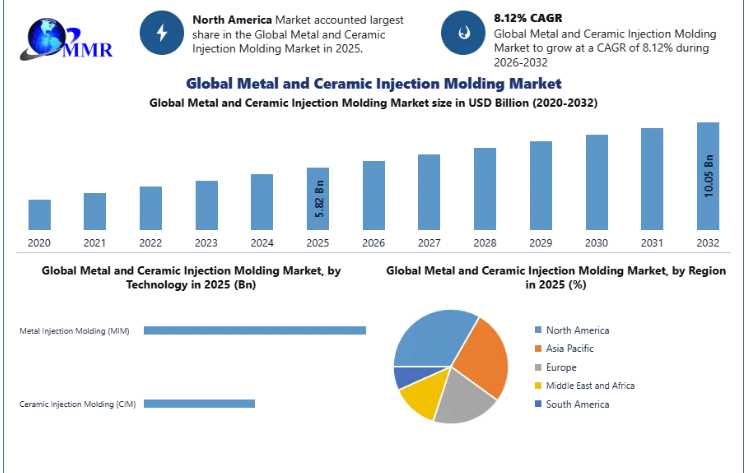
- Market valued at USD 5.82 billion in 2025.
- Expected to reach USD 10.05 billion by 2032.
- Forecast CAGR stands at 8.12% during 2026–2032.
- Medical and healthcare remains the largest application segment.
- Zirconia leads the material segment due to superior mechanical performance.
- North America accounts for nearly 40% of global market demand.
- Automotive manufacturing continues to generate the largest volume requirements.
- Automation and advanced material innovation are improving production efficiency.
- Supply chain localization is driving new manufacturing investments.
Why This Matters Now
Manufacturers across healthcare, automotive, aerospace, and electronics are replacing conventional machining with injection molding technologies capable of producing intricate, lightweight, and high-strength components at scale. Material innovation, production automation, and regional manufacturing expansion are lowering production costs while improving quality consistency. Companies investing in advanced powder technologies and automated production lines are strengthening their competitive position as demand for precision-engineered components increases.
Market Overview
The Metal and Ceramic Injection Molding Market combines powder metallurgy with plastic injection molding to manufacture highly complex metal and ceramic components with exceptional dimensional accuracy. The technology enables large-scale production while minimizing material waste and secondary machining requirements.
Demand continues to increase as manufacturers seek lightweight, durable, and corrosion-resistant components for medical devices, automotive systems, aerospace assemblies, industrial machinery, and consumer electronics.
Medical manufacturers increasingly rely on stainless steel and advanced ceramic materials because of their strength, wear resistance, and biocompatibility. Automotive manufacturers are expanding adoption to reduce production costs while improving component precision.
Growing interest in renewable biomaterials and sustainable manufacturing is creating additional opportunities for ceramic materials. At the same time, rising crude oil prices and increasing environmental concerns are encouraging industries to replace conventional plastic components with higher-performance alternatives.
However, manufacturing complexity, process limitations, and shortages of experienced molding professionals remain significant barriers for new market entrants.
Key Trends Driving Growth
Advanced Material Innovation
Manufacturers continue developing high-performance stainless steel powders, titanium alloys, and advanced ceramics that improve strength, corrosion resistance, and product durability. These innovations expand applications across medical implants, aerospace systems, and industrial equipment.
Hybrid Manufacturing Technologies
Companies are integrating ceramic injection molding with additive manufacturing to accelerate product development. Hybrid production reduces prototype lead times and enables faster commercialization of customized precision components.
Sustainability Becomes a Competitive Advantage
Manufacturers are investing in biomaterials and low-waste production technologies to meet environmental objectives. Injection molding naturally produces less material waste than conventional machining, improving resource efficiency.
Binder System Improvements
New binder technologies reduce distortion during ceramic sintering, improving production yields for complex geometries. Higher production efficiency directly lowers manufacturing costs and increases profitability.
Regional Manufacturing Expansion
Manufacturers are establishing production facilities closer to end markets to improve supply chain resilience and reduce transportation costs. This strategy has become increasingly important following recent global supply chain disruptions.
Explore detailed analysis, insights, and growth opportunities : https://www.maximizemarketresearch.com/request-sample/55157/
Segment Insights
Dominant Segment: Medical and Healthcare
Medical and healthcare represents the largest application segment because manufacturers require highly precise, corrosion-resistant, and biocompatible components. Surgical instruments, orthopedic implants, dental products, and diagnostic equipment increasingly utilize metal and ceramic injection molding technologies.
The business impact is significant. Healthcare customers demand strict quality standards, creating higher-value manufacturing contracts and long-term supplier relationships. Rising healthcare investments further strengthen demand for advanced molding technologies.
Fastest-Growing Segment: Zirconia Materials
Zirconia dominates the material segment owing to its exceptional fracture toughness, wear resistance, high strength, and biocompatibility.
Demand continues expanding across medical implants, dental restorations, luxury products, electronics, and industrial precision components. Improved ceramic processing technologies have enhanced production quality while reducing manufacturing defects.
The commercial impact is substantial because Zirconia products command premium pricing and support higher operating margins compared with conventional materials.
Automotive Applications
Automotive manufacturing accounts for approximately 45% of overall market demand. Vehicle manufacturers increasingly require lightweight, complex, and durable components that improve fuel efficiency and production economics.
Injection molding enables mass production while maintaining consistent dimensional accuracy, making it suitable for modern automotive manufacturing.
Industrial Machinery
Industrial equipment manufacturers continue adopting precision-molded components to improve equipment reliability, reduce maintenance requirements, and extend operational life.
Aerospace and Consumer Products
Aerospace manufacturers benefit from lightweight, high-strength components capable of operating under demanding conditions. Consumer product manufacturers utilize injection molding to produce intricate premium-quality components with excellent surface finishes.
Regional Growth Story
North America
North America remains the largest regional market, representing roughly 40% of global demand.
Advanced manufacturing infrastructure, strong healthcare investment, aerospace production, and continuous technology development across the United States and Canada support market leadership. Regional manufacturers continue investing in automation and advanced powder technologies to strengthen competitiveness.
Europe
Europe benefits from a mature automotive industry, established industrial manufacturing base, and growing medical device production. Innovation in sustainable manufacturing and advanced engineering continues supporting long-term demand.
Asia Pacific
Asia Pacific is becoming an increasingly important production hub due to rapid industrialization, expanding automotive manufacturing, rising electronics production, and growing healthcare infrastructure.
China, Japan, South Korea, and India continue attracting investments because of competitive manufacturing costs and expanding domestic demand.
Middle East, Africa, and South America
These regions remain emerging markets with increasing industrialization and infrastructure development. Growing manufacturing investments and healthcare modernization are creating new opportunities for injection molding suppliers.
Competitive Landscape
Competition remains concentrated among established manufacturers possessing advanced material expertise, integrated manufacturing capabilities, and global production networks.
Indo-MIM continues strengthening its international manufacturing footprint through regional capacity expansion, improving delivery performance for North American automotive customers.
ARBURG is differentiating through hybrid manufacturing technologies that combine ceramic injection molding with additive manufacturing, enabling faster product development and greater manufacturing flexibility.
Morgan Advanced Materials, Plansee Group, GKN Powder Metallurgy, and CoorsTek maintain competitive advantages through extensive material research, broad product portfolios, and strong customer relationships across industrial and medical sectors.
Specialized manufacturers including OECHSLER AG, CMG Technologies, ARC Group Worldwide, Epson Atmix Corporation, and ATW Companies continue investing in automation, advanced powders, and precision manufacturing to expand market share.
The competitive environment increasingly favors companies capable of combining advanced material science with automated, high-volume production while maintaining stringent quality standards.
Recent Developments
- 18 February 2026 – Formetrix: Introduced high-performance stainless steel powders designed for metal injection molding, improving strength and corrosion resistance for medical and automotive applications.
- 12 January 2026 – ARBURG: Launched the Freeformer 300-3X hybrid manufacturing system integrating ceramic injection molding with additive manufacturing, reducing prototype lead times by 40%.
- 05 November 2025 – Indo-MIM: Opened a fully automated manufacturing facility in Mexico, strengthening North American supply chain capabilities and reducing logistics costs.
- 14 May 2025 – CeramTec: Developed an advanced ceramic binder system that significantly reduces sintering distortion, improving manufacturing yields and lowering production waste for complex ceramic components.
Future Outlook
Companies that combine advanced material innovation, manufacturing automation, and regional production expansion will capture the greatest value as demand for precision-engineered medical, automotive, and industrial components accelerates toward 2032.
About Maximize Market Research
Maximize Market Research Pvt. Ltd. (MMR) is a global market research and consulting company that provides reliable, data-focused, and practical business insights. The firm serves a wide range of industries, including healthcare, pharmaceuticals, technology, automotive, electronics, chemicals, personal care, and consumer goods. Through market forecasts, competitive analysis, strategic consulting, and industry impact assessments, MMR helps organizations understand changing market conditions, identify growth opportunities, and make informed business decisions for long-term success.
Contact Us :
2nd Floor, Navale IT Park Phase 3
Pune Banglore Highway, Narhe
Pune, Maharashtra 411041, India
+91 9607365656
sales@maximizemarketresearch.com
Author Bio
Article Comments
No Comments!
At present there are zero comments on this article.
Why not be the first to make a comment?
Similar Articles
Search Pages
User Upgrade
account to full use of editor,
Including hyperlinks
Article Categories
There are zero sub-categories in this parent category.
There are zero sub-categories in this parent category.