Organic Baby Food Market Set For Strong Growth As Demand For Natural Infant Nutrition Rises

evenue Growth Outlook
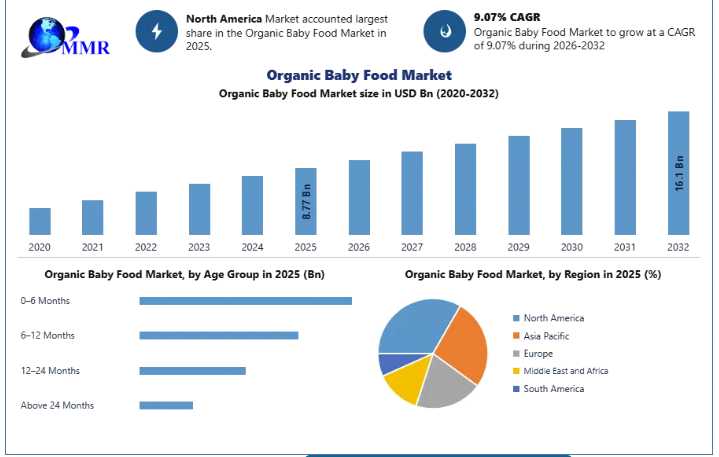
The Global Organic Baby Food Market was valued at USD 8.77 billion in 2025. According to the latest market assessment by Maximize Market Research, the market is projected to grow at a CAGR of 9.07% from 2026 to 2032, reaching approximately USD 16.1 billion by 2032. The report covers historical data from 2020 to 2025 and provides forecasts for 2026–2032.
The market's expansion is supported by increasing parental awareness of infant nutrition, growing preference for natural and chemical-free food products, rising demand for convenient feeding solutions, and a broader shift toward sustainable consumption.
Market Overview
The organic baby food industry is undergoing a significant transformation as parents increasingly prioritize nutrition, product safety, ingredient transparency, and sustainability. The market includes organic infant milk formula, wet food, dry food, cereals, purees, snacks, and other products designed to meet the nutritional requirements of infants and young children.
Growing awareness of the importance of nutrition during early childhood is one of the primary market growth drivers. Parents are increasingly examining food ingredients and production practices and are showing greater interest in products perceived as free from synthetic pesticides, genetically modified ingredients, and unnecessary additives.
Sustainability is also becoming an important purchasing consideration. Demand for locally sourced organic ingredients and environmentally responsible production reflects a wider movement toward ethical and sustainable food consumption.
Product diversification represents another important trend. Manufacturers are expanding beyond traditional baby food products by introducing innovative purees, nutritious snacks, ready-to-eat meals, and products designed around specific nutritional requirements. This diversification enables brands to serve different age groups and changing parental preferences.
However, premium pricing remains a major challenge. Organic production generally requires specialized farming practices, organic fertilizers, certification, and strict controls, increasing production costs. Shorter shelf life can also create additional storage, transportation, inventory, and wastage challenges.
Government initiatives present an important opportunity for market participants. Regulatory standards, organic certification frameworks, financial incentives, and consumer awareness programs can improve consumer confidence while encouraging organic agricultural production and supply availability.
Scope and Methodology
The research evaluates the global organic baby food industry through a combination of market structure analysis, competitive assessment, regional evaluation, segmentation analysis, industry dynamics, regulatory review, and market forecasting.
The study covers the period from 2020 to 2032, including historical market analysis through 2025 and forecast analysis for 2026–2032. The report evaluates market performance at global and regional levels and provides country-level analysis across major geographic markets.
The analytical framework includes:
- Market definition and study assumptions
- Industry structure and competitive landscape
- Market drivers, restraints, opportunities, and challenges
- Regional market dynamics
- Product and ingredient segmentation
- Packaging and age-group analysis
- Distribution-channel assessment
- Regulatory landscape
- Porter’s Five Forces analysis
- PESTLE analysis
- Technology roadmap
- Government schemes and initiatives
- Trade analysis
- Competitive benchmarking
- Company profiling and strategic analysis
The report also includes market-size and forecast analysis by product type, ingredient type, packaging type, age group, distribution channel, and region. Its competitive assessment covers company portfolios, business segments, revenue analysis, strategic positioning, partnerships, certifications, SWOT analysis, and recent developments.
Regional Analysis
North America
North America dominated the global organic baby food market in 2025. High disposable incomes and strong consumer awareness of child nutrition support demand for premium organic products. Parents in the region increasingly view organic baby food as a healthier and more nutritious alternative to conventional products. Government policies supporting organic food production and consumption also contribute to market accessibility.
The regional analysis covers the United States, Canada, and Mexico, with individual segmentation across product type, ingredient type, packaging, age group, and distribution channel.
Europe
Europe represents a strong market for premium organic baby food, supported by stringent organic standards and established consumer trust in certified products. Countries including the United Kingdom, France, Germany, Italy, Spain, Sweden, and Austria are covered in the report.
Brands such as HiPP, Holle, and Lebenswert have established strong positions through organic and biodynamic sourcing. Demand spans infant formulas, cereals, fruit pouches, and other organic products.
Asia Pacific
Asia Pacific represents an important growth opportunity as consumer awareness, urbanization, changing lifestyles, and demand for convenient nutrition products increase. The report evaluates China, South Korea, Japan, India, Australia, Indonesia, Malaysia, Vietnam, Taiwan, Bangladesh, Pakistan, and the rest of Asia Pacific.
The region also presents opportunities for manufacturers targeting emerging consumer segments through localized products, convenient packaging, online distribution, and affordable organic offerings.
Middle East and Africa
The Middle East and Africa market is assessed across South Africa, GCC countries, Egypt, Nigeria, and other markets. Growth opportunities are associated with increasing awareness of premium nutrition products and the expansion of modern retail and specialized food distribution.
South America
South America is analyzed through Brazil, Argentina, and the rest of South America. Rising consumer awareness and expanding availability of organic food products create opportunities for manufacturers and distributors.
Explore detailed analysis, insights, and growth opportunities : https://www.maximizemarketresearch.com/request-sample/221143/
Market Segmentation
The Organic Baby Food Market is segmented into product type, ingredient type, packaging type, age group, distribution channel, and region.
By Product Type
- Wet Food
- Infant Milk Formula
- Dry Food
- Others
Wet food dominated the product-type segment in 2025. Purees and jarred products benefit from their convenience, smooth texture, portion control, and perceived nutritional advantages.
Meanwhile, infant milk formula is identified as the fastest-growing product segment, supported partly by changing lifestyles and the increasing working-women population, which increases demand for convenient feeding solutions.
By Ingredient Type
- Fruits
- Vegetables
- Grains & Cereals
- Dairy
- Meat & Fish
- Others
Ingredient diversification allows manufacturers to address different nutritional requirements while providing parents with greater product choice.
By Packaging Type
- Pouches
- Jars/Bottles
- Others
Convenient and hygienic packaging remains important because baby food products require strong protection, portion control, storage convenience, and ease of consumption.
By Age Group
- 0–6 Months
- 6–12 Months
- 12–24 Months
- Above 24 Months
The 6–12 months segment accounted for more than 57.2% of the market in 2025, according to the report. This period represents an important transition toward solid foods, increasing demand for organic purees and other easily digestible products.
By Distribution Channel
- Supermarkets/Hypermarkets
- Speciality Stores
- Online Sales Channels
- Others
The combination of traditional retail, specialty organic stores, and online channels allows brands to reach consumers across different purchasing preferences and geographic markets.
Key Players
The global organic baby food market features a mix of established multinational food and nutrition companies, specialized organic brands, and emerging manufacturers. Key companies profiled by the report include Hipp Holdings, Organix Brands Ltd., The Hain Celestial Group, Inc., Plum, PBC, Healthy Sprouts Foods, Baby Gourmet Foods Inc., Abbott Nutrition, Nestlé S.A., Happy Family Organics, Little Duck Organics, Olli, Earth's Best, Amara Organic Foods, Bellamy's Organic, Ella's Kitchen, Danone, Sprout Organic Foods, Pristine Organics Pvt. Ltd., Yashili International Group Co., Ltd., Kewpie Corporation, AAK AB, Arla Foods, Kraft Heinz Canada ULC, Hero Group, and Lactalis, among others.
Competition is shaped by product innovation, portfolio expansion, sustainability initiatives, strategic partnerships, mergers and acquisitions, and investments in research and development.
Recent industry developments highlighted in the report include Nestlé's investment of approximately USD 100 million in an infant nutrition research facility in Switzerland in May 2024 and Danone's acquisition of a majority stake in Kate Farms in May 2025, strengthening its position in specialized, plant-based nutrition.
The competitive landscape also includes innovations such as science-backed baby foods, plant-based organic products, specialized infant purees, and sustainability-focused product lines.
Key Questions Answered
The report addresses major strategic questions, including:
- What is the current size of the global Organic Baby Food Market?
- What will be the market size by 2032?
- What CAGR will the market achieve during 2026–2032?
- What are the primary factors driving market growth?
- What challenges and restraints could limit market expansion?
- Which product type currently dominates the market?
- Which segment is expected to grow at the fastest rate?
- How is demand distributed across different age groups?
- Which ingredients and packaging formats represent important opportunities?
- How are supermarkets, specialty stores, and online channels contributing to market development?
- Which region currently dominates the global market?
- What opportunities exist across North America, Europe, Asia Pacific, the Middle East and Africa, and South America?
- Who are the leading companies competing in the organic baby food industry?
- What strategies are companies using to strengthen their competitive positions?
- How are regulations, government initiatives, sustainability, and consumer preferences influencing the industry?
- What emerging trends are expected to shape the market through 2032?
Key Offerings of the Report
The Organic Baby Food Market report provides a comprehensive framework for understanding market growth and competitive opportunities. Major deliverables include:
- Global market size and revenue forecasts for 2025–2032
- CAGR analysis for 2026–2032
- Historical market assessment from 2020–2025
- Product-type segmentation
- Ingredient-type segmentation
- Packaging-type analysis
- Age-group analysis
- Distribution-channel analysis
- Regional and country-level market forecasts
- Regional drivers, restraints, opportunities, and challenges
Explore More: Visit our website for Additional reports :
Global Functional Foods and Drinks Market https://www.maximizemarketresearch.com/market-report/global-functional-foods-and-drinks-market/113698/
India Fumigation Products Market https://www.maximizemarketresearch.com/market-report/india-fumigation-products-market/40417/
About Maximize Market Research
Maximize Market Research Pvt. Ltd. (MMR) is a global market research and consulting company that provides reliable, data-focused, and practical business insights. The firm serves a wide range of industries, including healthcare, pharmaceuticals, technology, automotive, electronics, chemicals, personal care, and consumer goods. Through market forecasts, competitive analysis, strategic consulting, and industry impact assessments, MMR helps organizations understand changing market conditions, identify growth opportunities, and make informed business decisions for long-term success.
Contact Us :
2nd Floor, Navale IT Park Phase 3
Pune Banglore Highway, Narhe
Pune, Maharashtra 411041, India
+91 9607365656
sales@maximizemarketresearch.com
Author Bio
Article Comments
No Comments!
At present there are zero comments on this article.
Why not be the first to make a comment?
Similar Articles
Search Pages
User Upgrade
account to full use of editor,
Including hyperlinks
Article Categories
There are zero sub-categories in this parent category.
There are zero sub-categories in this parent category.