Mosquito Repellent Market Set For Strong Growth Through 2034

Revenue Growth Outlook
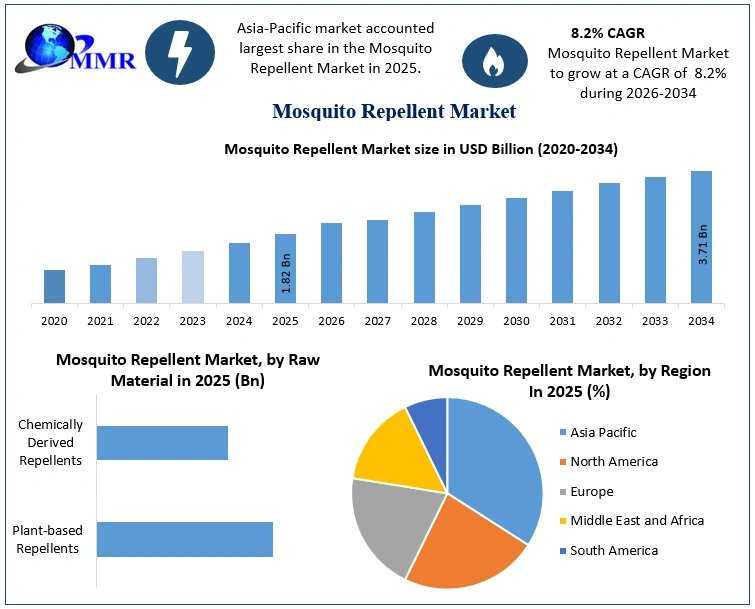
The global Mosquito Repellent Market was valued at USD 1.82 billion in 2025 and is expected to reach approximately USD 3.71 billion by 2034, expanding at a CAGR of 8.2% during 2026–2034. The market's expansion is closely associated with increasing mosquito-borne diseases, rising consumer awareness regarding personal protection, growing demand for plant-based repellents, and the introduction of innovative household and personal mosquito-control products.
The study uses 2025 as the base year, historical data from 2020–2025, and forecasts the market through 2034.
Market Overview
Mosquito repellents are products designed to prevent mosquitoes from approaching or biting humans. They are available in multiple formats, including sprays, creams, oils, coils, mats, and other household or personal-protection solutions. Repellent formulations generally contain an active ingredient that discourages mosquitoes and supporting ingredients that help deliver the active compound effectively.
The increasing prevalence of mosquito-borne diseases is one of the most significant factors supporting market growth. Diseases associated with mosquito transmission, including malaria, dengue, Zika, West Nile virus, and chikungunya, continue to create demand for effective preventive products. The resulting emphasis on household pest control and personal protection is expected to sustain consumption through the forecast period.
Another major trend is the growing consumer preference for plant-based and comparatively mild mosquito repellents. Ingredients derived from plants and essential oils, particularly citronella, are increasingly incorporated into natural repellent products. This trend is supported by consumers seeking alternatives to conventional chemical formulations.
At the same time, concerns regarding certain active chemical ingredients are encouraging manufacturers to explore alternative formulations. The MMR report identifies consumer interest in ingredients such as picaridin and IR3535 as one response to concerns surrounding conventional chemical repellents. Regulatory requirements governing insect-repellent products also influence product development, testing, commercialization, and market access across different countries.
Product innovation is another important market development. Recent industry activity includes botanical aerosol sprays, rechargeable mosquito-repellent devices, improved aerosol formulations, residential vector-control systems, and advanced liquid-vaporizer technologies. These developments indicate a shift toward products that combine effectiveness, convenience, longer protection, lower chemical exposure, and improved consumer experience.
Scope and Methodology
The MMR study provides a comprehensive evaluation of the global Mosquito Repellent Market, covering historical market performance, current market conditions, future forecasts, market dynamics, segmentation, regional developments, and competitive positioning. The study period extends from 2020 to 2034, with 2025 as the base year and 2026–2034 as the forecast period.
The research evaluates demand and supply conditions, industry trends, market drivers, restraints, opportunities, challenges, regulatory factors, and competitive developments. Market estimation and forecasting are supported by historical data analysis and evaluation of industry-specific factors affecting product adoption.
The analytical framework includes Porter's Five Forces, PESTEL analysis, technology-roadmap assessment, regulatory analysis, government initiatives, trade analysis, key opinion leader analysis, and competitive benchmarking. The report also evaluates companies based on product portfolios, pricing, financial position, growth strategies, and regional presence.
The market is analyzed across raw material, product, distribution channel, and regional segments, allowing stakeholders to assess demand patterns and identify high-growth opportunities.
Regional Analysis
Asia Pacific dominated the global Mosquito Repellent Market in 2025, accounting for approximately 42% of the market. The region's leading position is supported by large household populations, widespread mosquito-borne diseases, growing consumer awareness, and increasing availability of mosquito-repellent products. The growing number of manufacturers in the region is also contributing to market development.
China is a particularly important market within Asia Pacific because of its large household-repellent manufacturing base. The country's extensive consumer market and increasing demand for household pest-control solutions strengthen the region's overall position.
India and Southeast Asian countries such as Indonesia, Malaysia, and Vietnam also represent significant opportunities because of mosquito prevalence, tropical climates, urbanization, and increasing awareness of household and personal protection.
Middle East & Africa is expected to grow at approximately 6% CAGR during the forecast period. The region faces a substantial burden from mosquito-transmitted diseases, particularly malaria in Sub-Saharan Africa. Increasing disease awareness and demand for protective products are expected to support regional market growth.
North America represents an established market supported by consumer awareness, outdoor recreational activity, product innovation, and demand for convenient personal-protection solutions. The United States, Canada, and Mexico are included in the regional assessment.
Europe is characterized by established consumer markets and stringent regulatory requirements for insect-repellent products. The United Kingdom, France, Germany, Italy, Spain, Sweden, Austria, and other European markets are covered in the report.
South America also offers opportunities driven by mosquito-borne disease prevalence, consumer awareness, and demand for household pest-control products. Brazil and Argentina are among the markets covered in the regional analysis.
Explore detailed analysis, insights, and growth opportunities : https://www.maximizemarketresearch.com/request-sample/42235/
Market Segmentation
The Mosquito Repellent Market is segmented by raw material, product, distribution channel, and region.
By Raw Material
- Plant-based Repellents
- Chemically Derived Repellents
Plant-based repellents are gaining attention as consumers increasingly seek products perceived as more natural and skin-friendly. Citronella and other plant-derived ingredients are widely used in natural repellent formulations.
Chemically derived repellents remain important because of their established efficacy and broad availability. However, regulatory requirements and consumer concerns regarding certain chemicals are encouraging manufacturers to develop safer and more consumer-friendly formulations.
By Product
- Spray
- Cream & Oil
- Coil
- Mat
- Others
The Spray segment dominated the market in 2025 with approximately 35% share. Demand is supported by the availability of herbal and skin-friendly sprays, convenient application, and consumer preference for products offering effective protection with reduced irritation.
The Coil segment is projected to grow at approximately 5% CAGR during the forecast period, supported by continued use in rural areas and outdoor applications.
By Distribution Channel
- Online
- Offline
The Offline segment held approximately 62% market share in 2025, supported by easy product availability through pharmacies, supermarkets, hypermarkets, convenience stores, and other retail outlets.
The Online segment is expected to grow as smartphone and internet penetration increases. Discounts, convenient payment options, wider product selection, and home delivery are supporting the expansion of online mosquito-repellent sales.
Key Players
The competitive landscape includes global consumer-goods companies, household insecticide manufacturers, personal-care companies, and specialized repellent producers. Key players identified in the MMR report include:
- Reckitt Benckiser Group plc.
- Godrej Household Products Ltd.
- S. C. Johnson & Son, Inc.
- Dabur International Limited
- Jyothy Laboratories Ltd.
- Spectrum Brands Holdings Inc.
- Quantum Health
- Enesis Group
- Coghlan's Ltd
- PIC Corporation
- Avon Products Inc.
- Sawyer Products, Inc.
- Himalaya Herbals
- Johnson & Johnson Services, Inc.
- BASF SE
- 3M Company
Competition is increasingly focused on product efficacy, consumer safety, formulation innovation, natural ingredients, convenience, brand recognition, distribution reach, and geographic expansion. Manufacturers are also investing in new delivery formats and advanced active ingredients to address changing consumer expectations.
Recent developments demonstrate this competitive shift. Reckitt expanded its Mortein portfolio with botanical aerosol sprays in Southeast Asia, Thermacell introduced a rechargeable mosquito-repellent device, Godrej Consumer Products introduced an upgraded Kala HIT spray, and Mosqitter launched a residential vector-control device in the United States. Further developments from S.C. Johnson and Godrej demonstrate continued investment in differentiated formulations and product technologies.
Key Questions Answered
- What is the current size of the global Mosquito Repellent Market?
- What market size is expected by 2034?
- What CAGR is projected during 2026–2034?
- Which region held the largest market share in 2025?
- What are the major factors driving mosquito-repellent demand?
- How are mosquito-borne diseases influencing market growth?
- What is driving demand for plant-based mosquito repellents?
- Which product segment currently dominates the market?
- Why is the spray segment leading the market?
- How are coils expected to perform during the forecast period?
- Which distribution channel holds the largest market share?
- How is e-commerce changing mosquito-repellent sales?
- What regulatory factors influence the industry?
- Who are the leading companies operating in the market?
- What product innovations are shaping competitive strategies?
- Which regions and countries offer the strongest growth opportunities?
Key Offerings of the Report
The MMR report provides a detailed assessment of the global Mosquito Repellent Market, including market forecasts, industry dynamics, segmentation, regional analysis, competitive positioning, regulatory assessment, and strategic insights. The report forecasts the market from 2026 to 2034, with revenue expected to increase from USD 1.82 billion in 2025 to nearly USD 3.71 billion by 2034 at an 8.2% CAGR.
Major report deliverables include:
- Global market size and revenue forecasts through 2034
- Historical analysis covering 2020–2025
- Raw-material segmentation
- Product-level market analysis
- Distribution-channel analysis
- Regional and country-level forecasts
- Market drivers, restraints, opportunities, and challenges
- Competitive landscape analysis
- Company benchmarking
- Market leaders, followers, and emerging-player assessment
- Porter's Five Forces analysis
- PESTEL analysis
- Technology roadmap
About Maximize Market Research :
Maximize Market Research Pvt. Ltd. (MMR) is a global market research and consulting company that provides reliable, data-focused, and practical business insights. The firm serves a wide range of industries, including healthcare, pharmaceuticals, technology, automotive, electronics, chemicals, personal care, and consumer goods. Through market forecasts, competitive analysis, strategic consulting, and industry impact assessments, MMR helps organizations understand changing market conditions, identify growth opportunities, and make informed business decisions for long-term success.
Contact Us :
2nd Floor, Navale IT Park Phase 3
Pune Banglore Highway, Narhe
Pune, Maharashtra 411041, India
+91 9607365656
sales@maximizemarketresearch.com
Author Bio
Article Comments
No Comments!
At present there are zero comments on this article.
Why not be the first to make a comment?
Similar Articles
Search Pages
User Upgrade
account to full use of editor,
Including hyperlinks
Article Categories
There are zero sub-categories in this parent category.
There are zero sub-categories in this parent category.