Cork Material Market: Innovation, Sustainability And Emerging Opportunities

Revenue Growth Outlook
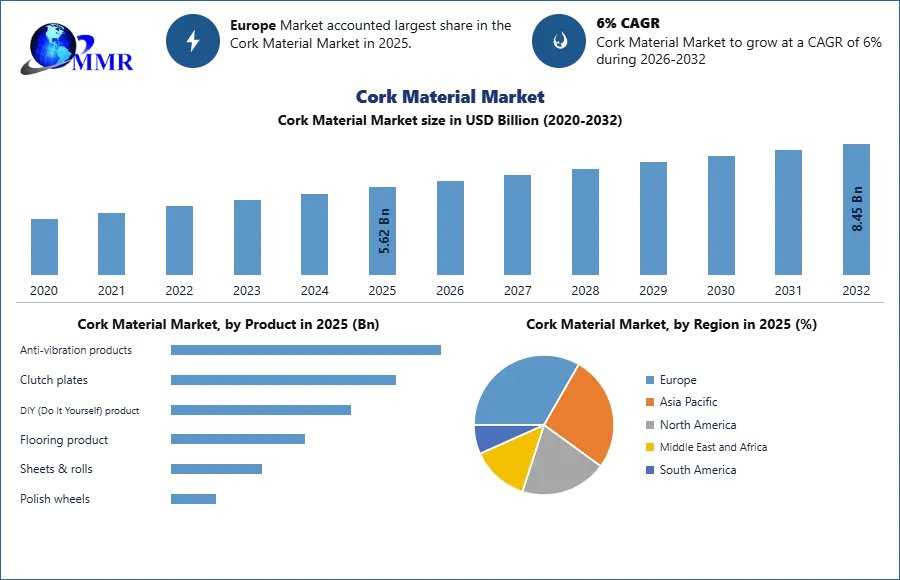
The Global Cork Material Market was valued at USD 5.62 Billion in 2025 and is projected to reach nearly USD 8.45 Billion by 2032, expanding at a CAGR of 6% from 2026 to 2032. The market is benefiting from rising demand for renewable and sustainable materials across construction, packaging, transportation, aerospace, sports, food and beverages, and other industries.
Cork's combination of lightweight construction, elasticity, buoyancy, cushioning capability, thermal insulation, sound absorption, and natural fire-retardant properties is supporting its transition from a traditional bottle-closure material into a broader high-performance material solution.
Market Overview
Cork is a natural material harvested from the cork oak tree and is used across a diverse range of applications. Its microscopic bubble-like structure provides cushioning and insulation characteristics, while its natural elasticity and fire-retardant properties make it suitable for flooring, walls, ceilings, facades, insulation, and other applications. Cork is also widely used for wine bottle closures and continues to benefit from demand from the alcoholic beverage industry.
The market is increasingly being shaped by the global movement toward renewable and environmentally responsible materials. Cork forests contribute to soil protection, erosion control, biodiversity, and water-cycle regulation, strengthening the material's sustainability credentials. Rising awareness of these environmental advantages is opening opportunities in green construction and sustainable product design.
Beyond construction and packaging, cork is finding applications in transportation and advanced industries. The MMR report highlights its use in railway carriages, automotive interiors, aircraft, and aerospace applications. Its lightweight and protective characteristics make it particularly attractive where weight reduction, insulation, cushioning, and fire resistance are important.
Consumer lifestyle changes are also supporting demand. Cork is increasingly used in footwear, jewelry, clothing, sports equipment, and other consumer products, demonstrating the material's expanding versatility.
Scope and Methodology
The Maximize Market Research study provides a comprehensive assessment of the Cork Material Market, covering market dynamics, segmentation, regional performance, technology, investment trends, competitive positioning, and industry developments. The report uses a demand- and supply-side approach to evaluate market performance and future opportunities.
The study covers 2020–2025 historical data, uses 2025 as the base year, and forecasts the market from 2026 to 2032. Market estimation is supported by segment-level analysis across product, application, type, and region.
The analytical framework includes Porter's Five Forces, SWOT, and PESTEL analysis, together with examination of technology roadmaps, regulatory landscapes, government initiatives, trade analysis, value-chain dynamics, and competitive benchmarking. The report also evaluates company positioning based on factors including product portfolio, pricing, financial position, growth strategies, and regional presence.
Regional Analysis
Europe remains the dominant regional market for cork materials. The region benefits from its strong wine industry, established cork supply chain, and growing demand for sustainable construction materials. Spain, Portugal, Italy, and Poland are identified among the leading cork-exporting countries, while Spain, Poland, and Slovakia are highlighted as important importing markets in the report's trade analysis.
Europe's construction sector is another important growth contributor. Increasing investment in construction and rising demand for cork ceilings, flooring, and facades are creating opportunities for cork-based building materials.
Asia Pacific is expected to register the fastest growth during the forecast period. Increasing awareness of cork materials, their applications, and their environmental benefits is supporting adoption across the region. China and India are expected to increase cork imports, creating opportunities for suppliers and manufacturers.
North America, South America, and the Middle East & Africa are also covered in the report, with opportunities linked to sustainable construction, packaging, insulation, consumer products, and industrial applications.
Market Segmentation
The Cork Material Market is segmented by product, application, type, and region:
- By Product
- Anti-vibration products
- Clutch plates
- DIY products
- Flooring products
- Sheets & rolls
- Polish wheels
- By Application
- Wine bottles
- Thermal insulation
- Building & decorations
- Sports
- Bulletin boards
- Aerospace
- Food & beverages
- By Type
- Natural Cork
- Agglomerated/Technical Cork
- Synthetic Cork
- Colored/Treated Cork
The flooring product segment has historically dominated the market. Cork flooring benefits from natural renewability, cushioning, thermal characteristics, and fire resistance, making it suitable for both new construction and retrofit applications.
By application, Building & Decorations has been a leading segment, supported by increasing use of cork in flooring, ceilings, facades, and other architectural applications. The Food & Beverages segment is also expanding, particularly through cork bottle closures and other applications.
The Aerospace segment is anticipated to experience strong growth during the forecast period. Cork's lightweight, protective, and fire-retardant characteristics make it valuable for aviation-related applications and insulation.
Key Industry Developments and Trends
The Cork Material Market is experiencing increased innovation and strategic activity. According to the MMR report, recent developments include:
- iCork Floor introduced an antimicrobial-treated glue-down cork tile line for healthcare and education facilities in October 2025.
- CorkLink expanded its North American distribution network through a strategic partnership with green-building suppliers in June 2025.
- Granorte launched the CorkFlex composite insulation and acoustic panel series in May 2025.
- Granorte achieved Cradle to Cradle Gold certification for its residential cork flooring range in April 2025.
- Corticeira Amorim announced the acquisition of Barbero Corks in March 2025 to strengthen its premium cork-stopper technology portfolio.
These developments highlight the industry's movement toward sustainable construction, advanced insulation, premium packaging, circular-economy solutions, and specialized high-performance cork products.
Explore detailed analysis, insights, and growth opportunities : https://www.maximizemarketresearch.com/request-sample/102822/
Key Players
The competitive landscape includes established cork manufacturers, material suppliers, flooring specialists, and specialized product companies. Key players profiled by Maximize Market Research include:
- AMORIN
- Ecore International
- Charles Cantrill Ltd
- Nu-Cork
- Granorte
- Corksribas
- MJO Cork
- LICO
- Globus Cork
- WE Cork
- Jelinek Cork Group
- Cork Supply
- Manton Cork
- iCork Floor
- Green Building Supply
- Expanko
- Capri Collections
- Beach Bros Ltd
- ThermalCork Solutions
- Bouchon Corks
- Barbero Corks
- Agro Cork
- Nature Cork
- Wellington Corks
- Mamadou Cork
Companies are competing through product innovation, technology development, strategic partnerships, acquisitions, sustainability certifications, geographic expansion, and diversification into higher-value cork applications.
Key Questions Answered
- What is the current size of the Cork Material Market?
- What will the Cork Material Market be worth by 2032?
- What CAGR is expected between 2026 and 2032?
- What are the major factors driving Cork Material Market growth?
- Which product segment dominates the market?
- Which application segment represents the strongest growth opportunity?
- Why is aerospace emerging as an important application for cork?
- Which region currently dominates the global market?
- Why is Asia Pacific expected to experience rapid growth?
- Who are the leading companies operating in the Cork Material Market?
- What recent strategic developments are influencing the competitive landscape?
- What sustainability and technology trends will shape the market through 2032?
Key Offerings of the Report
The Maximize Market Research report provides stakeholders with:
- Global market size and forecast through 2032
- Historical market data from 2020 to 2025
- Product-level segmentation and forecasts
- Application-level market analysis
- Type-level market assessment
- Regional and country-level analysis
- Market drivers, restraints, opportunities, and challenges
- Competitive landscape and company benchmarking
- Mergers and acquisitions analysis
- Technology roadmap
- Regulatory landscape by region
- Government schemes and initiatives
- Trade analysis
- Value-chain assessment
- Porter's Five Forces analysis
- SWOT and PESTEL analysis
- Key opinion leader analysis
- Strategic insights for investors and industry participants
Future Outlook
The Cork Material Market is moving toward a broader role in the global sustainable-materials economy. While wine closures remain an important application, growth in green construction, thermal and acoustic insulation, flooring, aerospace, sports, automotive, and consumer products is expanding the addressable market.
With revenue projected to reach USD 8.45 Billion by 2032, the combination of renewable sourcing, functional performance, sustainability credentials, and expanding industrial applications positions cork as an increasingly attractive alternative material. The strongest opportunities are expected to emerge w
Explore More: Visit our website for Additional reports :
India Cocoa Butter Market https://www.maximizemarketresearch.com/market-report/india-cocoa-butter-market/46333/
Global Waste Paper Recycling Market https://www.maximizemarketresearch.com/market-report/global-waste-paper-recycling-market/84320/
About Maximize Market Research
Maximize Market Research Pvt. Ltd. (MMR) is a global market research and consulting company that provides reliable, data-focused, and practical business insights. The firm serves a wide range of industries, including healthcare, pharmaceuticals, technology, automotive, electronics, chemicals, personal care, and consumer goods. Through market forecasts, competitive analysis, strategic consulting, and industry impact assessments, MMR helps organizations understand changing market conditions, identify growth opportunities, and make informed business decisions for long-term success.
Contact Us :
2nd Floor, Navale IT Park Phase 3
Pune Banglore Highway, Narhe
Pune, Maharashtra 411041, India
+91 9607365656
sales@maximizemarketresearch.com
Author Bio
Article Comments
No Comments!
At present there are zero comments on this article.
Why not be the first to make a comment?
Similar Articles
Search Pages
User Upgrade
account to full use of editor,
Including hyperlinks
Article Categories
There are zero sub-categories in this parent category.
There are zero sub-categories in this parent category.