Liquid Cooling Solutions Transform Supercomputer Market Sustainability

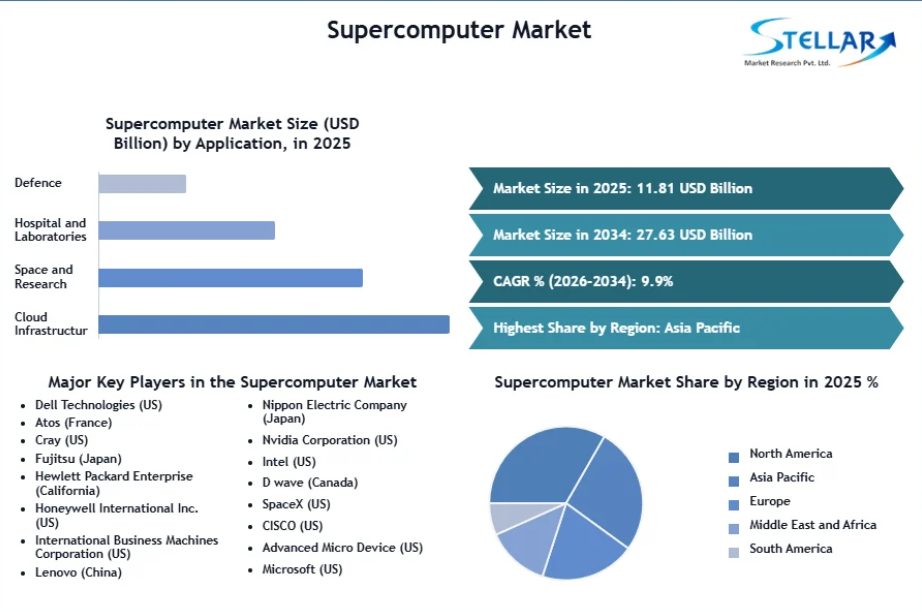
The Supercomputer Market is undergoing a profound structural evolution, shifting from traditional scientific simulation toward real-time generative artificial intelligence, complex financial modeling, and national technological sovereignty. According to a comprehensive new market intelligence report released by Stellar Market Research, the market was valued at USD 11.81 billion in 2025 and is projected to scale aggressively to USD 27.63 billion by 2034, registering a compound annual growth rate (CAGR) of 9.9% throughout the forecast period. This study highlights why high-performance computing (HPC) has transitioned from an academic niche into the foundational bedrock of modern enterprise digital transformation, national defense, and industrial R&D.
The global computation landscape is witnessing a historic paradigm shift. Modern enterprises and government entities are no longer utilizing supercomputers merely for linear mathematical equations; instead, they are deploying exascale-class architectures to power massive large language models (LLMs), drug discovery simulations, and digital twin ecosystems. This insatiable demand for ultra-low latency data processing has triggered a race toward sovereign infrastructure, where nations and conglomerates heavily invest in domestic computing power to mitigate supply chain vulnerabilities and ensure data security. Furthermore, the convergence of cloud-based HPC services is democratizing access, allowing medium-to-large enterprises to tap into extreme computational muscle without shouldering prohibitive capital expenditure barriers for on-premise hardware.
Key Findings from the Report
Market Valuation & Trajectory: The global supercomputer market, valued at USD 11.81 billion in 2025, is on track to achieve USD 27.63 billion by 2034, driven by a 9.9% CAGR.
Dominant Architecture Type: Tightly connected cluster computers and vector processing machines retain the lion's share of deployment value, fueled by mission-critical defense and aerospace requirements.
Fastest-Growing Segment: Cloud-integrated and hybrid HPC infrastructure represents the fastest-growing application category, registering accelerated adoption among commercial corporate entities.
Leading End-User Segment: Government entities and national research laboratories maintain the largest revenue share, propelled by state-backed initiatives in weather forecasting, nuclear research, and cybersecurity.
Regional Dominance: North America leads global revenue generation, sustained by robust federal investments and heavy private-sector R&D spending.
Emerging Growth Frontier: The Asia-Pacific (APAC) region emerges as the fastest-growing market, accelerated by national supercomputing missions in countries like Japan, China, and India.
Investment Relevance: Rising public-private partnerships and venture allocations into semiconductor design and liquid cooling technologies are unlocking high-yield avenues for tech investors.
For further information, click the following link:https://www.stellarmr.com/report/req_sample/supercomputer-market/2647
Market Drivers and Restraints
Drivers
Exponential Rise of Artificial Intelligence & Big Data: The explosive scaling of generative AI, deep learning parameters, and massive data sets necessitates exascale processing power that traditional computing systems cannot fulfill.
Expansion of National Security & Sovereign AI Initiatives: Governments worldwide are heavily funding indigenous supercomputing clusters to protect critical data, advance defense systems, and secure technological independence.
Industrial Adoption of Digital Twins and Simulation: High-value sectors including automotive, aerospace, and pharma are increasingly relying on real-time physics simulations and digital twins to shorten product design cycles.
Restraints
Escalating Energy Consumption & Thermal Management: Power density challenges and the massive electricity demands of running exascale hardware create severe operational bottlenecks for data center operators.
Persistent Talent Shortage & Skill Gaps: A global scarcity of specialized parallel programming engineers and skilled HPC system administrators continues to limit optimal capacity utilization across installations.
Technology, Regulation, and Sustainability Trends
The supercomputer industry is undergoing a green transition. Driven by strict environmental regulations and corporate ESG mandates, vendors are redesigning hardware ecosystems around advanced liquid cooling, intelligent power orchestration, and energy-aware workload scheduling. Concurrently, regulatory frameworks governing cross-border data transfer are compelling organizations to adopt localized, sovereign cloud-HPC architectures. On the technological front, early strides in hybrid quantum-classical computing are redefining the post-exascale frontier, promising to solve previously intractable problems in molecular chemistry and material science.
Regional Insights
North America currently dominates the global supercomputer landscape, underpinned by advanced technological infrastructure, heavy defense budgets, and early commercial adoption by hyperscalers. Meanwhile, the Asia-Pacific region is experiencing exceptional momentum, acting as the primary engine for global market expansion. Countries such as Japan, China, and India are channeling substantial capital into state-of-the-art national research centers, upgrading domestic semiconductor ecosystems, and fostering indigenous high-performance computing frameworks to support burgeoning digital economies.
Recent Industry Developments
Hewlett Packard Enterprise (HPE) (2025): Delivered next-generation exascale architecture utilizing advanced liquid-cooling systems, reducing power consumption for enterprise AI workloads by over 20%.
NVIDIA (2025): Partnered with global research institutions to deploy massive supercomputing fabrics powered by specialized superchips, accelerating training speeds for large-scale foundational AI models.
Fujitsu (2025): Expanded its ARM-based supercomputing portfolio targeting commercial manufacturing and pharmaceutical simulation, driving down infrastructure costs for enterprise clients.
University of Bristol / Isambard-AI (2025): Launched Isambard-AI, recognized as a leading university-based supercomputer utilizing thousands of advanced accelerators to spearhead national scientific discovery.
Cray / Hewlett Packard Enterprise (2026): Secured a multi-million-dollar government contract to upgrade national weather forecasting infrastructure, optimizing predictive accuracy for severe climate events.
Competitive Landscape
The global supercomputer market is characterized by a consolidated core of tier-one technology giants and a dynamic ecosystem of specialized infrastructure innovators. Leading market players—including Cray (US), Fujitsu (Japan), Hewlett Packard Enterprise (US), and Honeywell International Inc.—are actively focusing on strategic mergers, collaborative public-private research partnerships, and modular hardware scalability. Major vendors are emphasizing energy-efficient design, hybrid cloud integrations, and proprietary software toolchains to capture high-margin government and commercial contracts.
Analyst Commentary
"The supercomputer market has crossed a critical threshold from isolated academic experimentation to an essential commercial and sovereign utility," said a Senior Research Analyst at Stellar Market Research. "As generative AI workloads scale and industries rush to adopt digital twins, hardware efficiency and modularity will separate market leaders from laggards. Stakeholders must prioritize liquid cooling innovations and software optimization to unlock true value through 2034."
Future Outlook
Through 2034, the supercomputer market will experience accelerated integration with cloud delivery models and emerging quantum processing technologies. As energy regulations tighten, green computing and sustainable infrastructure will become non-negotiable procurement criteria. Demand will increasingly pivot toward versatile systems capable of simultaneously handling deep learning, analytics, and traditional numerical simulations, solidifying supercomputing as the backbone of the future global digital economy.
For further information, click the following link:https://www.stellarmr.com/report/req_sample/supercomputer-market/2647
About Stellar Market Research
Stellar Market Research is a multifaceted market research and consulting company with professionals from several industries. Some of the industries we cover include medical devices, pharmaceutical manufacturers, science and engineering, electronic components, industrial equipment, technology and communication, cars and automobiles, chemical products and substances, general merchandise, beverages, personal care, and automated systems. To mention a few, we provide market-verified industry estimations, technical trend analysis, crucial market research, strategic advice, competition analysis, production and demand analysis, and client impact studies.
Address
Phase 3, Navale IT Zone, S.No. 51/2A/2, Office No. 202, 2nd floor, Near, Navale Brg, Narhe, Pune, Maharashtra 411041
Email
sales@stellarmr.com
Mobile
+91 9607365656
Author Bio
Article Comments
No Comments!
At present there are zero published comments on this article.
Similar Articles
Search Pages
Article Categories
There are zero sub-categories in this parent category.
There are zero sub-categories in this parent category.