Connected Operating Rooms Boost Autotransfusion Devices Market Demand

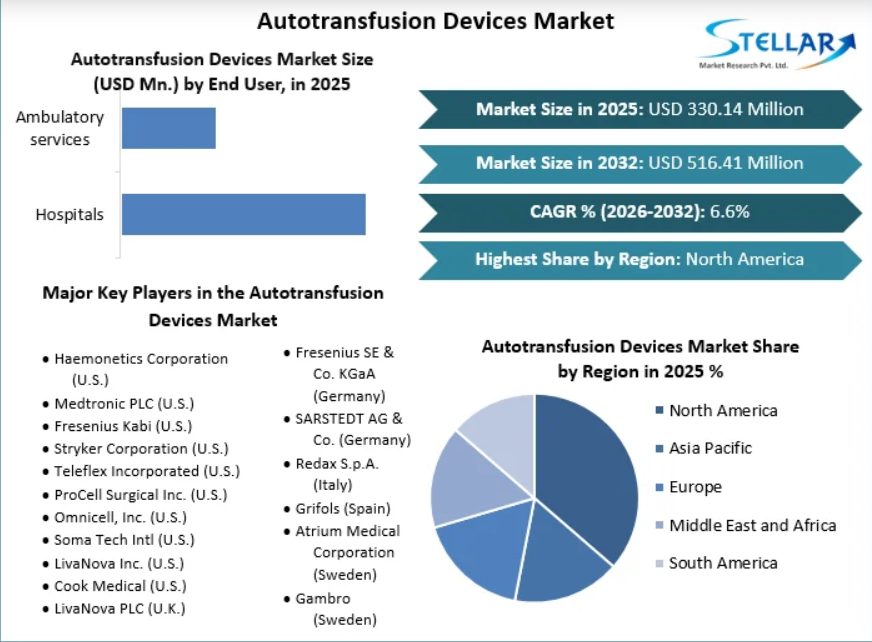
The global Autotransfusion Devices Market, analyzed in a new study by Stellar Market Research, was valued at USD 330.14 million in 2025 and is projected to expand at a 6.6% CAGR over the forecast period. As recurring donor blood shortages, rising allogeneic transfusion costs, and stricter Patient Blood Management (PBM) mandates press hospital networks worldwide, recovering and reinfusing a patient's own red blood cells has moved from an optional operating room safeguard to a core clinical and financial priority.
Operating rooms across developed and emerging healthcare systems are confronting a structural squeeze. Donor blood inventories remain volatile while cross-matching, storage, and transfusion reaction expenses continue to climb. At the same time, hospital CFOs and surgical quality committees are evaluating equipment investments through value-based care metrics that penalize preventable complications, extended ICU stays, and supply bottlenecks.
Key Findings from the Report:
Baseline Valuation & Growth Trajectory: The global Autotransfusion Devices Market stood at USD 330.14 million in 2025 and is forecast to grow at a 6.6% CAGR across the forecast horizon, reflecting steady surgical volume expansion and blood conservation adoption.
Product & Consumable Dynamics: Durable autotransfusion systems anchor capital procurement in major surgical centers, while single-use bowls, reservoirs, and wash kits generate repeat procedural revenue tied directly to case counts.
Application Leadership & Trauma Momentum: Cardiovascular surgeries represent the largest clinical demand base due to high blood loss risks in cardiac procedures, while orthopedic, trauma, and emergency surgical settings expand as blood conservation protocols broaden.
Regional Dominance & Growth Pockets: North America leads global revenue on the back of established PBM standards and high-acuity surgical infrastructure, while Asia-Pacific registers faster momentum as hospital capacity and surgical volumes scale.
Demand & Supply Shift: Hospital networks are moving toward standardized, easy-to-operate platforms that reduce operator variability and support recurring consumable supply contracts over one-off hardware purchases.
Investor & Buyer Relevance: Medical technology strategics and growth investors are prioritizing automated processing speed, washout efficiency (such as heparin and fat removal), and digital traceability that align with value-based hospital reimbursement.
For further information, click the following link:https://www.stellarmr.com/report/req_sample/autotransfusion-devices-market/2852
Market Drivers and Restraints:
Driver 1 — Patient Blood Management (PBM) & Donor Blood Constraints: Tighter donor blood supply chains, rising costs of allogeneic blood units, and institutional PBM guidelines push surgical teams to salvage and reinfuse autologous red blood cells.
Driver 2 — Rising High-Blood-Loss & Aging-Population Surgeries: Expanding cardiovascular, orthopedic, and complex surgical caseloads—driven in part by aging demographics—sustain baseline and incremental demand for intraoperative and postoperative blood recovery.
Driver 3 — Automation & Faster Processing Cycles: Modern systems with automated fill/wash cycles, adaptive suction, and compact footprints lower technical barriers for staff and improve operating room turnover.
Restraint 1 — Upfront Capital Cost & Per-Case Disposable Expense: Initial system acquisition costs and ongoing single-use consumable expenses can strain budgets at smaller or cost-constrained hospitals without clear volume justification.
Restraint 2 — Clinical Appropriateness & Minimally Invasive Shifts: Shift toward minimally invasive procedures with lower blood loss—and selective clinical guidelines where salvage yield is low—can limit usage frequency in certain routine cases.
Technology, Regulation, and Sustainability Trends: Technology in autotransfusion is advancing toward automated blood sensing, adaptive vacuum control to curb hemolysis, faster wash cycles, and digital data connectivity that links salvage metrics with hospital records and perfusion workstations. On the regulatory side, manufacturers must navigate stringent medical device quality and premarket requirements (such as U.S. FDA 510(k) pathways and European MDR compliance) alongside institutional accreditation and blood safety standards.
From an operational and sustainability standpoint, hospitals weigh two competing environmental realities: reducing allogeneic blood collection, cold-chain transport, and wastage lowers upstream supply chain intensity, whereas single-use plastic disposables and biohazard waste add per-procedure material weight. Vendors addressing this balance focus on streamlined single-bowl designs, compact footprints, and waste-minimizing wash protocols.
Regional Insights:
Leading Region — North America (United States & Canada): Anchors global market revenue due to mature hospital surgical infrastructure, widespread adoption of structured PBM programs, and strong reimbursement and quality-reporting alignment across tertiary care centers.
Emerging & Fast-Growing Region — Asia-Pacific (India, China & Southeast Asia): Gains traction on expanding hospital networks, rising cardiovascular and orthopedic surgical capacity, growing awareness of blood conservation, and localized or regional commercial expansion by global medtech suppliers.
Recent Industry Developments:
Medtronic (2026): Issued updated 2026 coding and reimbursement guidance supporting the autoLog IQ Autotransfusion System, reinforcing hospital billing clarity and adoption of automated intraoperative blood collection, washing, and reinfusion.
Medtronic (2025): Advanced its Auto-Intel autotransfusion platform featuring sensor-driven feedback to optimize blood processing and red blood cell recovery in surgical workflows.
LivaNova (2025): Continued technical refinement of its Xtra autotransfusion system, targeting automation improvements and operating room workflow integration across cardiovascular and orthopedic procedures.
Fresenius (2025): Expanded distribution of its autotransfusion devices across emerging market hospital networks to serve growing cardiovascular and orthopedic surgical capacity.
Aveiro University / SPARE Study Team (2025–2026): Progressed clinical evaluation on systematic intraoperative cell salvage within an established cardiac Patient Blood Management program (ClinicalTrials.gov NCT07922486), tracking donor red blood cell reduction and perioperative outcomes.
Competitive Landscape: The market features established medical device leaders competing on clinical blood quality, automation, consumable reliability, and hospital contracting reach. Key participants include Medtronic, Haemonetics Corporation, LivaNova, Fresenius, Terumo, and Braile Biomédica, alongside specialized cell salvage and surgical device innovators. Leading players differentiate through high red blood cell recovery and washout performance, intuitive touchscreens and barcode/data integration, comprehensive consumable portfolios, and clinical education programs that embed their platforms into daily surgical routines.
Analyst Commentary:
"Hospital blood conservation is no longer just a clinical preference—it has become an operational necessity as donor supplies tighten and surgical cases grow more complex," said a Senior Research Analyst at Stellar Market Research. "Vendors that pair reliable, automated cell salvage with seamless data capture and predictable consumable economics will capture the strongest long-term hospital commitments."
Future Outlook: Through the forecast period, demand for autotransfusion devices is expected to build steadily as surgical volumes rise and hospitals institutionalize PBM protocols across cardiac, orthopedic, trauma, and broader specialty care. Investment will concentrate on smarter automation, faster processing cycles, and connected data workflows that document clinical value. Regulatory scrutiny around device safety and clinical protocols will remain rigorous, while competition will reward suppliers that combine proven blood quality with practical cost-in-use models for diverse hospital tiers.
For further information, click the following link:https://www.stellarmr.com/report/req_sample/autotransfusion-devices-market/2852
About Stellar Market Research
Stellar Market Research is a multifaceted market research and consulting company with professionals from several industries. Some of the industries we cover include medical devices, pharmaceutical manufacturers, science and engineering, electronic components, industrial equipment, technology and communication, cars and automobiles, chemical products and substances, general merchandise, beverages, personal care, and automated systems. To mention a few, we provide market-verified industry estimations, technical trend analysis, crucial market research, strategic advice, competition analysis, production and demand analysis, and client impact studies.
Address
Phase 3, Navale IT Zone, S.No. 51/2A/2, Office No. 202, 2nd floor, Near, Navale Brg, Narhe, Pune, Maharashtra 411041
Email
sales@stellarmr.com
Mobile
+91 9607365656
Author Bio
Article Comments
No Comments!
At present there are zero published comments on this article.
Similar Articles
Search Pages
Article Categories
There are zero sub-categories in this parent category.
There are zero sub-categories in this parent category.