Bioethanol Market Growth Driven By Renewable Energy And Clean Fuel Demand

Bioethanol Market to Reach USD 148.23 Billion by 2032, Driven by Renewable Fuel Policies and Advanced Biofuel Investments
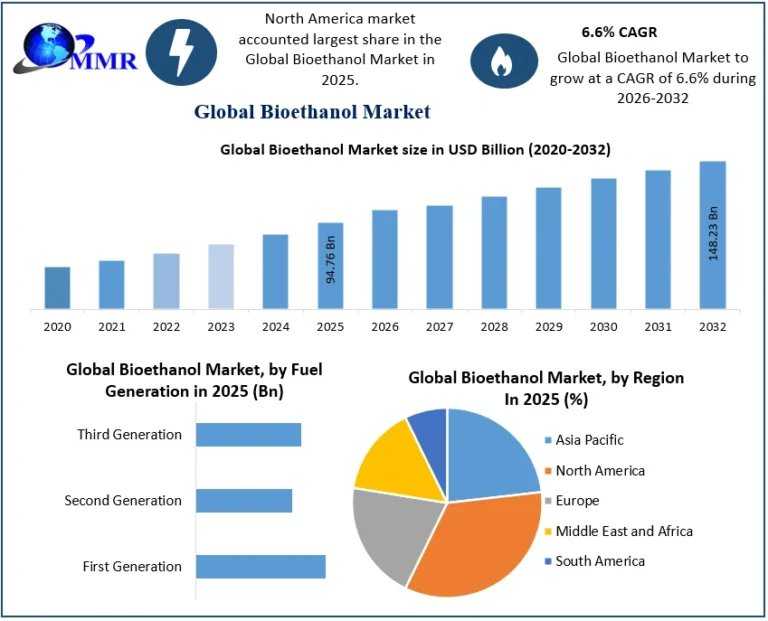
The Bioethanol Market is entering a period of sustained expansion as governments, fuel producers, automakers, and agricultural stakeholders increasingly prioritize renewable fuels, energy security, and lower-carbon transportation. According to the latest market analysis, the global Bioethanol Market was valued at USD 94.76 Billion in 2025 and is projected to grow at a CAGR of 6.6% from 2025 to 2032, reaching nearly USD 148.23 Billion by 2032.
Bioethanol is a renewable fuel produced from biological feedstocks such as corn, sugarcane, wheat, and other biomass. Its ability to blend with conventional gasoline and reduce dependence on petroleum makes it an important component of the global energy transition. Growing renewable-energy mandates, increasing adoption of ethanol-gasoline blends, concerns regarding greenhouse-gas emissions, and efforts to improve domestic energy security are major factors supporting market growth.
Market Estimation, Growth Drivers and Opportunities
The Bioethanol Market is benefiting from increasing government support for renewable fuels and the implementation of blending mandates across major economies. Policies encouraging renewable fuel consumption provide producers with relatively stable demand while encouraging investment in production facilities, distribution infrastructure, and advanced processing technologies.
Technological improvements in fermentation, enzymes, feedstock conversion, energy efficiency, and carbon management are creating additional opportunities. Producers are increasingly exploring cellulosic and other non-food feedstocks to improve sustainability and reduce competition between fuel production and food resources.
The expansion of E10, E15, and higher ethanol blends represents another significant opportunity. Bioethanol can help reduce fossil-fuel consumption while providing a renewable source of high-octane fuel. In addition, innovations such as carbon capture, utilization and storage, advanced fermentation, and integrated biorefineries are expected to improve the environmental performance and economic competitiveness of ethanol production.
Get a Free Sample Market Report Link : https://www.maximizemarketresearch.com/request-sample/2469/
U.S. Market Trends and Investments
The United States remains a critical market for bioethanol because of its large production base, abundant corn feedstock, established transportation-fuel infrastructure, and supportive renewable-fuel policies. During 2025, U.S. ethanol activity was strongly influenced by regulatory developments surrounding E15 gasoline. The U.S. Environmental Protection Agency expanded access to E15 and issued emergency waivers supporting nationwide summer sales, strengthening opportunities for ethanol producers and fuel suppliers.
Investment activity also highlighted the industry's ongoing consolidation and technology transition. In September 2025, POET completed its acquisition of Green Plains' Obion, Tennessee facility, expanding POET's network to 35 bioprocessing facilities across nine states and increasing annual bioethanol production capacity to approximately 3.1 billion gallons. Green Plains, meanwhile, continued advancing carbon-capture projects and low-carbon ethanol initiatives. ADM and Tallgrass also advanced a major carbon-capture project in Nebraska, demonstrating the industry's growing focus on reducing the carbon intensity of ethanol production.
Market Segmentation: Leading Segment
By Feedstock, the Starch segment dominated the Bioethanol Market in 2025 and is expected to maintain the largest market share throughout the forecast period. Starch-based bioethanol primarily uses corn and wheat, which are widely available in major producing regions. Established processing infrastructure, mature fermentation technologies, reliable feedstock supply, and large-scale production capabilities support the segment's leadership.
By End-Use Industry, Transportation Fuel held the largest market share. The widespread use of ethanol-gasoline blends, renewable fuel standards, and increasing availability of flex-fuel vehicles make transportation the principal application for bioethanol globally.
Competitive Analysis
The competitive landscape includes major ethanol producers, integrated energy companies, agricultural businesses, and advanced biofuel technology developers. Key companies are focusing on production expansion, acquisitions, carbon reduction, feedstock efficiency, and advanced bioprocessing technologies.
POET, LLC strengthened its position in 2025 by acquiring the Green Plains Obion facility in Tennessee. The transaction added 120 million gallons of annual production capacity and expanded POET's geographic reach. The company is also advancing zero-carbon bioethanol through regenerative agriculture, advanced biotechnology, and bio-CO₂ capture and utilization.
Green Plains Inc. has increasingly emphasized low-carbon ethanol and carbon-capture technologies. During 2025, its carbon-capture infrastructure progressed across multiple Nebraska facilities, while its strategy focused on improving ethanol value through lower-carbon production and emerging tax-credit opportunities.
Valero Energy Corporation continued to operate one of the largest integrated ethanol businesses among major U.S. energy companies. In 2025, Valero reported record ethanol production during the third quarter, demonstrating strong operating performance and continued demand for ethanol within its diversified energy portfolio.
Raízen remains a major global sugarcane-based ethanol producer. In 2025, the company faced financial pressures and explored capital-raising options, highlighting the importance of financial discipline and operational efficiency within large-scale biofuel operations. Its extensive sugarcane and ethanol infrastructure nevertheless provides significant global production capabilities.
Archer Daniels Midland Company (ADM) is investing in technologies that can substantially reduce the carbon intensity of ethanol. Its carbon-capture project in Columbus, Nebraska, developed with Tallgrass, became a major milestone in bioethanol decarbonization, demonstrating how ethanol plants can integrate large-scale CO₂ transportation and permanent storage.
Regional Analysis
United States: The U.S. is a leading bioethanol market supported by the Renewable Fuel Standard, extensive corn production, established ethanol-processing infrastructure, and growing E15 adoption. Federal policies encouraging renewable fuel consumption continue to support demand, while investments in carbon capture and low-carbon ethanol create new growth opportunities.
Germany: Germany's market is supported by European renewable-energy and transport decarbonization objectives. Demand for sustainable fuels and advanced biofuels is encouraging investment in efficient production technologies and alternative feedstocks.
France: France benefits from established biofuel blending policies, agricultural feedstock availability, and increasing interest in renewable transportation fuels. Its agricultural base provides opportunities for continued ethanol production and technology development.
United Kingdom: The UK is pursuing lower-carbon transportation through renewable-fuel policies and sustainable fuel development. Demand for renewable fuels and technological innovation provides opportunities for advanced ethanol applications.
China: China's large transportation sector, energy-security objectives, and increasing focus on renewable energy create opportunities for bioethanol adoption. Domestic agricultural resources and government-led renewable-energy initiatives can support future market expansion.
Japan: Japan's emphasis on energy diversification and carbon reduction supports interest in low-carbon fuels and sustainable fuel technologies. Bioethanol can contribute to the country's broader strategy of reducing transportation-related emissions.
Key Players
POET, LLC; Green Plains Inc.; Valero Energy Corporation; Raízen; Bunge Limited; CropEnergies AG; Tereos; Abengoa Bioenergy; Wilmar International Limited; Praj Industries Ltd.; Thai Agro Energy Public Company Limited; Archer Daniels Midland Company (ADM); INEOS Bio; Pacific Ethanol, Inc.; Ethanol Company Limited; Gulf Bio Fuels Company LLC; and HPCL Biofuels Limited.
Why This Market Matters Now
The Bioethanol Market matters now because the global transportation industry is balancing decarbonization targets with the need for affordable, reliable, and scalable fuels. Bioethanol provides an immediately deployable renewable option that can utilize existing gasoline infrastructure while supporting farmers, rural economies, and domestic energy supply chains.
The next phase of market development will increasingly depend on advanced feedstocks, carbon capture, improved conversion efficiency, higher ethanol blends, and policies that reward lower-carbon fuels. With the market projected to reach USD 148.23 Billion by 2032, bioethanol is positioned to remain an important component of the evolving global renewable-energy landscape.
Explore More Related Reports:
Explore additional market intelligence and industry reports from Maximize Market Research covering renewable energy, biofuels, chemicals, automotive, energy, and emerging technologies.
https://sites.google.com/view/the-future-of-electronics/home/electronic-nose-market-trends-growth-drivers-and-opportunities
https://sites.google.com/view/material-and-chemical-news/home/inorganic-corrosion-inhibitors-market-growth-demand-and-future-outlook
About Maximize Market Research
Maximize Market Research Pvt. Ltd. (MMR) is a global market research and consulting company that provides reliable, data-focused, and practical business insights. The firm serves a wide range of industries, including healthcare, pharmaceuticals, technology, automotive, electronics, chemicals, personal care, and consumer goods. Through market forecasts, competitive analysis, strategic consulting, and industry impact assessments, MMR helps organizations understand changing market conditions, identify growth opportunities, and make informed business decisions for long-term success.
Contact Us
Maximize Market Research Pvt. Ltd.
2nd Floor, Navale IT Park Phase 3
Pune Banglore Highway, Narhe
Pune, Maharashtra 411041, India
Phone: +91 9607365656
Email: sales@maximizemarketresearch.com
Author Bio
Article Comments
No Comments!
At present there are zero comments on this article.
Why not be the first to make a comment?
Similar Articles
Search Pages
User Upgrade
account to full use of editor,
Including hyperlinks
Article Categories
There are zero sub-categories in this parent category.
There are zero sub-categories in this parent category.