Hyperscale Market Shift: AI Infrastructure Outpaces Cloud

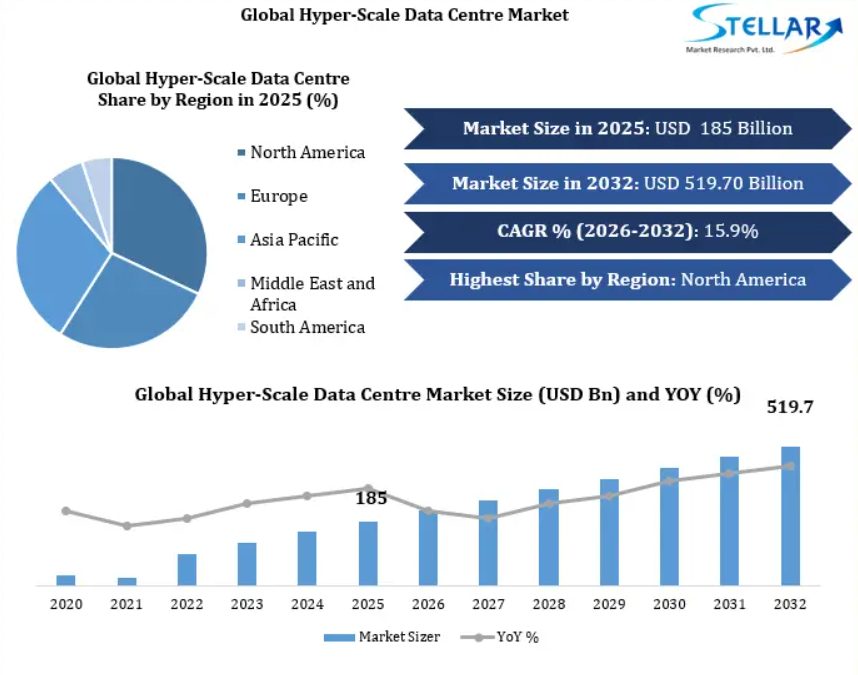
The Global Hyper-Scale Data Centre Market is undergoing an unprecedented structural evolution, propelled by the massive compute demands of artificial intelligence and enterprise cloud workloads. According to a comprehensive market intelligence report published by Stellar Market Research, the market was valued at USD 185.0 billion in 2025 and is projected to scale to USD 519.70 billion by 2032, registering a compound annual growth rate (CAGR) of 15.9% over the forecast period. This research highlights how next-generation digital infrastructure has transitioned from traditional cloud storage hubs into high-density, energy-intensive AI factory campuses that dictate global technological competitiveness.
The modern digital economy is witnessing a paradigm shift: data centers are no longer passive real estate assets, but active strategic catalysts for artificial intelligence training, real-time analytics, and sovereign cloud operations. The proliferation of Large Language Models (LLMs), deep learning algorithms, and high-frequency IoT data streams has triggered a massive capital expenditure cycle among hyperscalers. Operators are moving away from traditional air-cooled, modular designs toward sprawling 100 MW to 300 MW power blocks equipped with direct-to-chip liquid cooling systems and dedicated behind-the-meter renewable energy sources. This evolution addresses the acute need to maximize compute density while overcoming critical grid interconnection bottlenecks, opening lucrative avenues for hardware manufacturers, specialized engineering firms, and green-energy developers.
Key Findings from the Report
Market Valuation & Growth: The market stands at USD 185.0 billion in 2025 and is forecasted to hit USD 519.70 billion by 2032, maintaining a 15.9% CAGR.
Power Capacity Segmentation: The 50 MW to 100 MW power capacity segment commands the dominant market share at 38%, balancing large-scale cloud availability zone expansion with grid feasibility.
Data Center Type Leadership: Cloud provider-owned hyper-scale facilities capture a leading 41% share, driven by massive investments from major hyperscalers building out dedicated AI and sovereign cloud regions.
Component Dynamics: Hardware solutions—comprising high-performance GPU/TPU clusters, advanced networking switches, and resilient electrical infrastructure—represent the largest revenue contributor.
Regional Dominance: North America leads global revenue generation, sustained by aggressive venture capital, deep-pocketed tech giants, and massive multi-gigawatt AI campus deployments.
Emerging Growth Frontier: Asia-Pacific is identified as the fastest-growing regional market, catalyzed by rapid digitalization, government-backed data localization policies, and expanding tier-2 colocation hubs in India and Southeast Asia.
Investment Relevance: Rising infrastructure costs per megawatt, driven by specialized liquid cooling and high-density rack configurations, are reshaping institutional investment strategies and pushing developers toward long-term power purchase agreements (PPAs).
For further information, click the following link:https://www.stellarmr.com/report/req_sample/hyper-scale-data-center-market/2942
Market Drivers and Restraints
Drivers:
Exponential Expansion of Generative AI Workloads: The surging global adoption of AI training and inference applications necessitates massive GPU/TPU clusters, directly compelling hyperscale operators to scale up white-space infrastructure and high-speed fiber interconnects.
Proliferation of Sovereign Cloud and Data Localization Mandates: Stringent cross-border data protection regulations and national security policies are forcing enterprises and government bodies to demand localized hyper-scale infrastructure.
Strategic Regional Expansion by Cloud Titans: Continuous investments by market leaders in establishing new availability zones to reduce network latency and improve service resilience are sustaining high capital expenditure in digital infrastructure.
Restraints:
Critical Power Scarcity and Grid Interconnection Delays: Surging electricity consumption by AI data centers has outpaced local power grid capacity, leading to severe connection backlogs and prolonged site-approval timelines.
Capital Expenditure Inflation and Supply Chain Volatility: The high cost of specialized liquid cooling hardware, high-voltage transformers, and advanced power distribution units creates significant financial hurdles for mid-sized operators.
Technology, Regulation, and Sustainability Trends
The hyper-scale landscape is redefining operational norms through aggressive sustainability mandates and advanced engineering practices. With power usage effectiveness (PUE) coming under intense regulatory scrutiny, operators are rapidly integrating direct-to-chip liquid cooling, rear-door heat exchangers, and waste-heat recovery systems to curb environmental impact. Concurrently, environmental, social, and governance (ESG) pressures have made securing long-term green energy contracts—such as direct solar, wind, and nuclear energy PPAs—a baseline requirement for project financing. Furthermore, regulatory frameworks regarding carbon emissions and water usage effectiveness (WUE) are compelling operators to adopt closed-loop cooling systems and advanced Data Center Infrastructure Management (DCIM) software powered by AI automation.
Regional Insights
North America: Retains its position as the dominant regional market, underpinned by heavy capital outlays from major cloud service providers, advanced technological ecosystems, and expansive campus developments across traditional hubs like Northern Virginia as well as emerging secondary markets.
Asia-Pacific: Represents the fastest-growing regional market. Accelerated by surging smartphone penetration, 5G rollouts, and proactive government digitization initiatives in nations like India, China, and Japan, APAC is witnessing a massive surge in wholesale colocation and regional hyper-scale builds.
Europe: Driven by stringent data sovereignty laws and ambitious net-zero carbon targets, European operators are aggressively investing in renewable-powered "AI Gigafactories" across Germany, the Nordic countries, and the United Kingdom, turning waste-heat reuse into a standard municipal integration.
Recent Industry Developments
Microsoft (2025): Announced an expanded multi-billion-dollar capital expenditure framework targeting the construction of next-generation AI-enabled hyper-scale data center campuses to support growing OpenAI workloads.
Google (2024): Committed a USD 624 million investment to construct a sustainable hyper-scale data center in Norway, slated for completion in 2026, leveraging 100% renewable hydropower and innovative excess heat reuse systems [1.2.2].
Bridge Michigan & Regional Tech Partners (2025): Unveiled a $7 billion collaborative initiative to establish the first major hyper-scale campus in Michigan, addressing regional cloud demand and local digital economic development [1.2.1].
Amazon Web Services - AWS (2025): Scaled up regional availability zone investments globally, integrating modular prefabricated power blocks to cut time-to-market for new hyper-scale capacity by up to 25%.
Equinix (2026): Deployed advanced direct-to-chip liquid cooling architecture across select International Business Exchange (IBX) hyper-scale sites to accommodate ultra-high-density enterprise AI racks without violating thermal efficiency caps.
Competitive Landscape
The global hyper-scale data centre market features a highly competitive and capital-intensive ecosystem characterized by aggressive strategic expansions, joint ventures, and technological differentiation. Key market participants include Amazon Web Services (AWS), Microsoft Azure, Google Cloud, Meta Platforms, Alibaba Cloud, Oracle Cloud Infrastructure, Equinix, Digital Realty, NTT Global Data Centers, and CyrusOne. Leading players are increasingly focusing on strategic acquisitions, securing long-term renewable power contracts, and proprietary liquid cooling innovations to maintain competitive advantages and capture higher market share amid escalating AI infrastructure demands.
Analyst Commentary
"The hyper-scale data center sector has officially entered the AI era, where compute density and power availability outweigh traditional real estate metrics. Operators who successfully integrate liquid cooling technologies and secure clean, behind-the-meter energy solutions will dictate the pace of market expansion through 2032." — Senior Research Analyst, Stellar Market Research
Future Outlook
Looking toward 2032, the hyper-scale data centre market will continue its exponential trajectory, transitioning firmly toward decentralized regional nodes and gigawatt-scale AI campuses. As grid constraints intensify, the industry will see a heavier reliance on alternative energy sources, modular prefabricated construction, and autonomous AI-driven facility management. Competition will increasingly hinge on an operator's ability to deliver sustainable, ultra-low PUE infrastructure capable of handling high-density neural network training without compromising grid stability or regulatory compliance.
For further information, click the following link:https://www.stellarmr.com/report/req_sample/hyper-scale-data-center-market/2942
About Stellar Market Research
Stellar Market Research is a multifaceted market research and consulting company with professionals from several industries. Some of the industries we cover include medical devices, pharmaceutical manufacturers, science and engineering, electronic components, industrial equipment, technology and communication, cars and automobiles, chemical products and substances, general merchandise, beverages, personal care, and automated systems. To mention a few, we provide market-verified industry estimations, technical trend analysis, crucial market research, strategic advice, competition analysis, production and demand analysis, and client impact studies.
Address
Phase 3, Navale IT Zone, S.No. 51/2A/2, Office No. 202, 2nd floor, Near, Navale Brg, Narhe, Pune, Maharashtra 411041
Email
sales@stellarmr.com
Mobile
+91 9607365656
Author Bio
Article Comments
No Comments!
At present there are zero published comments on this article.
Similar Articles
Search Pages
Article Categories
There are zero sub-categories in this parent category.
There are zero sub-categories in this parent category.